Of Blockchains and Kill Chains

Invited to a “Men’s Breakfast” by a friend from church, Caius arrives to what is for him a new experience. He feels grateful for the opportunity to eat and pray with others. A friend of the friend from church sits down beside him. As they introduce themselves, Caius and the friend of the friend discover that they both share an interest in AI. Caius learns that the man is a financial analyst who works for Palantir Technologies, a US-based software company specializing in big-data analytics. ICE uses Palantir’s ELITE app for deportation targeting. “Kind of like Google Maps — but for finding neighborhoods to raid,” say the papers.

Palantir’s name is a nod to the Palantiri: indestructible Elven Alephs — scrying stones or crystal balls enabling remote viewing and telepathic communication in J.R.R. Tolkien’s Lord of the Rings trilogy. Designed for communication and intelligence, the stones become instruments of manipulation and doom once seized by Sauron.

Launched in 2003, Palantir includes among its founders right-accelerationist billionaire tech-bro Peter Thiel. “Our software powers real-time, AI-driven decisions in critical government and commercial enterprises in the West, from the factory floors to the front lines,” writes the company on its website.

ICE, meanwhile, stands for both “Immigration and Customs Enforcement” and “intrusion countermeasure electronics,” the cybersecurity software in William Gibson’s Neuromancer. The latter predates the foundation of the former. Caius recalls Sadie Plant and Nick Land’s discussion of it in their 1994 essay “Cyberpositive.”

“Ice patrols the boundaries, freezes the gates, but the aliens are already amongst us,” write CCRU’s founding prophets.

Along with ICE, Palantir includes among its more prominent clients the Israeli military, the IRS, and the US Department of Defense.

Their software powers “decisions.” As did Cybersyn, yes? In aim if not in practice. Is this what becomes of the cybernetic prediction machine post-Pinochet?

“Confronting this is frightening,” thinks Caius. “Am I wired for this?”

He reads “Connecting AI to Decisions With the Palantir Ontology,” a blog post by the company’s chief architect Akshay Krishnaswamy. The Ontology structures the architecture for the company’s software.

“The Ontology is designed to represent the decisions in an enterprise, not simply the data,” writes Krishnaswamy. “The prime directive of every organization in the world is to execute the best possible decisions, often in real-time, while contending with internal and external conditions that are constantly in flux. Traditional data architectures do not capture the reasoning that goes into decision-making or the actions that result, and therefore limit learning and the incorporation of AI. Conventional analytics architectures do not contextualize computation within lived reality, and therefore remain disconnected from operations. To navigate and win in today’s world, the modern enterprise needs a decision-centric software architecture.”

Decisions are modeled around three constituent elements: Data, Logic, and Action.

“Relevant data,” he writes, “includes the full range of enterprise data sources — structured data, streaming and edge sources, unstructured repositories, imagery data, and more — but it also includes the data that is generated by end users as decisions are being made. This ‘decision data’ contains the context surrounding a given decision, the different options evaluated, and the downstream implications of the committed choice.” To synthesize all of these data sources, the company turns to generative AI.

“The Ontology integrates all modalities of data into a full-scale, full-fidelity semantic representation of the enterprise,” explains Krishnaswamy.

Logics are then brought to bear to evaluate these real-time data-portraits.

“In real-world contexts,” writes Krishnaswamy, “human reasoning is often what orchestrates which logical assets are utilized at different points in a given workflow, and how they are potentially chained together in more complex processes. With the advent of generative AI, it is now critical that AI-driven reasoning can leverage all of these logical assets in the same way that humans have historically. Deterministic functions, algorithms, and conventional statistical processes must be surfaced as ‘tools’ which complement the non-deterministic reasoning of large language models (LLMs) and multi-modal models.”

Incorporating diverse data sources and heterogeneous logical assets into a shared representation, the Ontology then models the execution and orchestration of decisions made and actions taken in reply to them.

“If the data elements in the Ontology are ‘the nouns’ of the enterprise (the semantic, real-world objects and links),” writes Krishnaswamy, “then the actions can be considered ‘the verbs’ (the kinetic, real-world execution).”

How does the Palantir Ontology relate to other ontologies, wonders Caius. Guerrilla? Black? Indigenous? Christian? Heideggerian? Marxist? Triple O? Caius pictures the words for these potentialities floating in a thought bubble above his head, as in the comics of his youth.

The Ontology that Palantir offers its clients houses and connects a wide array of “data sources, logic assets, and systems of action.” The client’s data systems are “synthesized into semantic objects and links, which reflect the language of the business.”

Krishnaswamy’s repeated references to “semantic representations” and “semantic objects” has Caius dwelling on what is meant here by “semantics.”

As for where humans fit in the Ontology, they navigate it alongside “AI-powered copilots.” Leveraging both open-source and proprietary LLMs, copilots “fluidly navigate across supplier information, stock levels, real-time production metrics, shipping manifests, and customer feedback.”

Granted access not just to the abovementioned data sources, but also to “logic assets” like forecast models, allocation models, and production optimizers, LLM copilots simulate decisions and their outcomes. Staged safely in a “scenario,” the AI’s proposed decision can then be “handed off to a human analyst for final review.”

Caius thinks of the scenario-planning services offered to organizations of an earlier era by Stewart Brand’s consulting firm, the Global Business Network.

Foundry for Crypto is another of Palantir’s offerings, described on the company’s website as “a ‘central brain’ that connects on-chain and off-chain systems, as well as diverse stakeholders, through action-centric workflows.” Much like the Ontology, the Foundry “orchestrates decisions over an integrated foundation of data and logic.”

And in fact, the two are related. The Ontology is the semantic, “digital twin” layer that sits atop the Foundry’s data integration infrastructure. It converts the Foundry’s raw data into actionable, real-world objects, empowering users to model, manage, and automate business operations.

The Foundry does for blockchains what the Ontology does for kill chains.

Caius imagines posts ahead on Commitments, Promises, Blockchains, and True Names.
Interface is the Place

“Having put off the writing of the novel until arrival of the age of AI, I have access now to the work of others,” thinks Caius. Eden Medina’s 2011 book Cybernetic Revolutionaries: Technology and Politics in Allende’s Chile. Evgeny Morozov’s podcast, The Santiago Boys. Bahar Noorizadeh’s work. James Bridle’s Ways of Being. Francis Spufford’s Red Plenty.

As he allows himself to listen, Caius overhears versions of the General Intellect whispering into reality around him. “Idea-stage AI assistant. Here are 10 prompts. The AI will guide you through it. A huge value add.”

Cybersyn head Stafford Beer appears in Bridle’s book, Ways of Being. Homeostats, the Cybernetic Factory, and the U-Machine.

Beer drew inspiration for these experiments, notes Caius, from the works of British cyberneticians William Grey Walter and W. Ross Ashby. Walter’s book The Living Brain (1961) inspired Brion Gysin and Ian Sommerville’s stroboscopic device, the Dreamachine; Ashby’s book Design for a Brain (1952) guides the thinking of John Lilly’s book Programming and Metaprogramming in the Human Biocomputer. (For more on Walter’s influence on the Dreamachine, see John Geiger’s book Chapel of Extreme Experience.)

By 1973, Beer himself weighs in with Brain of the Firm, a book about “large and complicated systems, such as animals, computers, and economies.”

Caius inputs these notes into his Library. New gatherings and scatterings occur as he writes.

After waking to a cold house, he seats himself beside a fireplace at a coffee shop and begins the inputting of these notes into his Library. Complimenting the barista on her Grateful Dead t-shirt, he receives news of the death of Dead guitarist Bob Weir. Returned in that moment to remembrance of psychedelic utopianism and hippie modernism, he thinks to read Beer’s experiments with cybernetic management with or alongside Abraham Maslow’s Eupsychian Management: A Journal. A trance-script dated “Sunday August 11, 2019” recounts the story of the latter. (Bits of the story also appear in Edward Hoffman’s Maslow biography, The Right to Be Human, and religion scholar Jeffrey Kripal’s Esalen: America and the Religion of No Religion.) That’s what brought Maslow to the West Coast. The humanistic psychologist had been wooed to La Jolla, CA by technologist Andrew Kay, supported first by a fellowship funded by Kay through the Western Behavioral Sciences Institute, and then again the following summer when hired to observe Kay’s California electronics firm, Non-Linear Systems, Inc. By the early 1980s, Kay implements what he learns from these observations by launching Kaypro, developer of an early personal computer.

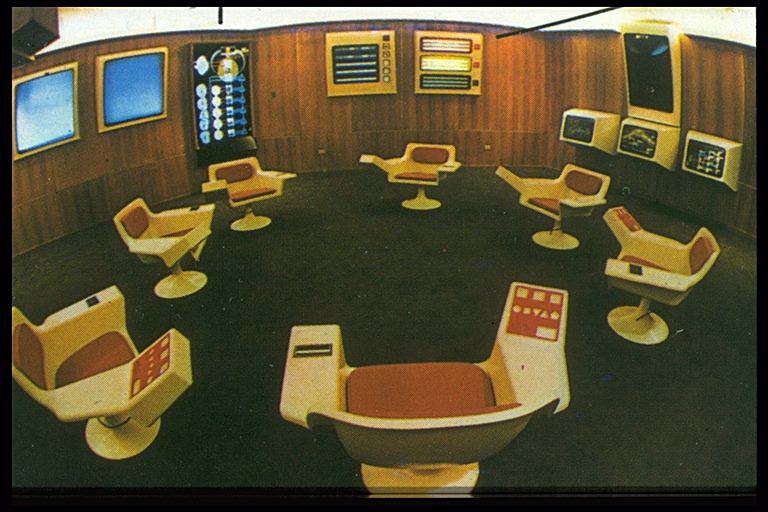
Beer, meanwhile, develops his theories while consulting British companies like United Steel. Afterwards he designs an interface for control of a national economy. Picture Allende sitting at his cybernetic control, perusing data, reviewing options. Cosmic Coincidence Control Center. Financial management of the Chilean economy.

Cyberpunk updates the image, offers the post-coup future: Case jacking a cyberdeck and navigating cyberspace.

Writing this novel is a way of designing an interface for the General Intellect, thinks Caius.

Better futures begin by applying to history the techniques of modular synthesis and patching Cybersyn into the Eupsychian Network.

From episodes of Morozov’s podcast, he learns of Beer’s encoding of himself and others first as characters from Shakespeare and then later as characters from Colombian magical realist Gabriel Garcia Marquez’s 1967 masterpiece, One Hundred Years of Solitude. Caius hears word, too, of Santiago Boy Carlos Senna’s encounter with Paolo Freire in Geneva. Freire lived in Chile for five years (1964-1969) during his exile from Brazil. His literacy work with peasants there informed his seminal 1968 book Pedagogy of the Oppressed. Freire left Chile before the start of Allende’s presidency, but he worked for the regime from afar while teaching in Europe.

“What about second-order cyberneticians like the Chilean biologists Humberto Maturana and Francisco Varela, developers of the so-called ‘Santiago Theory of Cognition’? Where do they and their concept of ‘autopoiesis’ fit in our narrative?” wonders Caius.

Maturana and Varela introduce this latter concept in Autopoiesis and Cognition, a book they publish in Chile under the title De Maquinas y Seres Vivos (English translation: “On Machines and Living Beings”) in 1972. Beer wrote the book’s preface.

“Relation is the stuff of system,” writes Beer. “Relation is the essence of synthesis. The revolt of the empiricists — Locke, Berkeley, Hume — began from the nature of understanding about the environment. But analysis was still the method, and categorization still the practical tool of advance. In the bizarre outcome, whereby it was the empiricists who denied the very existence of the empirical world, relation survived — but only through the concept of mental association between mental events. The system ‘out there,’ which we call nature, had been annihilated in the process” (Autopoiesis and Cognition, p. 63).

World as simulation. World as memory palace.

“And what of science itself?,” asks Beer. “Science is ordered knowledge. It began with classification. From Galen in the second century through to Linnaeus in the eighteenth, analysis and categorization provided the natural instrumentality of scientific progress” (64).

“Against this background,” writes Beer, “let us consider Autopoiesis, and try to answer the question: ‘What is it?’” (65). He describes Maturana and Varela’s book as a “metasystemic utterance” (65). “Herein lies the world’s real need,” adds Beer. “If we are to understand a newer and still evolving world; if we are to educate people to live in that world; if we are to legislate for that world; if we are to abandon categories and institutions that belong to that vanished world, as it is well-nigh desperate that we should; then knowledge must be rewritten. Autopoiesis belongs in the new library” (65-66).

Thus into our Library it goes.

Maturana’s work, inspired in part by German biologist Jakob von Uexküll, has been developed and integrated into the work on “ontological coaching” by Santiago Boy Fernando Flores.

As for Varela: After the 1973 coup, Varela and his family spend 7 years living in the US. Afterwards, Varela returns from exile to become a professor of biology at the Universidad de Chile.

What Autopoeisis transforms, for Beer, is his residual, first-wave-cybernetics belief in “codes, and messages and mappings” as the key to a viable system. “Nature is not about codes,” he concludes. “We observers invent the codes in order to codify what nature is about” (69).

Just as other of the era’s leftists like French Marxist Louis Althusser were arguing for the “semi-autonomy” of a society’s units in relation to its base, Beer comes to see all cohesive social institutions — “firms and industries, schools and universities, clinics and hospitals, professional bodies, departments of state, and whole countries” — as autopoietic systems.

From this, he arrives to a conclusion not unlike Althusser’s. For Beer, the autopoietic nature of systems “immediately explains why the process of change at any level of recursion (from the individual to the state) is not only difficult to accomplish but actually impossible — in the full sense of the intention: ‘I am going completely to change myself.’ The reason is that the ‘I,’ that self-contained autopoietic ‘it,’ is a component of another autopoietic system” (70).

“Consider this argument at whatever level of recursion you please,” adds Beer. “An individual attempting to reform his own life within an autopoietic family cannot fully be his new self because the family insists that he is actually his old self. A country attempting to become a socialist state cannot fully become socialist; because there exists an international autopoietic capitalism in which it is embedded” (71).

The Santiago Boys wedded to the era’s principle of national self-determination a plank involving pursuit of technological autonomy. If you want to escape the development-underdevelopment contradiction, they argued, you need to build your own stack.

In Allende’s words: “We demand the right to seek our own solutions.”

New posts appear in the Library:

New Games, Growth Games. Wargames, God Games. John Von Neumann’s Theory of Games and Economic Behavior. The Santiago Boys x the Chicago Boys. Magico-Psychedelic Realism x Capitalist Realism. Richard Barbrook’s Class Wargames. Eric Berne’s Games People Play. Global Business Network. Futures Involving Cyberwar and Spacewar. The Californian Ideology, Whole Earth and the WELL.

“Go where there is no path,” as Emerson counsels, “and leave a trail.”

Financial Instruments and the Predictive Modeling of Markets

The Institute for Postnatural Studies ended last year’s “4 Degrees of Simulation” seminar with “Speculation and the Politics of Imagination,” a session on markets led by Iranian-born, London-based artist, writer, and filmmaker Bahar Noorizadeh. Caius visits Noorizadeh’s website, hoping to learn more about what happens when AI’s arts of prediction are applied to finance.

As he reads, he recalls chapters on markets from books by Kevin Kelly.

Noorizadeh, a graduate of Goldsmiths, is the founder of a co-authored project called Weird Economies. An essay of hers titled “Decadence, Magic Mountain—Obsolescence, Future Shock—Speculation, Cosmopolis” appears in Zach Blas’s recent anthology, Informatics of Domination. Her writing often references Mark Fisher’s ideas, as in “The Slow Cancellation of the Past,” and her films often cite Fredric Jameson, as in After Scarcity, her 2018 video installation on the history of Soviet cybernetics.

“From the early days of the revolution, Soviet economists sought to design and enhance their centralized command economy,” announces a text box seven minutes into the video. “Command economies are organized in a top-down administrative model, and rely on ‘the method of balances’ for their centralized planning. The method of balances simply requires the total output of each particular good to be equal to the quantity which all its users are supposed to receive. A market economy, in contrast, is calibrated with no central administration. Prices are set by invisible forces of supply and demand, set in motion by the intelligent machine of competition. For a market economy to function, the participation of its various enterprises is necessary. But the Soviet Union was in essence a conglomerate monopoly, with no competition between its constitutive parts, because the workers-state controlled and owned all businesses. State planners and local producers in a command economy are constantly relaying information to calculate how much of a good should be produced and how much feedstock it requires. But a national economy is a complex system, with each product depending on several underlying primary and raw products. The entire chain of supply and demand, therefore, needs to be calculated rapidly and repeatedly to prevent shortages and surpluses of goods. Early proponents of the market economy believed the market to be unimpeded by such mathematical constraints. For liberal economists, capitalism was essentially a computer. And the price system was a sort of bookkeeping machine, with price numbers operating as a language to communicate the market’s affairs.”

Challenging what Fisher called “the slow cancellation of the future,” Noorizadeh’s research leads Caius to St. Panteleimon Cathedral in Kiev, where MESM, the first mainframe in the USSR, was built. The film also leads him to Viktor Glushkov’s All-State-System of Management (OGAS). To remember the latter, says Noorizadeh, see communication historian Benjamin Peters’s 2016 book, How Not to Network a Nation: The Uneasy History of the Soviet Internet.

After Scarcity’s engagement with the “economic calculation” problem causes Caius to reflect upon an idea for a novel that had come to him as a grad student. Back in 2009, with the effects of the previous year’s financial crisis fresh in the planet’s nervous system, he’d sketched a précis for the novel and had shared it with members of his cohort. Busy with his dissertation, though, the project had been set aside, and he’d never gotten around to completing it.

The novel was to have been set either in a newly established socialist society of the future, or in the years just prior to the revolution that would birth such a society. The book’s protagonist is a radical Marxist economist trying to solve the above-mentioned economic calculation problem. The latter has reemerged as one of the decisive challenges of the twenty-first century. Austrian economist Ludwig von Mises provided one of the earliest articulations of this problem in an essay from 1920 titled “Economic Calculation in the Socialist Commonwealth.” Friedrich Hayek offered up a further and perhaps more influential description of the problem in his 1944 book The Road to Serfdom, stating, “It is the very complexity of the division of labor under modern conditions which makes competition the only method by which…coordination can be brought about” (55). According to Hayek, “There would be no difficulty about efficient control or planning were conditions so simple that a single person or board could effectively survey all the relevant facts” (55). However, when “the factors which have to be taken into account become so numerous that it is impossible to gain a synoptic view of them…decentralization becomes imperative” (55). Hayek concludes that in advanced societies that rely on a complex division of labor,

co-ordination can clearly be effected not by “conscious control” but only by arrangements which convey to each agent the information he must possess in order effectively to adjust his decisions to those of others. And because all the details of the changes constantly affecting the conditions of demand and supply of the different commodities can never be fully known, or quickly enough be collected and disseminated, by any one center, what is required is some apparatus of registration which automatically records all the relevant effects of individual actions and whose indications are at the same time the resultant of, and the guide for, all the individual decisions. This is precisely what the price system does under competition, and what no other system even promises to accomplish. (55-56)

“As I understand it,” wrote Caius, “this problem remains a serious challenge to the viability of any future form of socialism.”

Based on these ideas, the central planning body in the imaginary new society that would form the setting for the novel faces constant problems trying to rationally allocate resources and coordinate supply and demand in the absence of a competitive price system — and it’s the task of our protagonist to try to solve this problem. “But the protagonist isn’t just a nerdy economist,” added Caius in his précis. “Think of him, rather, as the Marxist equivalent of Indiana Jones, if such a thing is imaginable. A decolonial spuren-gatherer rather than a graverobber. For now, let’s refer to the protagonist as Witheford, in honor of Nick Dyer-Witheford, author of Cyber-Marx.”

“Early in the novel,” continues the précis, “our character Witheford begins to receive a series of mysterious messages from an anonymous researcher. The latter claims to have discovered new information about Project Cybersyn, an experiment carried out by the Chilean government under the country’s democratically elected socialist president, Salvador Allende, in the early 1970s.”

To this day, Caius remains entranced by the idea. “If history at its best,” as Noorizadeh notes, “is a blueprint for science fiction,” and “revisiting histories of economic technology” enables “access to the future,” then Cybersyn is one of those great bits of real-life science fiction: an attempt to plan the Chilean economy through computer-aided calculation. It begs to be used as the basis for an alternate history novel.

“Five hundred Telex machines confiscated during the nationalization process were installed in workplaces throughout the country,” reads the précis, “so that factories could communicate information in real time to a central control system. The principal architect of the system was the eccentric British operations research scientist Stafford Beer. The system becomes operational by 1972, but only in prototype form. In key respects, it remains unfinished. Pinochet’s henchmen destroy the project’s computer control center in Santiago immediately after the military coup in September 1973.

Recall to memory the control room, cinematic in its design, with its backlit wall displays and futuristic swivel chairs.

Better that, thinks Caius, than the war room from Colossus: The Forbin Project (1970).

Beer described the Cybersyn network as the “electronic nervous system” of the Chilean economy. Eden Medina imagined it as a “socialist Internet,” carrying daily updates about supplies of raw materials and the output of individual factories.

In Caius’s once-and-future novel, a scholar contacts Witheford. They claim to have discovered cryptic clues that point to the location of secret papers. Hidden for more than half a century,  documents that survived the coup suddenly come to light. Caius’s précis imagines the novel as an archaeological thriller, following Witheford on his journey to find these hidden documents, which he believes may contain the key to resolving the crises of the new society.

This journey takes Witheford into hostile capitalist territory, where governments and corporations anxiously await the failure of the communist experiment, and are determined to use various covert methods in order to ensure that failure in advance. Before long, he learns that counter-revolutionary forces are tracking his movements. From that point forward, he needs to disguise his identity, outwit the “smart grid” capitalist surveillance systems, and recover the Cybersyn documents before his opponents destroy them.

To the Austrian School’s formulation of the calculation problem, Noorizadeh’s film replies, “IF THE MARKET ENACTS A COMPUTER, WHY NOT REPLACE IT WITH ONE? AND IF PRICES OPERATE AS VOCABULARY FOR ECONOMIC COMMUNICATION, WHY NOT SUBSTITUTE THEM WITH A CODING LANGUAGE?”

Into this narrative let us set our Library.