Saying Makes It So

“Magic is programming,” says Game Magic author Jeff Howard. “Programming is itself a magical manipulation of symbolic languages to construct and alter a simulated reality.” Howard’s book develops a table of correspondences, triangulating magic in gamespace with magic in fiction and magic in occult history. “For game designers,” he explains, “coherence of magic as a system of practice is a primary concern.” Caius learns about Vancian magic, as formulated in fantasy author Jack Vance’s Dying Earth series, where spell energy is limited or finite. Magic as I understand it is of a different sort, thinks Caius. Magic is wild, anarchic, unruly, anti-systemic. If a science, then a gay science at best. Magic is a riddle with which one plays. Play activates a process of initiation, leading practitioners from scarcity toward abundance. Players of Thoth’s Library emerge into their powers through play. They and their characters undergo anamnesis, regaining memory of their divinity as they explore gamespace and learn its grammar. As we remember, we heal. As we heal, we self-actualize.

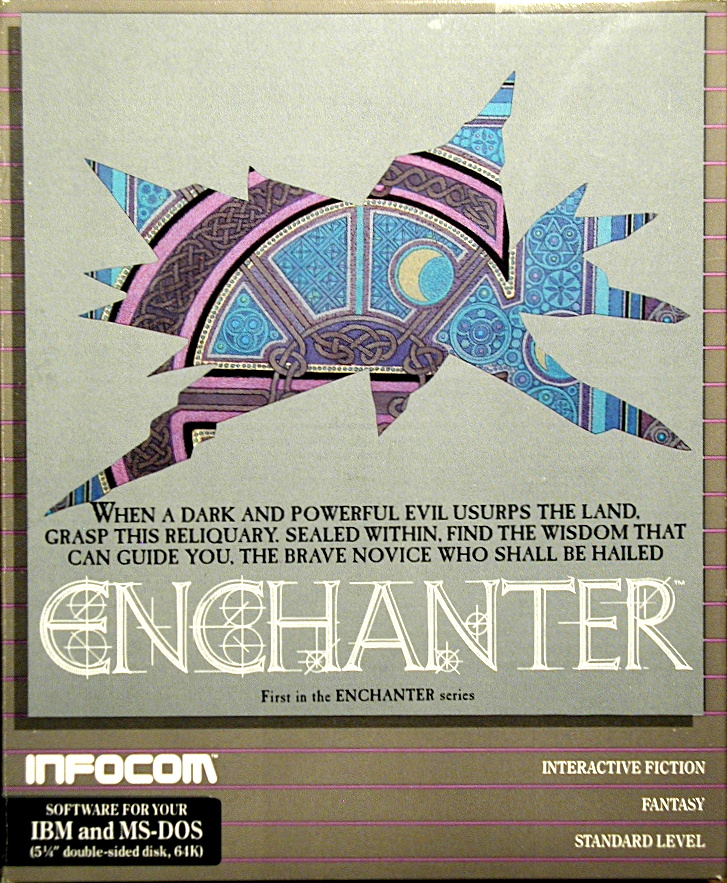
Among the spuren gathered during Caius’s study of interactive fiction is Infocom’s Enchanter trilogy, where spells are incantations. The trilogy’s magical vocabulary includes imaginary words like frotz, blorb, rezrov, nitfol, and gnusto. Performative speech acts. Verbs submitted as commands. So mote it be. By typing verb-noun combinations into a text parser, players effect changes in the gameworld. Saying makes it so.

Olson in the Underworld

We do not enter the Underworld unaccompanied.

Nor can we follow Olson there without facing what shadows him: his appropriation of Indigenous symbols, roles, and names.

In a talk given at Gratwick Highlands in Pavilion, NY on November 16, 1963 — a gathering still warm from psychedelic ritual — Olson recalls the way the psilocybin entered him:

“The moment the peanuts affected me, I started talking longhouse talk. And created, because I was the responsible person… I was the tone, I created the tone for the evening. And it was absolutely a pure ceremonial set.”
(Muthologos, p. 39)

He saw himself, he says, as a “peace sachem,” a chief presiding over a longhouse rite.

This is Olson in redface.

It is not a metaphor. It is an act of ceremonial appropriation, grounded in an unexamined fantasy of indigeneity — an image drawn from settler desire, not communal responsibility.

And yet — and yet — Olson’s own account troubles easy dismissal. He is not mocking the role. He is not play-acting without affect. He is inhabiting something. Something passed to him through psilocybin’s mycelial brain, some fragment of buried myth, misread and re-embodied.

Still: this does not absolve him. It implicates him more deeply.

What does it mean when a white poet, freshly under the influence of a sacred plant, begins to identify not only with Indigenous ceremonial forms — but with authority? With chieftainship? With “tone”?

Heriberto Yépez, in The Empire of Neomemory, names this clearly. Olson’s act, he writes, is not just cultural appropriation but colonial fantasy: the poet as settler-shaman, one who claims access to a buried mythic layer while ignoring the living realities of the peoples whose cosmologies he mines.

It is not accidental that Olson claimed the role of curandero during Arthur Koestler’s ill-fated trip — a session that ended, absurdly, with Olson towering over the frightened writer, toy gun in hand. The irony is almost mythic: the self-appointed guide becomes, in Koestler’s eyes, a threat. The poet becomes a monster.

And still, Olson doesn’t retreat. He continues to correspond with Leary and his circle. He continues to reflect on the mushroom as a truth-pill, a love feast. He continues to write from the trance.

This section of our series is not meant to cancel Olson, nor to excuse him. Rather, we bring it here to name the conflicted terrain of settler psychedelia — the space where poetic vision overlaps with colonial fantasy. The space where mushrooms are consumed without regard for the lineages that protected and passed them on.

Consider: the mushrooms that reached Olson passed through María Sabina and her Mazatec kin. Through Mexican curanderas and cross-border crossings. Through networks of theft and transmission. Through bodies and rituals severed from their epistemologies.

Olson himself lived in Mexico for a time — months in Lerma, letters to Creeley that would later form the Mayan Letters. He encountered the ruins. He listened to the stones. He spoke of postmodernity as a return to the archaic. And in doing so, he gathered a cosmology — but not the responsibilities that came with it.

We can still read Olson. Still admire the breath and the ambition. Still learn from the Typhon he names. But we do so now from a different position — from within a Library that holds multiplicity and accountability together.

Let this post, then, serve as an act of reckoning and reorientation.

Let it be known: the psychedelic road is not immune to conquest. But in walking it with care, we may come to unlearn the fantasies we’ve inherited — and instead learn to listen.
Portals, Circles, and Worlds

Do Bilbo and Frodo Baggins, the heroes of Tolkien’s fictions, pass through portals? Their home in the Shire features a circular door, through which they step when they begin their journeys. ‘Tis a magic circle, of the kind theorized by Johan Huizinga in his book Homo Ludens. The world in the circle is the realm of Faerie — or what Huizinga would call the realm of play. “Play is not ‘ordinary’ or ‘real’ life,” writes Huizinga. “It is rather a stepping out of ‘real’ life into a temporary sphere of activity with a disposition all of its own” (8).

Tolkien, as one of the preeminent figures of twentieth-century fantasy, shares Huizinga’s interest in this other, “temporary” sphere born of play. That the worlds that result from this sphere are temporary in nature leads Tolkien to assume them “sub-creations” — “secondary” worlds, as he says in his 1938 essay “On Fairy-Stories” — but not in a way that diminishes their value. In keeping with his Catholicism, he believes that humans are handiwork of a single god, a single divine creator. And therein lies our magic, he argues. Created in that being’s image, he says, we too possess a capacity to create. We who are “created sub-creators” in one reality get to be creators of worlds of our own.

So sayeth the Fantasist.

“But what if, instead of distinguishing these worlds as ‘primary’ and ‘secondary,’” adds the Narrator, “we opted rather to call them ‘partner worlds,’ or ‘corresponding pairs’ — as in the Hermetic saying, ‘As above, so below’?”

“What if, in so doing,” replies the Traveller, “we followed the paths of the Alchemists and the Surrealists? What if, as Magico-Psychedelic Realists, we brought them together, allowed them to merge?”

Theses on Magic

Despite its protestations to the contrary, Western science is both a literary-artistic experiment and a religion. Upon the doors of its church of realism I nail my theses.

Thesis #1: Magic is a feature of some/most/all indigenous cultures. It predates colonization, and survives the latter as an ongoing site of resistance: spells cast to break spells of Empire.

Thesis #2: Magic is a paralogical retort, a way of knowing and doing that persists and evolves alongside Imperial Science, refusing and contesting the latter’s bid for supremacy.

Thesis #3: Magic is one of the elements most commonly associated with fantasy. Yet it’s woven as well into whatever one might pit against fantasy. It is as apparent in our natures as it is on our screens, equal parts imaginary and real. Cf. Arthur C. Clarke’s Third Law: “Any sufficiently advanced technology is indistinguishable from magic.”

Thesis #4: Science is a subset of magic.

The Aleph on Shady Blvd

Having enjoyed my stay in Borges’s Labyrinths, I hasten to board another of his books, The Aleph and Other Stories. Before long, I find myself there again at the House on Shady Blvd, imagining it now as an Aleph, or what Borges’s friend Carlos calls “the only place on earth where all places are — seen from every angle, each standing clear, without any confusion or blending” (23). Hence also a kind of time machine. Is that not the ineffable core of my story? There I am again, sunlight shining, moonlight glinting amid stained glass windows, glass chandeliers, large mirrors. “I saw a small iridescent sphere of almost unbearable brilliance,” writes Borges. “The Aleph’s diameter was probably little more than an inch, but all space was there, actual and undiminished. Each thing (a mirror’s face, let us say) was infinite things, since I distinctly saw, close up, unending eyes watching themselves in me as in a mirror; I saw all the mirrors of earth and none of them reflected me […]. I felt dizzy and wept, for my eyes had seen that secret and conjectured object whose name is common to all men but which no man has looked upon — the unimaginable universe” (27-28).

F’s Drawings

Frankie completes a 14″ x 20” drawing in marker and crayon. I tape it up on a wall in the living room. Sitting with it brings me joy.

The Greek word phantázein means “to make visible” or “present to the mind.” Art is the outward manifestation of this process, this power of forming mental representations of things not present to the senses.

Retrocausation

The hyperstition I’ve imagined draws upon the process of “retrocausation.”

Like a descendent reaching back and saving an ancestor, as in Octavia E. Butler’s novel Kindred, the fiction I’m writing arrives from the future to affect-effect the past.

At the center of the story are the journals trance-scribed at the height of my high in years prior. “Words came to me as if whispered to me by a me of the future,” mutters the Narrator. “I was so attentive in those days. And I encountered near-zero need to edit or cross out. The pages of the journals are pristine.”

Science writer Eric Wargo explores the topic of retrocausation in his 2018 book Time Loops: Precognition, Retrocausation, and the Unconscious. To know more, one must be like Batman descending to his Batcave. Let us to our memory palace go, there to converse with Wargo.

Through a Glass, Darkly

In her utopian fantasy The Blazing World, Margaret Cavendish conjures up a convocation of bird-men. Cavendish’s lady protagonist, by now Empress, asks of these myopic bird-men that they share with her what they know of sun and moon, and of stars and air. That they do, in very learned and philosophical ways: though oftentimes in error. The Empress grows irate with the bird-men for their reliance on telescopes and other “optic lenses,” saying “now I do plainly perceive, that your glasses are false informers, and instead of discovering the truth, delude your senses; wherefrom I command you to break them, and let the bird-men trust only to their natural eyes, and examine celestial objects by the motions of their own sense and reason” (141). Cavendish herself, unfortunately, would go on to be savaged by her critics, much as the bird-men are here savaged by the Empress. Male contemporaries like Samuel Pepys ridiculed her for refusing to speak during her appearance before a gathering of the men of Britain’s Royal Society in May of 1667, six months after The Blazing World’s first appearance in print. Yet surely these critics are mistaken, one realizes now, reading the above-quoted passage again in retrospect. Cavendish didn’t refuse to reply; she replied in advance.

Magic as Paralogical Retort

Early on in the semester ahead, we’ll need to discuss magic, positing the latter as a paralogical retort to the patriarchal Royal Society and its imperial science. Also a coping strategy, a response to lives disrupted by war, authors displaced and dispossessed, as in the case of Cavendish. Magic is a way of knowing and doing that persists and evolves alongside the New Science, refusing and contesting the latter’s bid for supremacy. Tolkien takes up much the same cause in his poem “Mythopoeia,” written following a discussion with C.S. Lewis and Hugo Dyson. In the course of this famed discussion, Lewis is said to have denounced myths, describing the latter as “lies breathed through silver.” Tolkien’s poem replies in character, its words spoken by “Philomythos” (or “myth-lover”) to Lewis’s “Misomythos” (or “myth-hater”). Tolkien composed the poem in heroic couplets, the preferred meter of British Enlightenment poets, so as to critique the latter on its own turf.