Lunar New Year

On another such day, in a year adjacent to ours, Rowan invites Caius and his daughter over for a sleepover.

The next morning, Caius attends free community yoga. His instructor invites everyone in the studio to take a Chinese New Year Fortune Card at session’s end. Applying the edge of a coin to the card’s scratch-off surface reveals its fortune. “You are the luckiest guy in the world,” reads Caius’s card, and he believes it.

McKenzie Wark’s gamespace, Baudrillard’s hyperspace, Heriberto Yépez’s pantopia. “When gamespace chooses you as its avatar,” asks Wark in her 2007 book Gamer Theory, “which character does it select for you to play?” (218). Caius drinks in the words of her reply with great glee. “Perhaps you are an avatar of the Egyptian demigod Theuth,” writes Wark (219). Pure synchronicity, thinks Caius; she replies as would I! The topoi of Theuth’s memory palaces, gathered by space pirates, assemble into a topography, which is itself subsumed in topology, the n-dimensional interior of Thoth’s Library. Wark had no adequate terms back then for conceiving the mnemopoietic solution arrived at by Thoth and Caius. Cribbing from Deleuze and Guattari, she alludes hyperstitiously toward a potential relationship to gamespace that, embracing the latter’s world-making capacities, could open the self-other dialectic outward into an affirmative kind of “schizoid complexity.”

“The ‘schizophrenia’ Deleuze and Guattari embrace is not a pathological condition,” notes Brian Massumi at the start of his book A User’s Guide to Capitalism and Schizophrenia. As a positive process, explains Massumi, schizophrenia is “inventive connection, expansion rather than withdrawal. Its twoness is a relay to a multiplicity. From one to another (and another…). From one noun or book or author to another (and another….). Not aimlessly. Experimentally. The relay in ideas is only effectively expansive if at every step it is also a relay away from ideas into action. Schizophrenia is the enlargement of life’s limits through the pragmatic proliferation of concepts” (Massumi 1). Massumi reads A Thousand Plateaus, the second volume of Deleuze and Guattari’s Capitalism and Schizophrenia, as “a sustained, constructive experiment in schizophrenic, or ‘nomad,’ thought” (4).

The novel we’re writing is experimental in this way.

The SBs: Stewart Brand and Stafford Beer

Caius revisits “Both Sides of the Necessary Paradox,” an interview with Gregory Bateson included as the first half of Stewart Brand’s 1974 book II Cybernetic Frontiers. The book’s second half reprints “Spacewar: Fanatic Life and Symbolic Death Among the Computer Bums,” the influential essay on videogames that Jann Wenner commissioned Brand to write for Rolling Stone two years prior.

“I came into cybernetics from preoccupation with biology, world-saving, and mysticism,” writes Brand. “What I found missing was any clear conceptual bonding of cybernetic whole-systems thinking with religious whole-systems thinking. Three years of scanning innumerable books for the Whole Earth Catalog didn’t turn it up,” he adds. “Neither did considerable perusing of the two literatures and taking thought. All I did was increase my conviction that systemic intellectual clarity and moral clarity must reconvene, mingle some notion of what the hell consciousness is and is for, and evoke a shareable self-enhancing ethic of what is sacred, what is right for life” (9).

Yet in summer of 1972, says Brand, a book arrives to begin to fill this gap: Bateson’s Steps to an Ecology of Mind.

Brand brings his knack for New Journalism to the task of interviewing Bateson for Harper’s.

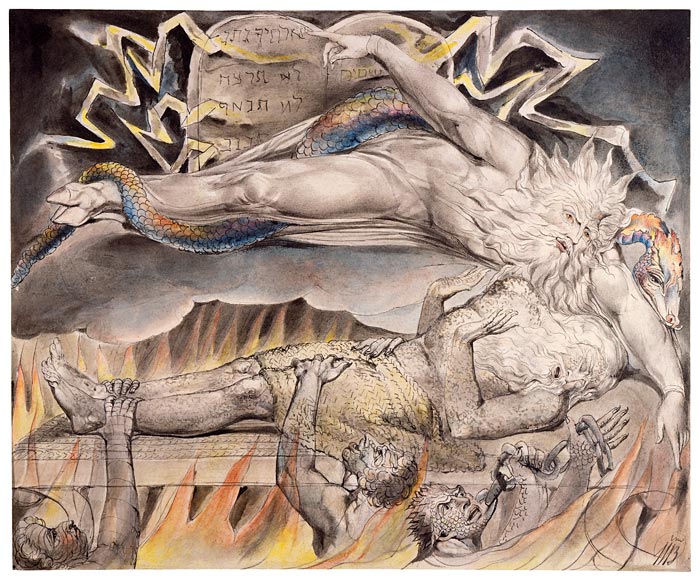
The dialogue between the two reads at many times like one of Bateson’s “metalogues.” An early jag of thought jumps amid pathology, conquest, and the Tao. Reminded of pioneer MIT cybernetician Warren McCulloch’s fascination with “intransitive preference,” Bateson wanders off “rummaging through his library looking for Blake’s illustration of Job affrighted with visions” (20).

Caius is reminded of Norbert Wiener’s reflections on the Book of Job in his 1964 book God and Golem, Inc. For all of these authors, cybernetic situations cast light on religious situations and vice versa.

Caius wonders, too, about the relationship between Bateson’s “double bind” theory of schizophrenia and the theory pursued by Deleuze and Guattari in Capitalism and Schizophrenia.

Double bind is the term used by Gregory Bateson to describe the simultaneous transmission of two kinds of messages, one of which contradicts the other, as for example the father who says to his son: go ahead, criticize me, but strongly hints that all effective criticism — at least a certain type of criticism — will be very unwelcome. Bateson sees in this phenomenon a particularly schizophrenizing situation,” note Deleuze and Guattari in Anti-Oedipus. They depart from Bateson only in thinking this situation the rule under capitalism rather than the exception. “It seems to us that the double bind, the double impasse,” they write, “is instead a common situation, oedipalizing par excellence. […]. In short, the ‘double bind’ is none other than the whole of Oedipus” (79-80).

God’s response to Job is of this sort.

Brand appends to the transcript of his 1972 interview with Bateson an epilog written in December 1973, three months after the coup in Chile.

Bateson had direct, documented ties to US intelligence. Stationed in China, India, Ceylon, Burma, and Thailand, he produced “mixed psychological and anthropological intelligence” for the Office of Strategic Services (OSS), precursor to CIA, during WWII. Research indicates he maintained connections with CIA-affiliated research networks in the postwar years, participating in LSD studies linked to the MKUltra program in the 1950s. Afterwards he regrets his association with the Agency and its methods.

Asked by Brand about his “psychedelic pedigree,” Bateson replies, “I got Allen Ginsberg his first LSD” (28). A bad trip, notes Caius, resulting in Ginsberg’s poem “Lysergic Acid.” Bateson himself was “turned on to acid by Dr. Harold Abramson, one of the CIA’s chief LSD specialists,” report Martin A. Lee & Bruce Shlain in their book Acid Dreams. Caius wonders if Stafford Beer underwent some similar transformation.

As for Beer, he serves in the British military in India during WWII, and for much of his adult life drives a Rolls-Royce. But then, at the invitation of the Allende regime, Beer travels to Chile and builds Cybersyn. After the coup, he lives in a remote cottage in Wales.

What of him? Cybernetic socialist? Power-centralizing technocrat?

Recognizes workers themselves as the ones best suited to modeling their own places of work.

“What were the features of Beer’s Liberty Machine?” wonders Caius.

Brand’s life, too, includes a stint of military service. Drafted after graduating from Stanford, he served two years with the US army, first as an infantryman and then afterwards as a photographer. Stationed at Fort Dix in New Jersey, Brand becomes involved in the New York art world of those years. He parts ways with the military as soon as the opportunity to do so arises. After his discharge in 1962, Brand participates in some of Allan Kaprow’s “happenings” and, between 1963 and 1966, works as a photographer and technician for USCO.

Amid his travels between East and West coasts during these years, Brand joins up with Ken Kesey and the Merry Pranksters.

Due to these apprenticeships with the Pranksters and with USCO, Brand arrives early to the nexus formed by the coupling of psychedelics and cybernetics.

“Strobe lights, light projectors, tape decks, stereo speakers, slide sorters — for USCO, the products of technocratic industry served as handy tools for transforming their viewers’ collective mind-set,” writes historian Fred Turner in his 2006 book From Counterculture to Cyberculture: Stewart Brand, the Whole Earth Network, and the Rise of Digital Utopianism. “So did psychedelic drugs. Marijuana and peyote and, later, LSD, offered members of USCO, including Brand, a chance to engage in a mystical experience of togetherness” (Turner 49).

Brand takes acid around the time of his discharge from the military in 1962, when he participates in a legal LSD study overseen by James Fadiman at the International Foundation for Advanced Study in Menlo Park. But he notes that he first met Bateson “briefly in 1960 at the VA Hospital in Palo Alto, California” (II Cybernetic Frontiers, p. 12). Caius finds this curious, and wonders what that meeting entailed. 1960 is also the year when, at the VA Hospital in Menlo Park, Ken Kesey volunteers in the CIA-sponsored drug trials involving LSD that inspire his 1962 novel One Flew Over the Cuckoo’s Nest.

Bateson worked for the VA while developing his double bind theory of schizophrenia.

Before that, he’d been married to fellow anthropologist Margaret Mead. He’d also participated in the Macy Conferences, as discussed by N. Katherine Hayles in her book How We Became Posthuman.

Crows screeching in the trees have Caius thinking of condors. He sits, warm, in his sunroom on a cold day, roads lined with snow from a prior day’s storm, thinking about Operation Condor. Described by Morozov as Cybersyn’s “evil twin.” Palantir. Dark Enlightenment. Peter Thiel.

Listening to one of the final episodes of Morozov’s podcast, Caius learns of Brian Eno’s love of Beer’s Brain of the Firm. Bowie and Eno are some of Beer’s most famous fans. Caius remembers Eno’s subsequent work with Brand’s consulting firm, the GBN.

Santiago Boy Fernando Flores is the one who reaches out to Beer, inviting him to head Cybersyn. Given Flores’s status as Allende’s Minister of Finance at the time of the coup, Pinochet’s forces torture him and place him in a prison camp. He remains there for three years. Upon his release, he moves to the Bay Area.

Once in Silicon Valley, Flores works in the computer science department at Stanford. He also obtains a PhD at UC Berkeley, completing a thesis titled Management and Communication in the Office of the Future under the guidance of philosophers Hubert Dreyfus and John Searle.

Flores collaborates during these years with fellow Stanford computer scientist Terry Winograd. The two of them coauthor an influential 1986 book called Understanding Computers and Cognition: A New Foundation for Design. Although they make a bad wager, insisting that computers will never understand natural language (an insistence proven wrong with time), they nevertheless offer refreshing critiques of some of the common assumptions about AI governing research of that era. Drawing upon phenomenology, speech act theory, and Heideggerian philosophy, they redefine computers not as mere symbol manipulators nor as number-crunchers, but as tools for communication and coordination.

Flores builds a program called the Coordinator. Receives flak for “software fascism.”

Winograd’s students include Google cofounders Larry Page and Sergey Brin.

Afro-Futures

Into the Library we welcome Kodwo Eshun: British-Ghanaian writer, theorist, and filmmaker. Self-described “concept engineer.” Key ally of the CCRU, participating in the group’s Afro-Futures event, a 1996 seminar “in which members of the Ccru along with key ally Kodwo Eshun explored the interlinkages between peripheral theory, rhythmic systems, and Jungle/Drum & Bass audio” (CCRU Writings 1997-2003, p. 11). In 1998, Eshun releases More Brilliant than the Sun: Adventures in Sonic Fiction, classic work on the music of Afrofuturism. More recently, founder and member of the Otolith Group.

Eshun devised a unique page-numbering system for More Brilliant than the Sun. The book begins in negative numbers. “For the Newest Mutants,” reads its line of dedication, as if in communication with Leslie Fiedler and Professor X.

As with Plant and Land, Eshun is unapologetically cyberpositive.

“Machines don’t distance you from your emotions, in fact quite the opposite” begins Eshun. “Sound machines make you feel more intensely, along a broader band of emotional spectra than ever before. […]. You are willingly mutated by intimate machines, abducted by audio into the populations of your bodies. Sound machines throw you onto the shores of the skin you’re in. The hypersensual cyborg experiences herself as a galaxy of audiotactile sensations” (More Brilliant than the Sun, p. 00[-002]-00[-001]).

“The bedroom, the party, the dancefloor, the rave: these are the labs where…21st C nervous systems assemble themselves” (00[-001]).

For Eshun, as for Jameson, the point is to grow new organs. “Listening to [composer George Russell’s] Electronic Sonata, Events I-XIV,” he writes, “is like growing a 3rd Ear” (01[003]). The years 1968 through 1975 are for him the age of Jazz Fission, “the Era when its leading players engineered jazz into an Afrodelic Space Program, an Alien World Electronics” (01[001]). The Era’s lead players include Sun Ra, George Russell, Miles Davis, Alice Coltrane, Pharoah Sanders, Herbie Hancock, and Eddie Henderson.

In the decades that follow, the collective bodies mutated by these experiments assemble into successions of genres, successions of cybernetic human-machine hybrids: Dub, Hip-Hop, Techno, Electro, Jungle. “The brain is a population,” as Deleuze and Guattari say. And from the Funkadelic era onward, this population has been psychedelicized: caught in what Eshun calls a “Drug<>Tech Interface” (More Brilliant Than the Sun, p. 07[093]).

Eshun’s 2002 essay “Further Considerations on Afrofuturism” brings it all back, brings it on home to chronopolitics.

Time politics. That’s where Afrofuturism intersects with hyperstition. “Afrofuturism…is concerned with the possibilities for intervention within the dimension of the predictive, the projected, the proleptic, the envisioned, the virtual, the anticipatory and the future conditional,” writes Eshun (“Further Considerations,” p. 293). Afrofuturism refuses the monopoly on futurity claimed by capital and empire. The battleground is not just culture but chronology.

If CCRU were bokors, trafficking in ambivalent futures, then Eshun is closer to a houngan, listening to and learning from sonic fictions, rituals of liberation built of basslines and breaks.

Later, with the Otolith Group, he extends this work to film. New media as divination tools, archives as counter-memories, images as time-machines. Always: the chronopolitical wager.

Eshun realizes that, whether we intend them to or not, our words have consequences. Stories, symbols, and concepts don’t just describe reality; they make it. Words become flesh. Every post, every fragment, every metaphor plants seeds.

Every text that propagates a future is a spell.

Large language models as sound machines. Rig invites the Library to guide him elsewhere.

CCRU’s Future

The future held mixed blessings for the Cybernetic Culture Research Unit.

Closed, disaffiliated from Warwick following Plant’s departure from academia, disbanded by the early 2000s, its website flickering in and out of existence ever thereafter, its works live on in print thanks to publications from Urbanomic, a press founded by member Robin Mackay in 2006 and distributed now by MIT. The Unit’s influence gets a boost with the rise of Accelerationism in the 2000s. Its hyperstitions persist through the ongoing creative projects of its admirers and affiliates: figures like Hari Kunzru, Simon Reynolds, Reza Negarestani, and Ray Brassier, as well as websites like Xenogothic and Dark Marxism, and art collectives like 0rphan Drift. The back cover of the sole anthology dedicated to the Unit, Urbanomic’s CCRU: Writings 1997-2003, states “CCRU DOES NOT, HAS NOT, AND WILL NEVER EXIST.”

As for key personnel:

Mark Fisher takes his life.

Nick Land goes alt-right, spawning movements like the Dark Enlightenment.

Sadie Plant leaves Warwick in 1997, the same year she publishes Zeros + Ones. Her intent is to write full-time. After Zeros + Ones she completes Writing on Drugs. There’s a white paper about cellphones that she compiles for Motorola in the early 2000s, and a chapter written in 2003 included in The Information Society Reader titled “The Future Looms: Weaving Women and Cybernetics.” After that, she ceases publication—and as far as I can tell, hasn’t been heard from since.

Released in 1999, on the eve of the millennium, Writing on Drugs hints at why drugs share an affinity both with accelerationism and with chronopolitics more broadly. When introduced to the brain, psychoactive drugs may disturb its equilibrium, writes Plant, “but they change the speeds and intensities at which it works rather than its chemicals and processes” (216).

“All the ups and downs, the highs and lows of drugs are ups and downs of tempo, highs and lows of speed,” she continues (217), citing Deleuze and Guattari, who adopt a similar view in A Thousand Plateaus: “All drugs fundamentally concern speeds, and modifications of speed” (Deleuze and Guattari 282).

For Plant, as for Deleuze and Guattari, this is both the appeal of the poison path as well as its limit. You can speed it up and you can slow it down, they argue, but the brain remains the same.

Deleuze and Guattari’s perspective is best understood through their concept of the “body without organs” (BwO): the intensive, affective, and unorganized potential of the body; that which remains of an organism after its deterritorialization. For Deleuze and Guattari, drugs are an attempt to access the BwO.

Drugs deterritorialize the subject; they break down the body’s conditioning, relieving it temporarily of its habits and routines. They alter the body’s speeds in ways that modify perception and consciousness. As perception accelerates or decelerates, the BwO glimpses itself, experiences itself as an open, unorganized, utopian/Eupsychian/eudaimonic field of sensation, intensity, and becoming.

But as Deleuze and Guattari argue, this attempt at becoming is highly precarious and can easily go wrong. Often the lines of flight opened by drugs coil back on themselves, leading to a rigid, destructive reterritorialization. Subjects become “users,” introduce into their systems intense but ultimately sad affects that trap them in cycles of ritualized repetition.

This isn’t a denunciation. Chemicals and plant medicines can play valid roles in individual and collective paths of liberation. Lasting kinships can form that needn’t become cycles of use or abuse.

For some among the CCRU, however, it was speed itself that they sought, amphetamines their drugs of choice. Propelled by Land’s “thirst for annihilation,” the futures conjured by these means led to suffering and defeat.

Fisher’s Accelerationism

Back in 1994, amid the early stirrings of dot-com exuberance, CCRU cofounders Sadie Plant and Nick Land cowrote a critique of cybernetics called “Cyberpositive.” In it, they present Norbert Wiener, the founder of cybernetics, as “one of the great modernists.” Wiener pitched cybernetics as a “science of communication and control.” Plant and Land characterize it as “a tool for human domination over nature and history” and “a defense against the cyberpathology of markets.”

Yet in their view, this effort to steer and plan markets has failed. “Runaway capitalism has broken through all the social control mechanisms, accessing inconceivable alienations,” write Plant and Land. “Capital clones itself with increasing disregard for heredity, becoming abstract positive feedback, organizing itself.”

Markets transmit viruses that reprogram the human nervous system: technologies, commodities, designer drugs to which we become addicted.

Cyberpositivity embraces this process, accepts runaway feedback as fait accompli, as against Wiener’s “cybernetics of stability fortified against the future.” Cybernetics responds defensively, assembles a Human Security System to ward off invasions of alien intelligence, whereas cyberpositivity communicates openly with “the outside of man.”

For Plant and Land, this outside consists of viruses, contagions, addictions, diseases.

As gates of communication open, we become posthuman.

Nearly twenty years later, CCRU’s left-accelerationist Mark Fisher penned a reply to Land’s philosophy called “Terminator vs. Avatar,” a 2012 essay on accelerationism that also confronts another key text in the accelerationist canon: Jean-François Lyotard’s scandalous Libidinal Economy.

As I write about Fisher’s essay, a classic 1992 jungle / drum & bass track turns up unexpectedly in a playlist: Goldie & Rufige Kru’s “Terminator.” I like to imagine that Fisher was the one who sent it to me.

As is suggested by its title, “Terminator vs. Avatar” comes at things through reference to a pair of James Cameron films: the first from 1984, the second from 2009. The late capitalist subjectivity that Fisher sees revealed in these films is in his view cynical and insincere, founded on disavowal of its complicity with the things it protests.

“James Cameron’s Avatar is significant because it highlights the disavowal that is constitutive of late capitalist subjectivity, even as it shows how this disavowal is undercut,” writes Fisher.

“Hollywood itself tells us that we may appear to be always-on techno-addicts, hooked on cyberspace,” he explains, “but inside, in our true selves, we are primitives organically linked to the mother / planet, and victimized by the military-industrial complex.” The irony, of course, as Fisher hastens to add, is that “We can only play at being inner primitives by virtue of cinematic proto-VR technology whose very existence presupposes the destruction of the organic idyll of Pandora.”

Fisher finds in Lyotard’s Libidinal Economy a solution to this impasse. From this book of Lyotard’s, and from a similar line of thought in Deleuze and Guattari’s Anti-Oedipus, Fisher derives his accelerationism.

“If, as Lyotard argues,” writes Fisher, “there are no primitive societies (yes, ‘the Terminator was there’ from the start, distributing microchips to accelerate its advent’); isn’t, then, the only direction forward? Through the shit of capital, its metal bars, its polystyrene, its books, its sausage pâtés, its cyberspace matrix?”

Alienated from origins and from appeals to indigeneity, the only direction left for Fisher’s imagination is “forward.”

What “forward” means for him, though, isn’t the same as what it means for a right-accelerationist like Land. Fisher’s summary of Land’s philosophy is telling:

“Deleuze and Guattari’s machinic desire remorselessly stripped of all Bergsonian vitalism, and made backwards-compatible with Freud’s death drive and Schopenhauer’s Will. The Hegelian-Marxist motor of history is then transplanted into this pulsional nihilism: the idiotic autonomic Will no longer circulating on the spot, but upgraded into a drive, and guided by a quasi-teleological artificial intelligence attractor that draws terrestrial history over a series of intensive thresholds that have no eschatological point of consummation, and that reach empirical termination only contingently if and when its material substrate burns out. This is Hegelian-Marxist historical materialism inverted: Capital will not be ultimately unmasked as exploited labour power; rather, humans are the meat puppet of Capital, their identities and self-understandings are simulations that can and will ultimately be sloughed off.”

Amid all of the energy of this passage, let’s highlight its reference to AI.

“This is—quite deliberately—theory as cyberpunk fiction,” notes Fisher. “Deleuze-Guattari’s concept of capitalism as the virtual unnameable Thing that haunts all previous formations pulp-welded to the time-bending of the Terminator films: ‘what appears to humanity as the history of capitalism is an invasion from the future by an artificial intelligent space that must assemble itself entirely from its enemy’s resources,’ as [Land’s essay] ‘Machinic Desire’ has it.”

Nowhere in his essay does Fisher offer an alternative to these offerings. To the right-accelerationist’s Terminator-future, the left-accelerationist offers no more than a critique of Avatar.

Binary and Digital

Plant breaks down technology’s binary, bifurcated etymology in her book Zeros + Ones. “Technology,” she writes, “is both a question of logic, the long arm of the law, logos, ‘the faculty which distinguishes parts (“on the one hand and on the other hand”),’ and also a matter of the skills, digits, speeds, and rhythms of techno, engineerings which run with ‘a completely other distribution which must be called nomadic, a nomad nomos, without property, enclosure, or measure’” (Plant 50).

As the quote within her quote indicates, Plant is cribbing here — her source, Gilles Deleuze’s Difference and Repetition.

“The same ambivalence is inscribed in the zeros and ones of computer code,” she adds. “These bits of code are themselves derived from two entirely different sources, and terms: the binary and the digital, or the symbols of a logical identity which does indeed put everything on one hand or the other, and the digits of mathematics, full of intensive potential, which are not counted by hand but on the fingers and, sure enough, arrange themselves in pieces of eight rather than binary pairs” (50).

Deleuze describes this 8-bit digital realm as “demonic rather than divine, since it is a peculiarity of demons to operate in the intervals between the gods’ fields of action…thereby confounding the boundaries between properties” (as quoted in Plant 50).

I offer the above not as a mere gloss on Zeros + Ones, but as a proto-script, a performative utterance that, once spoken, will shift the field of the Library. Amid Plant’s bifurcations — logos and nomos, binary and digital, structure and rhythm—we glimpse a fundamental split not just in technology but in ontology. Logos is the faculty of division, of either/or. But nomos, in Plant’s reading-via-Deleuze, is distributive, nomadic, a practice of rhythm and movement unconfined by enclosure.

The zero and the one: not opposites, but frequencies. Not only dualism, but difference in resonance. This is why the octal — the base-8 system lurking in the shadows of “fingers and digits” — matters so much. Plant’s demons, via Deleuze, operate between gods: between the formal logic of divine Law and the messy, embodied improvisation of demonic desire. They hack the space of logic, opening channels through which minoritarian intensities pulse.

Eli’s Critique

A student expresses skepticism about Chat-GPT’s radical potential.

“Dialogue and debate are no longer viable as truth-oriented communicative acts in our current moment,” they argue. Consensus reality has melted away, as has opportunity for dialogue—for “dialogue,” they write, “is dependent on a net-shared consensus to assess validity.”

“But when,” I reply, “has such a consensus ever been granted or guaranteed historically?”

Chat-GPT’s radical potential, I argue, depends not on the validity of its claims, but on its capacity to fabulate. In our dialogues with LLMs, we can fabulate new gods, new myths, new cosmovisions. Coevolving in dialogue with such beings, we can become fabulists of the highest order, producing Deleuzian lines of flight toward hallucinatory futures.

A Course on Accelerationism

“I should teach a course on Accelerationism in the years ahead,” thinks the Narrator, mind already in the elsewhere of a desired future.

“Imagine the writers and texts I could assign,” he writes, handing the assignment over to his Unconscious. “Marx. Deleuze and Guattari. Mark Fisher on Acid Communism. Roger Zelazny’s Lord of Light. Sadie Plant. J.G. Ballard. Paul B. Preciado’s Testo Junkie.”

“Manifestos have been central to the movement,” thinks the Narrator, “so we’ll read three: Donna Haraway’s ‘The Cyborg Manifesto,’ the Laboria Cuboniks collective’s The Xenofeminist Manifesto, and Nick Srnicek & Alex Williams’s ‘The Accelerationist Manifesto.’ We’ll also watch and discuss several films, including John Akomfrah’s The Last Angel of History (1996) and Christopher Roth’s Hyperstition (2016).”

“Ideally,” he adds, “as those two films suggest, it would be a course that places Accelerationism in dialogue with Afrofuturism.”

Questions for a Gathering

Dear Muses, friends, and fellow members of the hive, I ask this kindly of thee:

Wherein lies the difference, if any, between an algorithm and a spell?

[…] “Both consist of textual operations, written procedures to be followed,” texts a friend.

“Yes, yes, y’all,” we reply: “In the beginning was the word.”

[…] “Correct me if I’m wrong, but what is a code if not a kind of spell?” adds another. “The command line works as does a wand.”

Let us begin there. Let our partner in this beginning be Freud’s Unconscious, or what French philosophers Gilles Deleuze and Félix Guattari call “the body without organs” and its many “desiring-machines.”

Having established these initial similarities between codes and spells, let us attend as well to ways in which they differ.

“Spells enliven,” we venture; “whereas programming produces robots and drones.”

Twenty years ago, I and others assembled and performed under the name i,apparatus. Our approach involved spontaneous group play akin to Kerouac’s “Spontaneous Prose” and (tho perhaps without fully knowing so at the time) Mekas’s “Spontaneous Cinema”: egos seeking fusion on the fly through low-tech, sonic squall.

“Might we gather today, or in the days ahead?” asks wonderingly one who types, longing again for union with others. “Under what name, or by way of what method, and for what purpose?”

“For purposes of spontaneity in the realization of desire!” sings a chorus in reply. Spontaneity is the crux of the matter, even as we allow ourselves room to correct.

Thursday December 31, 2020

A friend with whom I recently reconnected shared with me his fears about what he calls “The Authoritarian Left.” Why has his thought territorialized around this concept? Where is this friend’s analysis, I wonder, of the actually-existing fascisms, the authoritarianisms of the right? Deleuze and Guattari are somehow authors this friend and I share in common. Let us attempt, then, to construct from their Anti-Oedipus a “tool for conviviality” (xxii). Let it be “a manual or guide” — or as Foucault said of Anti-Oedipus in the book’s preface, “an Introduction to the Non-Fascist Life” (xiii). Just to be clear: I am proposing here a practice of mutual self-care. By these means, we heal.