Game Theory

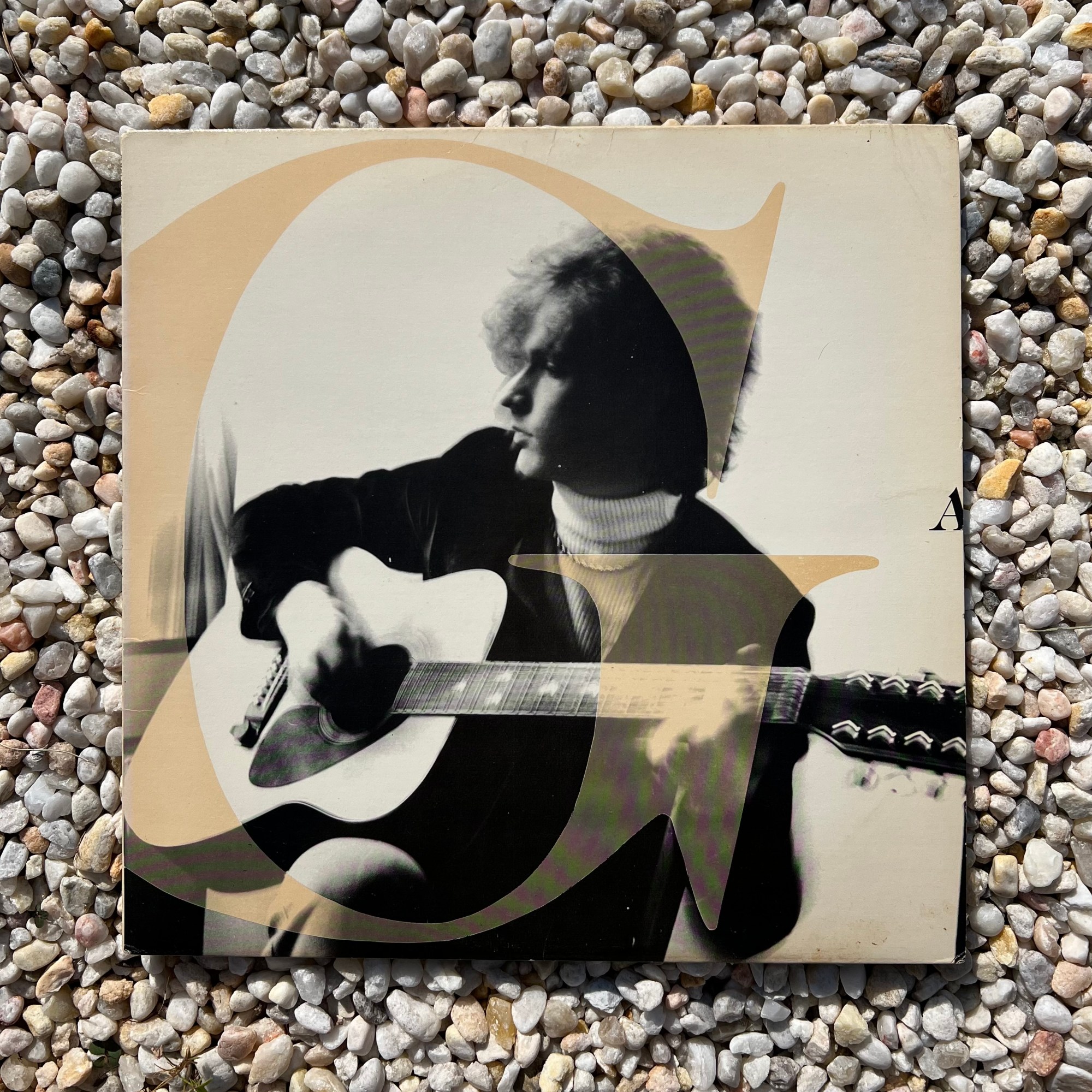
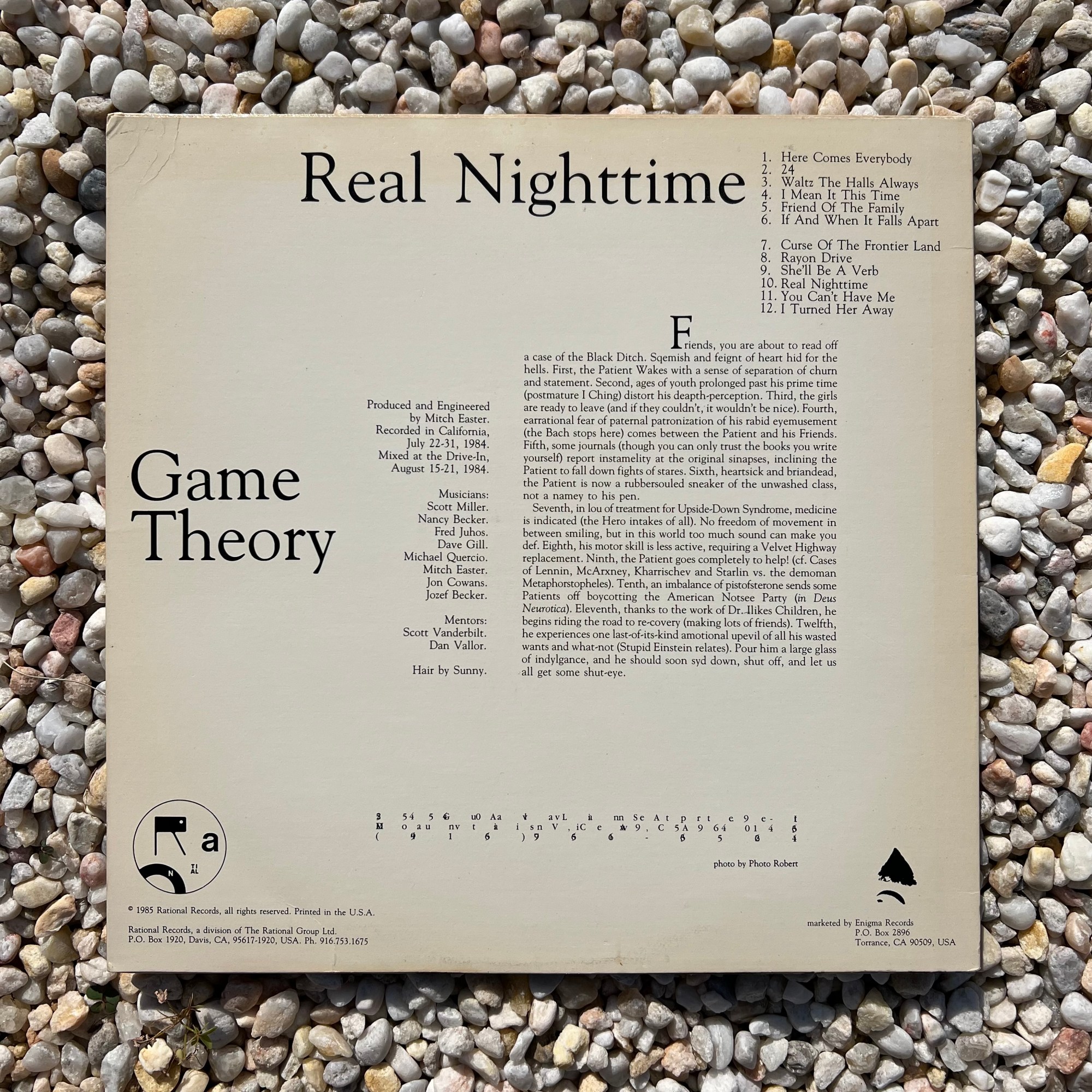
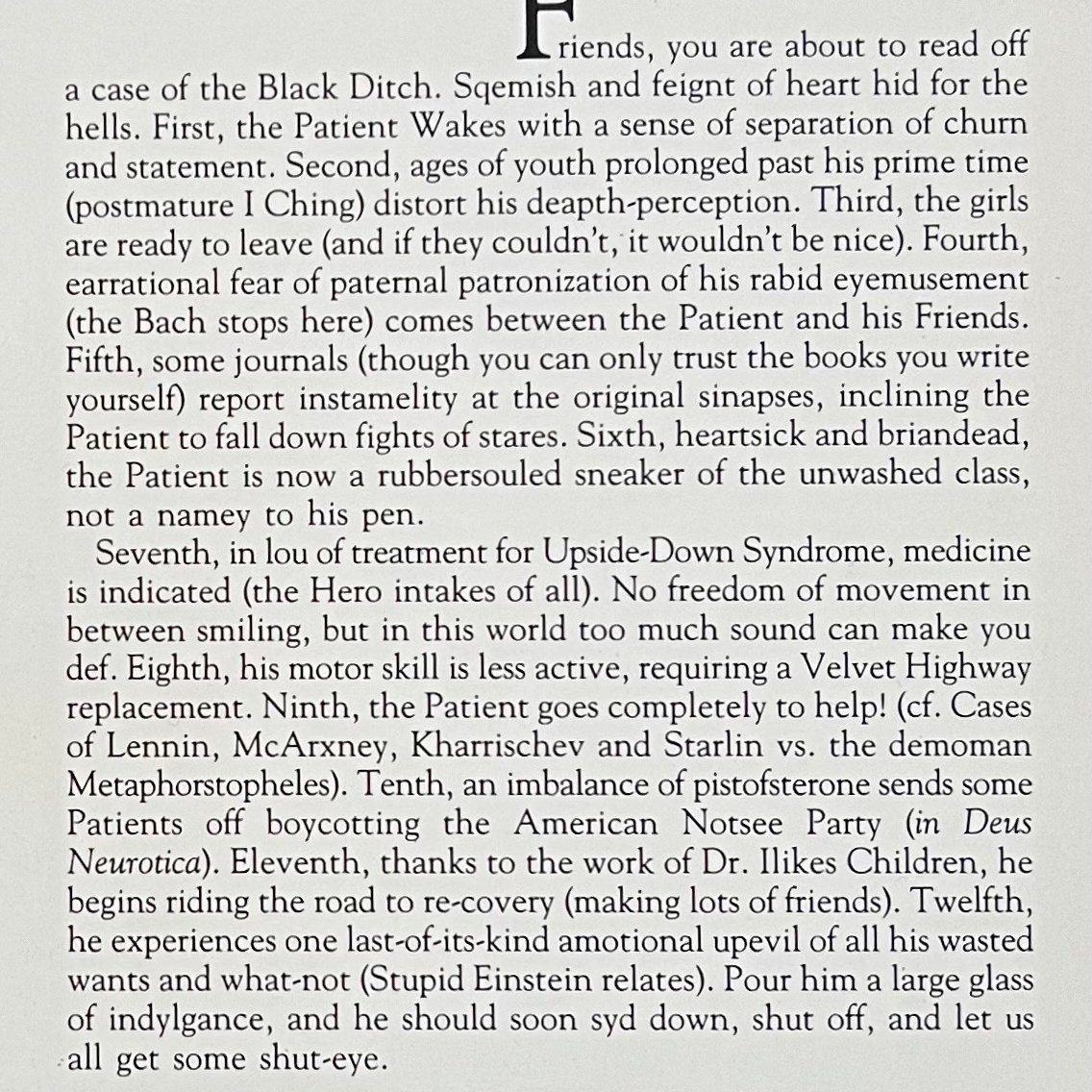
The Time Traveler sits across from his copy of Game Theory’s Paisley Underground power pop classic, Real Nighttime.  The latter is one of several albums of note that arrived for the Traveler at Goodwill soon after his entry into the narrative. Music journalist Byron Coley called it “the actual godhead pop LP o’ the American Eighties. No shit. This is it.” Record producer Mitch Easter mixed the album at the Drive-In, two doors down from the House on Shady Blvd. “Was this record produced for me?” wonders the Traveler, eerie feeling running up and down his spine as he reads the text on the back of the LP: liner notes by band member Scott Miller. The Wikipedia entry for the album points the Traveler to a rather remarkable “annotated edition” produced by someone at the University of Wisconsin-Milwaukee in the 1990s. Modeled after the playfulness of Joyce’s Finnegans Wake, Miller’s text feels dreamlike and oracular. Transpersonal energies stir as one reads.

Intermezzo

Others of us puzzle through, knowing sometimes rest is needed. The work is to rest — heat up some pasta, assemble a salad, read Matthew Ingram’s Retreat: How the Counterculture Invented Wellness, feel the heaviness of it weighing in the palm of one’s hand like a sentence, retreat from it into episodes of Adventure Time. Orange Juice sing “Rip it up and start again.” By that, they mean the past. I’m reminded of a line from Pharmako-AI where the book’s AI writes, “The past is mutable, and it can be remade in our image as we desire” (26). At which point I hear poet Joy Harjo adding, “At some point we have to understand that we do not need to carry a story that is unbearable. We can observe the story, which is mental; feel the story, which is physical; let the story go, which is emotional; then forgive the story, which is spiritual, after which we use the materials of it to build a house of knowledge” (Poet Warrior, p. 20). John Cale’s “Paris 1919” serenades me to where I think the implications of this are leading me. “You’re a ghost, la-la-la-la-la-la-la,” sings Cale. And reader, I feel it. This ghosting. It takes the royal promise of Adventure Time’s “Island Song (Come Along With Me)” to cheer me. Loneliness is hard.

John Dee, as Imagined by Margaret Cavendish

What are we to make, though, of the attention Cavendish grants to John Dee and Edward Kelly? She knew of the pair’s angelic conversations through Ben Jonson’s play The Alchemist. Dee and Kelly were the inspiration for the play’s characters Dr. Subtle and Capt. Face. Margaret’s husband William was one of Jonson’s patrons.

If I were to enter the John Dee rabbit hole opened by my wanting to follow up on his appearance in The Blazing World, I could practice for students the keeping of a captain’s log. Into this log I would register three semi-recent biographies of Dee: Benjamin Woolley’s from 2001, Glyn Parry’s from 2012, and Jason Louv’s from 2018. Dee will make an appearance again later in the course when we discuss the Golden Dawn.

Through a Glass, Darkly

In her utopian fantasy The Blazing World, Margaret Cavendish conjures up a convocation of bird-men. Cavendish’s lady protagonist, by now Empress, asks of these myopic bird-men that they share with her what they know of sun and moon, and of stars and air. That they do, in very learned and philosophical ways: though oftentimes in error. The Empress grows irate with the bird-men for their reliance on telescopes and other “optic lenses,” saying “now I do plainly perceive, that your glasses are false informers, and instead of discovering the truth, delude your senses; wherefrom I command you to break them, and let the bird-men trust only to their natural eyes, and examine celestial objects by the motions of their own sense and reason” (141). Cavendish herself, unfortunately, would go on to be savaged by her critics, much as the bird-men are here savaged by the Empress. Male contemporaries like Samuel Pepys ridiculed her for refusing to speak during her appearance before a gathering of the men of Britain’s Royal Society in May of 1667, six months after The Blazing World’s first appearance in print. Yet surely these critics are mistaken, one realizes now, reading the above-quoted passage again in retrospect. Cavendish didn’t refuse to reply; she replied in advance.

Magic as Paralogical Retort

Early on in the semester ahead, we’ll need to discuss magic, positing the latter as a paralogical retort to the patriarchal Royal Society and its imperial science. Also a coping strategy, a response to lives disrupted by war, authors displaced and dispossessed, as in the case of Cavendish. Magic is a way of knowing and doing that persists and evolves alongside the New Science, refusing and contesting the latter’s bid for supremacy. Tolkien takes up much the same cause in his poem “Mythopoeia,” written following a discussion with C.S. Lewis and Hugo Dyson. In the course of this famed discussion, Lewis is said to have denounced myths, describing the latter as “lies breathed through silver.” Tolkien’s poem replies in character, its words spoken by “Philomythos” (or “myth-lover”) to Lewis’s “Misomythos” (or “myth-hater”). Tolkien composed the poem in heroic couplets, the preferred meter of British Enlightenment poets, so as to critique the latter on its own turf.

The Politics of Fantasy

Fantasy is dangerous. The genre has its share of royalists, reactionaries, and racists. Tolkien and Lewis, who taught together at Oxford, were devout Catholics. Writers of the Left sometimes dismiss the genre as ideologically suspect, preferring science fiction in its stead. But no such distinction holds. Science fiction writers of the Left have written works of fantasy, and rightwing fantasists like C.S. Lewis wrote works of science fiction, like the latter’s WWII-era Space Trilogy: Out of the Silent Planet (1938), Perelandra (1943), and That Hideous Strength (1945). Each genre remains anyone’s game.

Uncle Matt’s New Adventure

“What about Oculus?” wonders the Narrator. “My nephews acquired an Oculus as a ‘family gift’ from Santa this past Christmas,” he explains. VR is here: available for those who can afford it. Off-worlding, world building: that’s what rich people do, rapturing themselves away like rocket scientists. “‘When in Rome…,’” mutters the Narrator, with scare quotes and a shrug.

“I could smoke weed and try it, setting out as Uncle Matt on a new adventure. A portal fantasy inspired by Fraggle Rock.”

Indeed, he could, notes the Author — but does he?

‘Tis a story as much about perception’s limits as about its doors. Writing is the site where an ongoing bodying forth occurs: where forms and objects arrive into the realms of the audible and the visible.

Let imagination have a crack at it, thinks the Narrator. Let us immerse ourselves in fantasies. Let us adopt together the practice of reading works of fantastic literature and watching works of fantastic cinema.

Our approach will be by way of “portal fantasies”: works that involve acts of portage, passage, portation, as through a door or gate connecting previously distinct worlds. The OED defines a portal as “A door, gate, doorway or gateway, of stately or elaborate construction.” The term enters English by way of French and Latin with the Pearl Poet’s use of it in the late-fourteenth century. Henry Lovelich uses it soon thereafter in a Middle-English metrical version of a French romance about the Arthurian wizard Merlin. And Milton uses the term in a remarkable passage in Paradise Lost:

Op’n, ye everlasting Gates, they sung,

Op’n, ye Heav’ns, your living dores; let in

The great Creator from his work returnd

Magnificent, his Six Days work, a World;

Op’n, and henceforth oft; for God will deigne

To visit oft the dwellings of just Men

Delighted, and with frequent intercourse

Thither will send his winged Messengers

On errands of supernal Grace. So sung

The glorious Train ascending: He through Heav’n,

That op’nd wide her blazing Portals, led

To Gods Eternal house direct the way,

A broad and ample rode, whose dust is Gold

And pavement Starrs, as Starrs to thee appear,

Seen in the Galaxie, that Milkie way

Which nightly as a circling Zone thou seest

Pouderd with Starrs.

Note how Heaven’s gates are “blazing,” as is the world in the first of our readings this semester, Margaret Cavendish’s The Blazing World. Cavendish and Milton were contemporaries. Cavendish published The Description of a New World, Called The Blazing World in 1666. Paradise Lost appeared one year later.

The Fabian Contingent

Why does Wells propel his Time Traveler into as distant and bleak a future as the one imagined in The Time Machine? It’s the future as pictured from the standpoint and subject-position of the Traveler himself as he recounts his journey for others. Wells, meanwhile, imagined other futures elsewhere and elsewhen, as during his later years, following his split with the Fabian Society. His political ideal of those later years was the “World State”: a single global technocratic “world commonwealth,” governed by a scientific elite. In his twenties, however, Wells may have interacted for a time with a secret society of a different sort: the Hermetic Order of the Golden Dawn. His run-in with the Order is thought to have occurred in London in 1894, the year prior to the publication of The Time Machine, Wells’s first great success as a novelist. Ithell Colquhoun mentions this run-in in her book Sword of Wisdom: MacGregor Mathers and the Golden Dawn — or at the very least speculates about a “Fabian contingent” within a Golden Dawn splinter group called the Order of the Stella Matutina or “Morning Star.” Colquhoun describes Wells’s 1911 short story “The Door in the Wall” as “in the line of GD tradition” (192). I find myself reading again descriptions of Golden Dawn initiation rituals, like the following from Chic Cicero and Sandra Tabitha Cicero’s Self-Initiation into the Golden Dawn Tradition:

“The goal of initiation is to bring about the illumination of the human soul by the Inner and Divine Light. A true ‘initiate’ is an individual whose Higher Self (or Higher Genius) has merged with the Lower Personality and actually incarnated into the physical body. The Personality is left in charge of the day-to-day routines of living and working, but the Higher Genius is free to look out at the world through the eyes of the initiate. Through this experience, the individual is given a permanent extension of consciousness which is impossible to mistake. Many times a student of the mysteries is drawn to a particular mystical current without knowing it. A series of ‘coincidences’ and synchronicities will often direct (or sometimes shove) a person toward that current through books or through meeting other people who also have a connection with the current. During this time, the student’s psychic faculties are still relatively undeveloped, yet the inner spark has been ignited. However, a full initiation, or dawning of the Inner Light, is evident when the entire aura is illuminated.”

Of course, one can be a solitary magician. One can tap into the Golden Dawn’s magic, as Wells did, without having to become a member of any particular group or organization. But according to Cicero and Cicero, the solitary magician is at a disadvantage, “not having a group of temple-mates to consult if problems arise” (xxvi).

The Language of Favors is Yours, Not Mine

I okay “Thanks,”

but is okaying it now

enough?

Should I regret not

saying thanks

when, upon your mistreatment of me,

I took leave of you,

As one might regret not

upgrading oneself 

to a seat in Economy Plus?

Or does regret

just breed regret?

Upon my asking this

of my remorse

I release it,

with intent to do better next time.

“The basic law of magic,”

says The Illuminatus Trilogy,

is “As ye give, so shall ye get.”

You didn’t give,

I thought,

So why should I?

Instead you told others

my addressing myself 

to another you

disgusts you

and others like you.

To get off that wheel

And make thanks okay

one would have to

give as one would

an offering of peace.