My therapist wants me to have fun. Astrologers and tarot readers suggest “big-big-love” once Mercury stations direct — as in that Pixies song, “Gigantic.” All I know is, I am ready for my body to be used in new ways in pursuit of joy. Pleasure, art, ecstasy. Dance, delicious meals, Dionysian revelry: all of these await. Meanwhile a fire rages at a fertilizer plant, disrupting campus affairs, forcing evacuations and cancellations of classes. Calendars will need adjustment in wake of this wild Imbolc. Neuroplastic rewirings and rewildings. I cook up a pot of soup: cauliflower & turmeric, finished with sprinklings of bacon. I’ve felt like Cabiria from Fellini’s Nights of Cabiria (1957) of late, walking teary-eyed amid a partying mass of singers and dancers, mascara running down her cheek. A friend wraps legs around me and lifts me up, heals me of my sorrow. Hugs me, says c’mere, cuddles me as we watch Carla Del Poggio, star of another of Fellini’s films, Variety Lights (1950). Rubs my neck. Feeds me cherries. Treats me right. Here on this queer Imbolc night, let us read Joy Harjo’s “Conflict Resolution for Holy Beings” and go for walks. Hard not to hear in the Harjo poem a reply to Margaret Cavendish. From this day hence, let us forgive each other. Let us love each other. Let us wake at dawn and want more.
Tag: Love
For-Itselfness
A friend texts requesting recommendations, works he could assign describing consciousness — particularly works that identify variable “dimensions” and “states.” I recommend Aldous Huxley’s The Doors of Perception, William James’s The Varieties of Religious Experience, and Abraham Maslow’s Toward a Psychology of Being. Reflecting afterwards on the exchange, I note down in a notebook, “Consciousness is something we grant or presuppose — based on our being here amid others in shared dialogue and shared study. Consciousness is Being as it comes to attention of itself as autopoetic subject-object — soul in communion with soul, each the other’s love doctor and angelic messenger.”
A Prayer for the Year Ahead
In an effort to set intentions amid the energy of a new moon, I write the following:
May I heal what hurts so as to be available to behave lovingly toward all.
May I learn to behave thus, so as to be other than a mere pontificating white man among other pontificating white men.
May I be a loving father.
May I forgive those who have harmed me, and may I be forgiven by those I’ve harmed.
May my love be true, practiced with the whole of my being, in ways that nourish the beloved and bring forth growth rather than harm.
May I be a great giver of gifts, grateful for the many gifts I’ve been given.
May the year ahead be a year of Lovers: a time of awakenings: a time of sexual and spiritual discovery; realization of love’s promise.
Amen. So mote it be.
Light Amid Darkness
Frankie has been a consistent source of light amid this darkness. Upon waking from her nap yesterday, she asked to go to “Dada’s House,” with “house” sounding a bit like “horse.” Why have I been inattentive to her here in these trance-scripts? She likes Dada’s House. She requests that we go there, cries if we don’t. Cats; playgrounds. Beautiful tall houses ‘round a bend. What’s not to like? Perhaps tomorrow we can embark on a stroller ride ‘round town. Time to stop ruminating. “Be Young, Be Foolish, Be Happy,” sing The Tams.
By nightfall, my sentiments align with a line from Chance the Rapper’s “Blessings”: “When the praises go up,” he sings, “the blessings come down.” Blessings make us feel, make us like as they land in our lap. Let us ready ourselves with praise.
Time to communicate lovingly, share the love out on the streets, hang with neighbors, chat with artists, bond through shared love of Buffalo Poetics and Black Mountain College. I feel like a lightning bug: if not a social butterfly, still a giver of gifts. 2022 will be a Lovers Year. Right now, though, I feel a bit crushed. Hurt. Heartbroken. Awaiting something beyond silence — some new adventure. For tonight I feel apart from the life I imagined. The narrative coordinates that have held are about to change, thinks the Time Traveler, scalp pricked and hands stigmata’d by impetigo. The hope is that love will prevail. And it does, it does, as soon as I listen to the record of the year: Moor Mother’s Black Encyclopedia of the Air.
Love Everyone
That is what happens. We time-travel to the present. Author catches up on publishing, begins live correspondence. Akron/Family balloon the belief. “See through strata,” they sing on their 2007 album Love Is Simple. “Go out and love, love, love, / everyone,” goes the chant — so we do. Love is simple with help from friends.
In so doing we find again things to say. Everything exists internally and externally. We are together nightly — in our beds, in dreams so real. And while sitting, meditating, concentrating on breathing: there, too, we meet. The fixated moment opens to flow and transformation. Old forms crumble. Old roles vanish. Mazeways give way to portals and pathways, ways and means.
After Todd Haynes’s The Velvet Underground
Yea, and I rise—
no grapes,
no gripes—
each breath an act of love.
Blacula (1972). Rocky Horror (1975). El Planeta (2021).
To our list, add Lou, too — his story eerily lesson-like, and relates —
though different, certainly, in its affect.
Gay nightclub noise bands formed
to silence Lou’s committee in head.
Enter John Cale, ex-Welshman
Radio tuned to foreign broadcast.
Out pops
“European Son.”
Artists escape to
New York at midcentury’s end.
42nd Street
Andy’s Film School
60s culture.
15-20 movie houses:
Here comes
new channels.
Here comes
LaMonte Young.
Very high spiritual states.
Long sustained tones.
Study of drone.
And along comes
Lou’s Syracuse buddy
Delmore Schwartz.
Add, too,
Jack Smith, Tony Conrad.
The drone of Western capitalism:
By Dream Syndicate Dazzled
By Dream We Dream
PS I LOVE YOU
To catch an evening screening of you, I hike downtown.
Seeming Lovers
ahead of me.
The Lovers
sit side by side
whispering in the dark.
“‘Tis my new favorite movie!” I tell myself:
made with masks all the more thrilling.
Plants kick in and
I relax,
Chasing happiness by my side.
Orpheus in Hades’ Lounge
There’s a parking, a journeying outward. Up and out we launch past West End Mill Works, off on tonight’s adventure, beginning with an evening stroll. Graffiti marks the spot. Stream to one side of us, water rushing over rocks. Spotify shifts from Steely Dan’s “King of the World” to Jan Hammer Group’s “Don’t You Know,” voices and cars in the distance. Looking both ways, we cross the street and rush down onto a shaded path through a nearby park, crickets singing in parallax with Neil Young’s “Computer Age.” We turn off the song and continue for a moment in silence. Upon arrival to a crossroads, we ask of each other (like Ginsberg to Whitman in Ginsberg’s “A Supermarket in California”), “Which way now?” Looking up, we rise and step proudly toward pink clouds. Conversation turns toward Old & Used Books as we pass a graffiti-clad muffler shop. Bulldog with paintbrush arrives as comic relief — reality for a moment a goofy animal fable whodunit. We grab beers as day turns to night. Ginsberg’s “lights out” reverberates, hangs in the air after us having heard earlier in the day Let’s Active’s “Orpheus in Hades’ Lounge,” featuring hometown hero Mitch Easter.
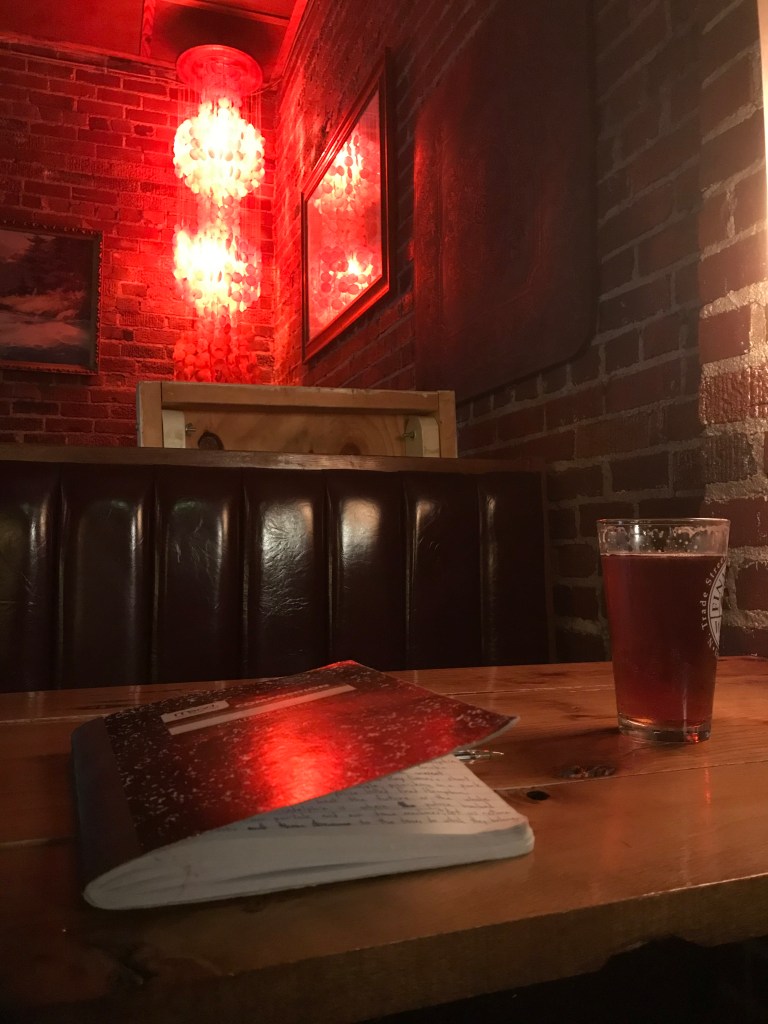
Can Orpheus be told anew? We recall to each other the character’s many forms. Jean Cocteau’s Orpheus (1950), Marcel Camus’s Black Orpheus (1959). Also Jean-Paul Sartre’s essay of that name. And let us not forget Samuel R. Delany’s Lo Lobey, the Orphic protagonist at the heart of Delany’s 1967 novel The Einstein Intersection. Hoots is a Hades’ Lounge, is it not, with its red light hanging above its corner booth? So we think as we drink, glorying finally in each other’s presence. “What would happen if our Time Traveler were to stage the scene again?” wonders the Narrator, listening alone now, seated at the same booth many months hence. With “King of the World” still fresh in our ears, members of Steely Dan singing, “No marigolds in the promised land; there’s a hole in the ground where they used to grow,” we restate the refrain of Jan Hammer Group’s “Don’t You Know.” Amid Orpheus wailing away on his flute come the words, “You’re to know that I love you. You’re to know that I care.”
Thoreau’s Demand
Thoreau demands that the good person, the ethical subject, refuse complicity with evil. In so doing, he reveals the nature of the bind in which we find ourselves: none of us able, it seems, to meet his demand. That’s why we’re here, trapped in this labyrinth of stuck desire. Rather than there, where lovers go as lovers do, and none are bound.
Love and Marriage: A Discourse
“There I was,” recalls the time traveler. “A married man, despite my vexed relationship to marriage as sacrament and institution.”
“Okay,” nods the narrator, eyebrows raised, trying to intuit from what he knows of the traveler’s past what might lie on the other side of “vexed” if that word was hyperlinked. “You’ll have to say more at some point—but go on.”
“Sarah and I had exchanged our vows seventeen years prior,” explains the traveler, “outdoors, in a state-sanctioned but otherwise nonreligious ceremony, with the blessing of friends and family.”
The traveler pauses, proceeds haltingly here in his telling, reliving again the flowers, the arbor, the sunshower afterwards. “I wasn’t seeking to marry,” he adds. “That wasn’t part of any future I’d imagined for myself in my youth.”
Narrator considers this, nods again approvingly, asks what he’d imagined in its place.
“As far as I can remember,” muses the traveler, “all I’d wanted was to write.” He smiles, picturing himself hunched over his notebooks in years past.
“But you and Sarah fell in love?” asks the narrator.
“Yes,” confirms the traveler, “no denial of that on my part. And there we were, in the final months of our Master’s program: both of us wanting to pursue PhDs in English, with hopes of earning a living, despite already mounting debt, by continuing to teach courses at the college level.”
“Fair enough,” says the narrator, elbows propped on the arms of his chair, fingers arched to form a pyramid. “But how did you get from there to the decision to marry?”
“The immediate stress in those days,” breathes the traveler, voice achieving new resolve, “was that we were drawn toward different programs. Mentors dear to us at the time advised us to go our separate ways. ‘Sarah should go to Buffalo,’ they told us. ‘Matt should go to Brown.’”
Narrator purses his lips, tries to conceive the traveler’s dilemma.
“I remember us crying afterwards upon leaving those meetings,” murmurs the traveler. “Neither of us wanted to live apart.”
Traveler looks up here in his telling, eyes glinting. “And so it happened.”
“Just like that?” inquires the narrator. Traveler nods. “Just like that,” he replies, snapping his fingers as if to illustrate. “Over dinner one evening: we agreed to marry.”
Free Jazz vs. Circuit City
The time travel narrative dredges up pain from the past. A bizarre love triangle rhymes without repeating. “The story needn’t go there,” thinks the narrator. If the machine or device is the narrative itself, then (to honor Moor Mother’s terms) let it draw us toward free jazz rather than circuit city. Let the “trance-script as time machine” be a liberation technology. Let it be a spirit-force that helps us heal.

