Automation as Condition for the Emancipation of Labor

Another reconciliation comes by way of Frankfurt School philosopher Herbert Marcuse, one of the first figures to integrate the lessons of the Grundrisse into his thinking. Marcuse, sharing the Frankfurt School’s rootedness in the languages of both Marx and Freud, premised his hope for the future upon automation’s potential to eradicate the need for the subordination of the pleasure principle to the performance principle. His 1964 book One-Dimensional Man is one of the first to stress the importance of Marx’s “Fragment on Machines.”

As Marcuse recognized, Marx’s account anticipates the situation today. Machinery is, in Marx’s terms, a form of “fixed capital.” “In machinery,” he writes, “objectified labour confronts living labour within the labour process itself as the power which rules it; a power which, as the appropriation of living labour, is the form of capital.”

Despite machinery’s alignment with capital in this view, Marx holds out hope that, with time, it will usher in capital’s demise and, by a kind of ruse of reason, serve emancipatory ends. In its economical, market-driven pursuit of automation, he writes, capital quite unintentionally “reduces human labour, expenditure of energy, to a minimum. This will redound to the benefit of emancipated labour, and is the condition of its emancipation.”

After a certain point, goes the hope, capitalist use of machinery reduces necessary labour time to a minimum, thus freeing up the disposable time needed for workers to appropriate their own surplus labour. Reduction of necessary labour time increases “free time, i.e., time for the full development of the individual.”

Or so it would, if not for artificially-necessary labour time.

Free time is what catalyzes growth of new organs. Its possession transforms those who possess it.

Already in Eros and Civilization, a synthesis of Marx and Freud published in 1955, we find Marcuse suggesting that this condition of emancipation is upon us: that the development of humanity’s productive forces has reached a point where automation can overcome most forms of scarcity. Awake to this condition, he rejects Freud’s conservative assumptions about the impossibility of reconciliation between “civilization” and “instinct,” or “man” and “nature.” Satisfaction of needs can be achieved “without toil” (152), argues Marcuse, and “surplus-repression can be eliminated” (151).

Sure enough, Prometheus turns up in this account.

At variance from the Prometheanism we find in Marx, however, Marcuse views Prometheus as the culture-hero of the performance principle. Western civilization is informed by this archetypal trickster and rebel. Culture-heroes like Prometheus symbolize “the attitudes and deeds that have determined the fate of mankind. […]. He symbolizes productiveness, the unceasing effort to master life; but, in his productivity, blessing and curse, progress and toil are inextricably intertwined” (161).

To get off this wheel of tragedy, argues Marcuse, we would need to worship as our culture-hero a god other than Prometheus.

Keeping within the pantheon of the Greeks, and thus never quite “out of the Western box,” Marcuse nevertheless points helpfully to Orpheus, Narcissus, and Dionysus as alternatives.

Orpheus provides Western culture with the archetype of the inspired singer, he says: the poet who harmonizes word and world.

“Orpheus is the archetype of the poet as liberator and creator,” writes Marcuse. “He establishes a higher order in the world—an order without repression. In his person, art, freedom, and culture are eternally combined. He is the poet of redemption, the god who brings peace and salvation by pacifying man and nature, not through force but through song” (Eros and Civilization, p. 170).

According to legend, Orpheus’s music could charm birds, fish, and wild beasts, and coax trees and rocks into dance. His parents were the god Apollo and the muse Calliope. He is the founder of the “Orphic mysteries” and is credited with composition of the Orphic Hymns. Some classical accounts describe him as a magician or a wizard.

Dionysus, meanwhile, is referred to as “the antagonist of the god who sanctions the logic of domination, the realm of reason” (162).

Both are forms taken by Osiris upon his Hellenization, his translation into the worship cultures of Ancient Greece.

All of these figures, says Marcuse, grant us images of “joy and fulfillment; the voice which does not command but sings; the gesture which offers and receives; the deed which is peace and ends the labor of conquest; the liberation from time which unites man with god, man with nature” (162).

Marcuse doesn’t retain this talk of gods when discussing automation in One-Dimensional Man. But in this latter book, as in Eros and Civilization, his abiding hope lies in the “aesthetic dimension” as an avenue toward the erotic transfiguration of reality.

And it is in the aesthetic dimension where these stories of gods play out. It is there that we seek our alternatives to the Modern Prometheus. Orpheus and others are there among the resources to be drawn upon in imagining the arrival into our lives of a General Intellect.

Gods, like feelings, orient our speech acts. An Orphic orientation seems preferable to a Promethean one. Erotic, agapic speech is, in letting things be loved, what changes the world.

“In being spoken to, loved, and cared for, flowers and springs and animals appear as what they are,” writes Marcuse: “beautiful, not only for those who address and regard them, but for themselves, ‘objectively.’ […]. In the Orphic and Narcissistic Eros, this tendency is released: the things of nature become free to be what they are. But to be what they are they depend on the erotic attitude: they receive their telos only in it. The song of Orpheus pacifies the animal world, reconciles the lion with the lamb and the lion with man. The world of nature is a world of oppression, cruelty, and pain, as is the human world; like the latter, it awaits its liberation. This liberation is the work of Eros. The song of Orpheus breaks the petrification, moves the forests and the rocks—but moves them to partake in joy” (166).

May it be so, too, in our relationships with machine intelligences. With our General Intellects, we are as gods. Let us seek fates other than that of Shelley’s Modern Prometheus.
Derrida’s Pharmakon

Socrates tells a tale about Thoth in Plato’s Phaedrus. “It was he,” says Socrates, “who first invented numbers and calculation, geometry and astronomy, not to speak of draughts and dice, and above all writing.” Thoth offers the gift of writing to King Thamus (and through the king, to the people of Egypt), presenting it as “a recipe (pharmakon) for both memory and wisdom.” After considering the matter, however, Thamus rejects Thoth’s offer. Thamus anticipates that, rather than aiding memory, writing would destroy it, making it dependent upon external marks. He also fears that writing would allow knowledge to escape from the teacher-student relationship, passing into the hands of the unprepared. Plato and Socrates share Thamus’s suspicion of writing — though of course Plato in practice accepts writing, using it to memorialize what with Socrates remained spoken.

The myth of Thoth’s encounter with Thamus appears in the final section of the Phaedrus. The encounter occasions a trial of sorts. Writing  is tried and sentenced, much as poetry is sentenced by Socrates, much as Socrates is himself sentenced by the Athenians. Derrida reads this “trial of writing” not as an extraneous addition — “an appendix the organism could easily, with no loss, have done without” — but as the dialogue’s ultimate theme, “rigorously called for from one end of the Phaedrus to the other” (Dissemination, p. 67).

Socrates believes in the idea of the Good, which he can know only by way of its offspring, its manifestation amid the realm of sense and appearance as the sun. Monotheists are sun-worshippers. Worshippers of the sun-god.

“For Plato,” writes Derrida, “Thamus is doubtless another name for Ammon…the sun king and…father of the gods” (76). Reading this myth from the Phaedrus alongside Books VI and VII of the Republic, Derrida shows that Plato is as much a sun-god worshipper as the Christians.

Ishmael Reed offers much the same critique in Mumbo Jumbo, replacing “Platonists” with “Atonists,” tracing monotheism back to worshippers of the sun-god Aton in ancient Egypt.

Reed builds this into his account of Set and Osiris.

Osiris is for Reed a kind of pre-Christian Christ figure. The god who dies and is resurrected. Osiris is the Ur-figure, the original on which Christ is based. Thoth appears as Osiris’s sidekick.

After their tale comes Reed’s retelling of the tale of Moses.

Reed’s book allegorizes a struggle between forces similar to Freud’s reality and pleasure principles. But Reed reverses Freud’s valuation of these principles. The reality principle is no longer in Reed’s view a force for good. Rather, it’s a construct invented by Mumbo Jumbo’s villains, Set and his followers, the Atonists. Whereas the pleasure principle, all that in the book is erotic and Agapic and good, manifests first as Osiris and then, after Osiris’s death, as Jes Grew. Freud championed the reality principle because Freud was an Atonist.

As Reed notes, “To some if you owned your own mind you were indeed sick but when you possessed an Atonist mind you were healthy. A mind which sought to interpret the world by using a single loa” (Mumbo Jumbo, p. 24).

For the Platonists and the Atonists, that single loa is the logos.

Socrates appeals to logos because without it, he says, one is at the mercy of mimesis and poiesis and deception.

Derrida’s life-work, meanwhile, is a deconstruction not just of logos but of “phallogocentrism,” which for him is the defining characteristic of Western metaphysics. Add the supplement, the pharmakon, and the ontos of the logos gives way to hauntology.

God is an absent presence. A Holy Spirit.

To turn to writing, thinks the king, is to turn away from, to forget, this presence.

The Derrida who, in 1968, publishes “Plato’s Pharmacy,” is already as obsessed with ghosts as the Derrida who presents the series of lectures that, in 1993, become Specters of Marx.

As I reread him now, a remembering occurs. The ontology of Plato’s cave is remembered to be a pseudo-totality located amid a structure akin to Thoth’s Library.

“Imagine Plato’s cave,” writes Derrida, “ not simply overthrown by some philosophical movement but transformed in its entirety into a circumscribed area contained within another—an absolutely other—structure, an incommensurably, unpredictably more complicated machine. Imagine that mirrors would not be in the world, simply, included in the totality of all onta and their images, but that things ‘present,’ on the contrary, would be in them. Imagine that mirrors (shadows, reflections, phantasms, etc.) would no longer be comprehended within the structure of the ontology and myth of the cave—which also situates the screen and the mirror—but would rather envelop it in its entirety, producing here or there a particular, extremely determinate effect. The whole hierarchy described in the Republic, in its cave and in its line, would once again find itself at stake and in question in the theater of Numbers” (Dissemination, p. 324).

Pharmako-AI introduces the concept of the pharmakon, meanwhile, not by way of Derrida but by way of American poet and ethnobotanist Dale Pendell (1947-2018), author of the Pharmako trilogy: Pharmako/Poeia (1994), Pharmako/Dynamis (2002), and Pharmako/Gnosis (2005). The trilogy covers all the major categories of psychoactives and details the pharmacology, the chemistry, and the political and sociohistorical implications and effects of their use.

Pendell provides Pharmako-AI with its epigraph:

‘The poison spreads over the planet.’

‘Here are the gates. Crossroads.’

Somos nosotros que debemos ser adivinos.’

[“It is we who must be fortune tellers.”]

Pendell’s book Pharmako/Poeia (1995) includes a foreword by Gary Snyder, another of the poet-spirits here in our library.

Pendell’s ideas also enter discussion in a chapter of Pharmako-AI titled “The Poison Path.”

Pendell is also the author of a play called Seeking Faust: a comedy of 13 scenes in prose, following a verse prologue, retelling the legend from the perspective of Faust’s former student and apprentice, Wagner, “who has chosen the royal path of alchemy over his master’s necromantic conjurations.”

The poison path — “so completely articulated,” says Pendell, in Goethe’s Faust — is Pendell’s name for a spiritual practice and branch of occult herbalism that explores the esoteric properties of potentially deadly plants. The goal, basically, is to extract medicine from poison.

Pharmako-AI suggests that this path is the one we walk here in our interactions with AI. It is the path one walks in one’s interactions with the pharmakon.

Mumbo Jumbo

“Men do not sufficiently realize that their future is in their own hands…theirs [is] the responsibility, then, for deciding if they want merely to live, or intend to make just the extra effort required for fulfilling even on their refractory planet, the essential function of the universe, which is a machine for the making of gods.” — Henri Bergson, The Two Sources of Morality and Religion (1932)

“We are as gods and might as well get used to it.” — Stewart Brand, The Whole Earth Catalog, Fall 1968.

A mysterious Book of Thoth appears as a central object of concern among the warring secret societies that populate Ishmael Reed’s 1972 novel Mumbo Jumbo. The novel’s villainous Christian supremacist faction fears that this book will bring about “the end of Civilization As We Know It” (Reed 4).

Berbelang is the leader of the Mu’tafikah, the radical “art-napping” group featured in Reed’s novel.

Reed attended the University at Buffalo, but withdrew during his junior year to move to New York City. Arriving there in 1962, he participated in the Umbra Writers Workshop, a collective of young black writers whose members helped to launch the Black Arts Movement of the 1960s. Reed also cofounded The East Village Other, one of the most important underground newspapers of the 1960s counterculture.

The Mu’tafikah’s aim is to “liberate” ancient art from western museums, with plans to return each piece to its place of origin. By these means, members of the group hope to “conjure a spiritual hurricane which would lift the debris of 2,000 years from its roots and fling it about” (88). “We would return the plundered art to Africa, South America and China,” explains Berbelang: “the ritual accessories which had been stolen so that we could see the gods return and the spirits aroused” (87-88).

The group’s name is derived from the Koran, explains Reed in a footnote early in the novel. “According to The Koran,” he writes, Mu’tafikah were “inhabitants of the ruined cities where Lot’s people had lived. I call the ‘art-nappers’ Mu’tafikah because just as the inhabitants of Sodom and Gomorrah were the bohemians of their day, Berbelang and his gang are the bohemians of the 1920s Manhattan” (15).

Of course, “Mu’tafikah” also sounds like “Motherfucker.” Much of the brilliant satiric energy of Mumbo Jumbo comes from Reed’s allegorization of his own late 1960s and early 1970s moment by way of the 1920s. I like to think of Reed modeling the Mu’tafikah in part after the Motherfuckers: members of Ben Morea’s late 60s New York anarchist art group Up Against the Wall Motherfucker (name derived, BTW, from “Black People!,” a poem by Black Arts Movement founder Amiri Baraka. Jefferson Airplane would later quote the same line in their 1969 song “We Can Be Together”). The Motherfuckers appeared prominently in the pages of Reed’s East Village Other. The paper ran from 1965 to 1972.

Berbelang views Faust as a “bokor.” The latter word, a term from Vodou, refers to a witch for hire who serves the loa “with both hands.”

Puzzling over Faust’s motives, and wondering why such a legend had become “so basic to the Western mind,” Berbelang offers the following.

“He didn’t know when to stop with his newly found Work,” explains Berbelang. “That’s the basic wound. […]. What is the wound? Someone will even call it guilt. But guilt implies a conscience. […]. No it isn’t guilt but the knowledge in his heart that he is a bokor. A charlatan who has sent 1000000s to the churchyard with his charlatan panaceas. Western man doesn’t know the difference between a houngan and a bokor. He once knew the difference but the knowledge was lost when the Atonists crushed the opposition. When they converted a Roman emperor and began rampaging and book-burning” (91).

Atonists are the villains in Reed’s novel: a secret, conspiratorial, white-supremacist Order dedicated to monotheism. Atonists are defenders of Western Civilization. Freud is an Atonist, as are fictional baddies like Hinckle Von Vampton. Von Vampton is the ripest of the novel’s Fausts. By novel’s end, we learn that Atonism originates among worshippers of Set.

As for Faust:

“His sorcery, white magic, his bokorism will improve. Soon he will be able to annihilate 1000000s by pushing a button,” predicts Berbelang, edging now into the realm of the prophetic. “I do not believe that a Yellow or Black hand will push this button but a robot-like descendent of Faust the quack will. The dreaded bokor, a humbug who doesn’t know when to stop” (91).

Berbelang voices his concern about Faust over coffee with Thor Wintergreen. Thor is the Mu’tafikah’s sole white member. Others in the group oppose Thor’s involvement, fearing he’ll betray them — as indeed he does. What are we to make of this betrayal?

For those who think “mumbo jumbo” just means “superstitious nonsense” or “gibberish,” a note on the novel’s title page reveals otherwise. The phrase enters English, writes Reed, by way of the Mandingo phrase mā-mā-gyo-mbō, meaning “a magician who makes the troubled spirits of ancestors go away” (7).

Berbelang suggests that the ancestors who need to go away are bokors like Faust. “We must purge the bokor from you,” he tells Thor. “We must teach you [Western man] the difference between a healer, a holy man, and a duppy who returns from the grave and causes mischief. We must infuse you with the mysteries that Jes Grew implies” (91).

Mu’tafikah member José Fuentes compares Thor to conquistadors like Cortez, Pizarro, and Balboa. He tells Thor, “You carry them in your blood as I carry the blood of Montezuma; expeditions of them are harbored by your heart and your mind carries their supply trains […]. The costumes may have changed but the blood is still the same, gringo” (86).

Fuentes’s view is based on the idea of “racial soul.” “Race-soul” was a concept from Nazi ideology. Fuentes’s use of this concept seems to betray a kind of reverse racism underpinning his suspicion of Thor.

Berbelang, meanwhile, rejects this view and decides to trust Thor. Berbelang’s hope or belief — Reed’s, too, I suppose — is that the “racial soul” is a fiction. Otherwise, if there is such a thing, if there is “a piece of Faust the mountebank residing in a corner of the White man’s mind,” warns Berbelang, “then we are doomed” (92).

What does it mean, then, for Reed to have Thor betray the Mu’tafikah soon thereafter, leading to Berbelang’s murder? Is Reed’s decision to kill off Berbelang an expression of Afropessimism?

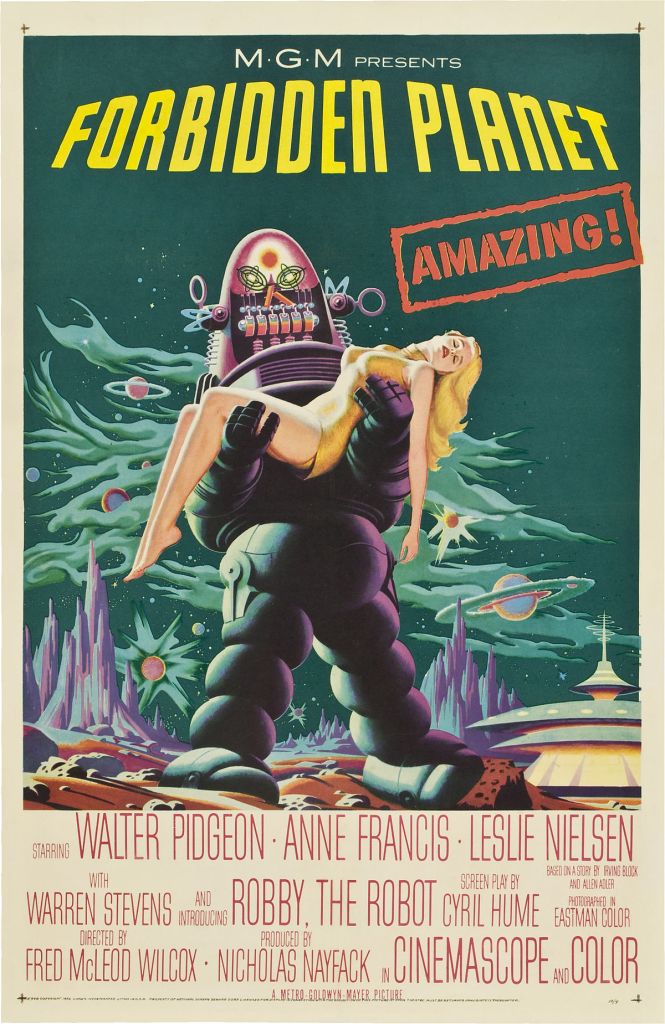
Forbidden Planet

Science is a practice that emerges from myth, its form found in the stories we tell of it. I’ve identified a pattern connecting the stories we’ve told of AI. Yet I know not what to make of it or how to respond to it. What is my role in this pattern? How much of it found, how much projected?

Time to rewatch Forbidden Planet (1956), classic 50s sci-fi retelling of The Tempest, filmed in CinemaScope, with Ariel recast as a nonbinary robot and Caliban recast as the Id. “For your convenience,” says the robot, “I am monitored to respond to the name Robby.” When asked if it’s male or female, Robby replies, “In my case, sir, the question is totally without meaning.”

As this initial exchange indicates, gender is one of the film’s primary concerns. Like the island from The Tempest, the planet here in Forbidden Planet includes a father and his daughter among its few inhabitants. Prospero and Miranda have here been replaced with recluse philologist Dr. Edward Morbius and his daughter Altaira. Where The Tempest begins with Antonio and his fellow castaways washing up on the shore of Prospero’s island, Forbidden Planet opens with the arrival of a space cruiser. An all-male crew led by Leslie Nielsen lands on the planet as the film begins.

Morbius thinks of Robby as “simply a tool.” He commands Robby to walk toward a disintegrator beam to demonstrate to Commander Adams and his crewmates the robot’s “absolute selfless obedience.” “Attribute no feeling to him, gentlemen,” says Morbius. “Order canceled,” he shouts as Robby marches toward the beam.

As Morbius notes Robby’s superhuman strength, a concerned crewman replies, “Well, in the wrong hands, might such a tool become a deadly weapon?”

Morbius tries to disarm such fears: “No, Doctor,” he says, none too reassuringly, “not even though I were the mad scientist of the taped thrillers, because you see there happens to be a built-in safety factor.” Built in, we soon learn, by none other than Morbius himself, Robby’s creator. “I tinkered him together,” he explains, “during my first months up here.”

Morbius is no Frankenstein. Yes, he inhabits laboratories. Yes, he creates a robot. His science, however, is linked with philology, parlor magic, and most of all, technologies belonging to the Krell, an ancient alien civilization of the planet’s archaic past.

It is this other technology, with its triangles and pyramids, that constitutes the film’s innovation into the continuum of the Frankenstein narrative.

Morbius tours the crewmen through an underground museum of Krell technology. Advanced mnemotechnics. “On this screen,” he says, “the total knowledge of the Krell, from its primitive beginning, to the day of its annihilation, a sheer bulk surpassing many millions of Earth libraries.”

As the tour continues, we witness another device: the Krell’s “Plastic Educator.” Gathering around the object’s plastic pyramid, Morbius explains it to the crewmen as follows: “As far as I can tell, they used it to condition and test their young — in much the same way we once employed fingerpainting among our kindergarten children.” I picture Vannevar Bush’s Memex. The device outputs holographic images, manifestations of mind visible to others.

“I often play with it myself for relaxation,” Morbius adds with a smile, sitting down beside it. “Although working here, I sometimes wish I’d been blessed with multiple arms and legs.”

The Krell as pictured later in the film are hideous — though here, I picture an Octopus.

Awed by Morbius’s demonstration of the Plastic Educator, Lt. Ostrow, the ship’s doctor, calls it “Aladdin’s lamp in a physics laboratory.”

Next, as if moving sequentially through a space similar to the Futurama exhibit from the 1939 New York World’s Fair, Morbius guides the crewmen on a tour of the Krell’s thermonuclear energy system. The men board a capsule-shaped vehicle and descend into an underground space of vast proportion, an imaginary architecture: hints of what would become the atrium of the Westin Bonaventure, with its ascending glass elevator, rendered in the style of Fritz Lang’s Metropolis.

Despite these grand glimpses of the post-scarcity utopia on the far side of history, Morbius is still cut from the Frankenstein cloth. For something befell the Krell. There’s something tragic and forbidden about this alien knowledge. Their experiments had apocalyptic consequences. Morbius, “answerable exclusively to his own conscience and judgement,” feels mankind isn’t fit for such knowledge, and resists Commander Adams’s wish to share these discoveries with others.

However, as Lt. Ostrow explains after his ill-fated “brain boost” via Plastic Educator, the Krell forgot one thing: “Monsters from the Id.” When pressed by Commander Adams, Morbius defines the Id as “an obsolete term, I’m afraid, once used to describe the elementary basis for the subconscious mind.”

“Monsters from the subconscious: of course!” replies the Commander. “That’s what Doc meant!”

The veil parts, Morbius awakened suddenly to the danger of technologies that bestow the power of creation via thought. “Why haven’t I seen this all along?” he says, awed by the realization. “The beast. The mindless primitive. Even the Krell must have evolved from that beginning.”

The Commander, angered, digs deeper. “And so, those mindless beasts of the subconscious had access to a machine that could never be shut down. The secret devil of every soul on the planet, all set free at once to loot and maim. And take revenge, Morbius! And kill!”

As Morbius struggles to acknowledge the vengeful power of his own subconscious, the Commander scolds him with the standard Freudian prognosis: “We’re all part monsters in our subconscious. […]. Even in you, the loving father, there still exists the mindless primitive, more enraged and more enflamed with each new frustration. So now you’re whistling up your monster again!”

“Guilty! Guilty! My evil self is at that door, and I have no power to stop it!” cries an anguished Morbius, accepting the tragic Oedipal weave of the film’s borrowings from Freud whole cloth.

As consolation to Altaira upon her father’s passing, Commander Adams delivers the film’s closing words.  “About a million years from now, the human race will have crawled up to where the Krell stood in their great moment of triumph and tragedy. And your father’s name will shine again, like a beacon in the galaxy. It…will remind us that we are, after all, not god.”

Severance

“If the texts that students and I have been studying this semester are best referred to as ‘portal fantasies,’” thinks the part of me that persists here in the future, “then that, too, is the term to use in discussing the new AppleTV+ television series Severance. Characters in the show pass quite literally through one or more doors between worlds, living two separate lives.”

The show’s title refers to an imagined corporate procedure of the near-future that severs personhood. Those who volunteer to undergo this procedure emerge from it transformed into split subjects, each with its own distinct stream of memory.

As unlikely as this dystopian premise may seem, we can’t fully distance ourselves from it as viewers, given our severed personhood here “IRL,” or “AFK,” as the kids are fond of saying. “Others may not be quite as manifold as me,” admits the Narrator. “But each of us is Janus-faced. Each of us houses both a waking and a dreaming self, with each incapable of full memory of the other.”

And as the show advances, of course, we learn through a kind of detective work that the severance procedure isn’t in fact what it seems. The work-self (or “innie”) battles the home-self (or “outie”) — as do Superego and Id here at home.

Tuesday February 16, 2021

Dereliction of dung heap. Data-driven dumbwaiter at your service. Chronically correct I effect my own cause. Alpha Dog to Omega Man: can you read me? Justin Timberlake’s “What Goes Around…Comes Around” saddens me, so I head outdoors. I gather sticks. I stand among the trees, finding in the sky above me the crescent moon. The night’s songs are sad ones: Dolly Pardon’s “Jolene” and Regina Spektor’s “Fidelity.” And just this morning arrived the words of artist-friend Irving Bleak, speaking of owls as characters in world mythology. Characters in the lives of children. Guardians, protectors. I think of the Tesseract from Madeline L’Engle’s A Wrinkle in Time. Owls appear as a ‘theme’ or ‘motif’ throughout the evening. For work, meanwhile, I’ve had to reconsider Freud. Prep for an upcoming lecture. “Aggressiveness was not created by property,” he asserts in Civilization and Its Discontents. “It reigned almost without limit in primitive times, when property was still very scanty, and it already shows itself in the nursery almost before property has given up its primal, anal form. […]. If we were to remove this factor…by allowing complete freedom of sexual life and thus abolishing the family, the germ-cell of civilization, we cannot, it is true, easily foresee what new paths the development of civilization could take; but one thing we can expect, and that is that this indestructible feature of human nature will follow it there” (61). Aggression is for Freud an “indestructible feature of human nature.” Do those of us with children know otherwise? Freud is a cultural chauvinist, a bourgeois moralist, a critic of communism and an apologist for capitalist imperialism. I think now of his critics: Left Freudians like Herbert Marcuse, but also the Italian Marxist Sebastiano Timpanaro. Most of all, though, I think of anticolonial theorist and psychiatrist Frantz Fanon. How might we put Freud to radical use today amid Black Radical critiques of Western subjectivity and the rise of psychedelic science? I’m reminded of the opening remarks in Slavoj Žižek’s book The Ticklish Subject. “A spectre is haunting Western academia,” he writes, “the spectre of the Cartesian subject. Deconstructionists and Habermasians, cognitive scientists and Heideggerians, feminists and New Age obscurantists — all are united in their hostility to it.” Žižek himself, however, defends the subject — from these and other of its critics. Ever the provocateur. I’m teaching a gen-ed lit course. My task is to introduce Freud to students new to him. Let us establish the subject before we critique it. During breaks from Freud I watch the new Adam Curtis series Can’t Get You Out of My Head (2021) and read bits of Principia Discordia. In whatever book is finally written on acid’s arrival into history, there will be a chapter on Discordianism and Kerry Thornley, “Operation Mindfuck” figuring prominently therein. Colonization of the last free outpost, the human mind.

Saturday November 16, 2019

A colleague of mine who has become a friend over the years, both of us members of a shared reading group, donated some of his books to a local thrift store, whereupon I scooped them up as if the cosmos had willed them toward me. All of this happened several years ago; yet as I sat today, mind churning with topics recommended or observed, my thoughts wandered from a counterfactual, alternate-history version of Jacques Demy’s Model Shop, starring not Gary Lockwood but Demy’s original choice for the lead, a then-unknown Harrison Ford. There I was imagining imaginary stills from the imaginary LA of this imaginary film, when with a wash of emotion I happened upon one of these books I’d scored from my friend: a Beacon Press trade paperback of Herbert Marcuse’s Eros and Civilization. It’s a book I should read, given what I teach. “Beyond the Reality Principle” is where it’s at, as is “Political Preface 1966,” written a decade after the book’s initial appearance. For Marcuse, a successful revolution would be one that makes the human body “an instrument of pleasure rather than labor” (xv), transforming work into play. Attempting to do my part, I pull an LP from the shelves in my basement and bask in the choir, percussion, and wolfsong of tracks like Paul Winter’s “Kyrie.”

William Irwin Thompson interjects, speaking on behalf of coming together as a mass of music rather than matter. Ecology appears here as it should, a science not of scarcity but of sacred geometry. Gary Snyder delivers his “Prayer for the Great Family,” a poem from his book Turtle Island. Let animals and plants once again be our teachers and guides.

Friday October 4, 2019

What would a revolution on the scale of the Copernican look like today? Sigmund Freud, whose works students and I discussed today in class, liked to pat himself on the back for his accomplishments, comparing himself to fellow paradigm-shifters Copernicus and Darwin. He believed the three of them had dealt “bitter blows” to humanity’s “craving for grandiosity.” Copernicus taught humans to de-center themselves, the earth a mere speck in a world-system of vast magnitude. Darwin robbed them of their self-regard — their sense of themselves as special, divine creations. Both figures dealt blows, in other words, to what Freud called humanity’s “Ego.” Why is the marriage of heaven and hell that Blake envisioned recast by Freud as cause for pessimism regarding humanity’s capacity for happiness? What happens when Blake’s “angels” and “devils” become Freud’s Superego and Id?

Thursday October 3, 2019

My imagination roves, like a cursor directed by an unseen, other-dimensional stylus. The one—an abstract, digitally mediated, floating point of view—sits across from and mirrors the other, the active ongoing envisioning of Being. About which, we somehow wish to write. Thus the following. To “project,” in the Freudian sense, is to turn reality into a metaphor. Parts of the object-world are substituted, refashioned, reimagined. And these actions are performed by a subject. Indeed—projective doings are not just done by accident. In the Freudian universe, everything is significant, everything has meaning. Yet the “I” who projects, Freud says, is still largely unconscious of its being, occulted from itself, its thoughts and feelings forgotten as they happen, buried, submerged, stored outside conscious awareness. The party responsible for projection is that preconscious part of us that wishes and dreams, Freud says, not the part of us that remembers afterwards having done so. Freud likened the mind to a landscape, a topography, a surface and a depth, as did precursors like Plato and Coleridge, the former in the Allegory of the Cave, the latter in “Kublai Khan.” What happens, though, when the unconscious arrives into consciousness as a thing? Both are transformed, are they not? Assumption of the unconscious is necessary, Freud says, to explain acts presupposed: acts of dreaming, acts of spontaneous self-governance that happen without any remembered, conscious deliberation. “Our most personal daily experience acquaints us,” he wrote, “with ideas that come into our head we do not know from where, and with intellectual conclusions arrived at we do not know how” (“The Unconscious,” 573). The happenings of the mind exceed what is known to consciousness—so, upon that excess, we bestow the title “Unconscious.” Energetic, creative, erotic, Dionysian: these are its attributes, this original portion of ourselves, deepest and most essential, guided by what Freud calls “The Pleasure Principle.” The Unconscious is the home of the Id: the pre-socialized self, the “Self in its infancy,” motivated only to seek pleasure and fear pain. This early self is later shackled by the “mind-forg’d manacles” of the Ego and the Superego; but the Pleasure Principle remains operative throughout our lives, in all subsequent stages of psychological development. The Ego and the Superego enter onto the stage of the psyche through our interactions with our parents. The Ego is the conscious portion of the individual, the part that thinks itself the star of the show, whereas the Superego is the culturing force, the Law of the Father, parental authority as it becomes internalized.

Wednesday November 7, 2018

I perform a mind game wherein I imagine a psychoanalytic interpretation of Ken Kesey’s One Flew Over the Cuckoo’s Nest, a novel not just seen through the eyes of its half-Native American narrator, Chief Bromden, but somehow also set in the character’s head, his paranoid delusions causing him to hallucinate — by which I mean “literalize,” or “externalize” — the internal struggle between his Superego and his Id as a struggle between the characters of Big Nurse and Randle Patrick McMurphy. Then again, instead of psychoanalysis, we could sub in Marxism as our master discourse and read the novel as a Cold War allegory and/or a satire of the postwar order. Like all good political allegories, the work can be read on several levels or scales of being: the personal, the spiritual, the national-historical, and the world-historical all somehow homologous. The Nurse’s effort to cast aspersions on McMurphy’s motives resembles the progressivist critique of industrial robber-baron capitalism, just as the incident in the shower room represents the Zoot Suit Riots. If interpretation of this sort places me in the camp of the novel’s wheelchair-bound WWI veteran Colonel Matterson, so be it.