“Do Things” (For Tess)

Frankie gravitates toward particular books of poetry, pulling from among a bookcase of several hundred the same ones these last few days: Joan Retallack’s How to Do Things With Words and a Penguin Classics reprint of the first edition of Walt Whitman’s Leaves of Grass. What can I say — the kid’s got great taste. She hands them to me, and the look in her eyes suggests I should read them, so I do. When I’ve taught Whitman in the past, I’ve used a different edition. Perhaps I should change it up. Celebrate that opening stanza of “Song of Myself” — but question its atomic physics. Though it’s as if Whitman knows of what becomes of and follows from his Manhattan and its projection in the next century. Yet he rejects it as mere talk:

“I have heard what the talkers were talking…the talk of the beginning and the end,

But I do not talk of the beginning or the end.

There was never any more inception than there is now,

Nor any more youth or age than there is now;

And will never be any more perfection than there is now,

Nor any more heaven or hell than there is now.”

My imprisoned cousin and I have begun an email correspondence. It is to him that I write the following:

Does write make right?

“Damned sure it does! / so one hopes”

seems inappropriate as a response.

So what is?

Gyres, Vortices

Adjusting to the work regime, hours clocked responding to emails, the subject muses upon what it means to be “COLLEGE RULED,” the phrase atop his notebook. One would rather dwell among gyres, vortices / brightly drawn in chalk. Gazing into one, I dream of fugitive study: texts read and discussed in the secret gatherings of an Undercommons. I read poems and hear them as they speak to me, their voices flitting about, “quick-winged / with women’s faces” (4), as in poet Alice Oswald’s Nobody. “It’s not all about you, Dad,” they say with a touch of vocal-fry (as do the rich college girls in Mike White’s HBO miniseries The White Lotus). “It’s time to recenter the narrative.”

Precipitations

More must be said, too, of Devin’s book, Precipitations: Contemporary American Poetry as Occult Practice. ‘Tis a book of criticism prepared by Devin based on a dissertation he wrote under the supervision of Robert von Hallberg and Saree Makdisi at the University of Chicago. I am grateful Devin wrote it — for with its overview of prior acts of trance-scription by the likes of poets Robert Duncan, James Merrill, and H.D. comes the potential to retell the backstory of what I’ve done. It sits with me here as I write.

Interrupted Forms

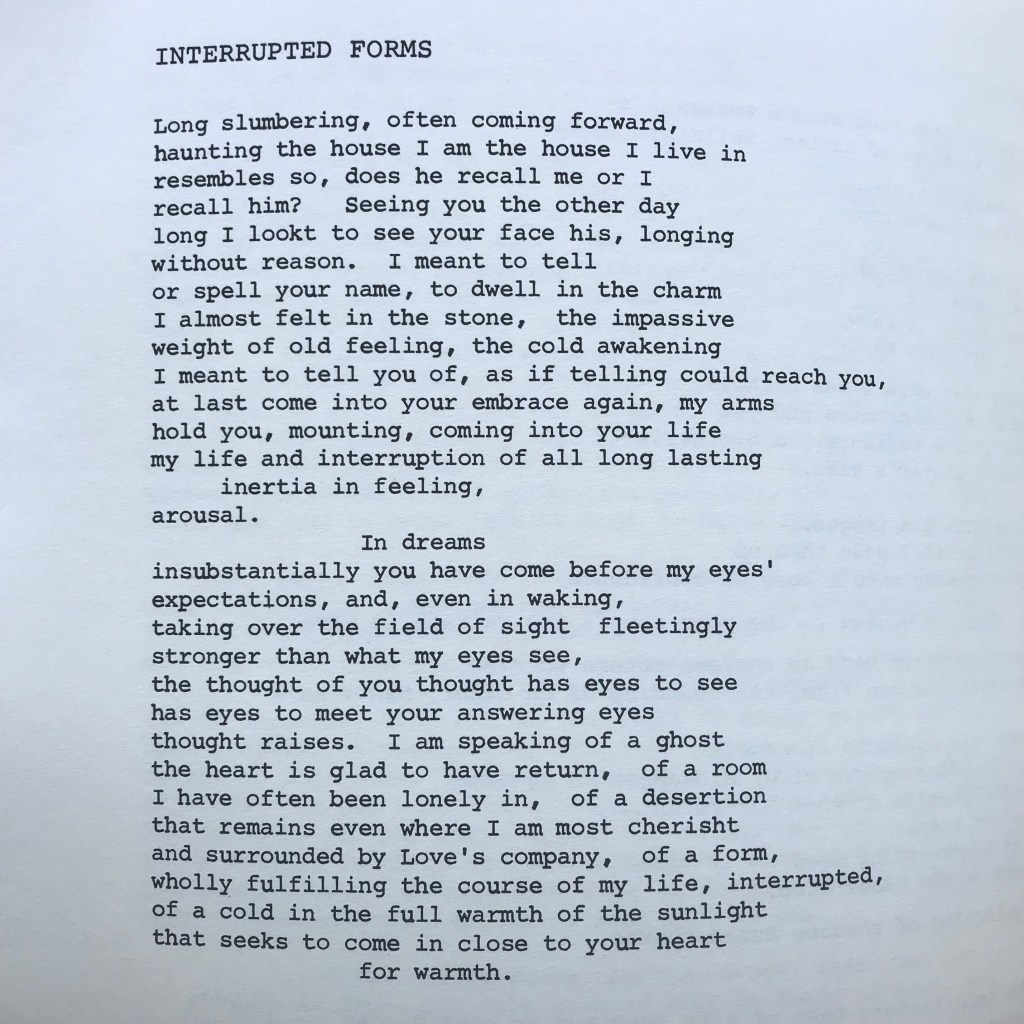
Devin’s essay “The Needs of Ghosts” turns upon “Interrupted Forms,” a poem by Robert Duncan, included at the start of the latter’s Poems from the Margins of Thom Gunn’s “Moly.”

Given its dedication to one who is both there and not there, ‘tis a poem that is both desirous and recollective simultaneously.

Into the situation of Duncan’s poem, I project this character of mine, the Gay Wizard — the ghost who haunts “The House on Shady Blvd.”

Of him, or of a ghost of similar make, Duncan writes as follows:

Long slumbering, often coming forward,

haunting the house I am the house I live in

resembles so, does he recall me or I

recall him?

Wanting today to alter the condition set upon me by the ghosting of me by others, I sing the poem to those I love. I sing it to you, dear reader, “as if telling could reach you,” hoping against hope you have ears to hear.

The Needs of Ghosts

There’s more to it, though; this vein of coincidence runs deep.

For Devin, too, has a place in this story.

I reach out to my colleague C., a poet-friend who studied under Dillon, and ask if he knows, too, of Devin. C. confirms that Dillon and Devin are indeed father and son.

Devin wrote an essay called “The Needs of Ghosts: On Poems from the Margins of Thom Gunn’s ‘Moly.’” The start of that title hits home, of course — startles me, lands with me now as I recollect my time on Shady Blvd. Having taught poems from Moly in my course on Hippie Modernism, I relish the opportunity to read Devin’s commentary. Not yet having familiarized myself with the other text about which he writes, however, I set to work doing so. I track down and read Robert Duncan’s Poems from the Margins of Thom Gunn’s “Moly,” a serial poem that Duncan published as a pamphlet in 1972, later reprinted in his 1984 collection Ground Work: Before the War.

For Duncan, writes Devin, crafting poems in the margins of Gunn’s book was a form of collaboration. The collaborator, he explains, is for Duncan “an inspiration from outside.”

And like that, it happens. The idea grows legs as I read. For I, too, wish to craft a text in the margins of another’s book. Mine will be a story crafted, in a sense, in the margins of Devin’s.

The Johnstons

I admire a small stone and a pair of clam shells: mementos from last weekend’s party on the beach. In thinking about bathing the stone in salt water, an occult practice suggested in Aidan Wachter’s book Weaving Fate, I’m reminded of Devin Johnston’s Precipitations: Contemporary American Poetry as Occult Practice (Wesleyan University Press, 2002), a book I read last fall. Although most of Devin’s books are collections of poetry, the above book is a work of criticism — as were the books on Irish poetry published by Devin’s father Dillon Johnston, who Devin thanks in the above book’s acknowledgements.

I introduce each figure here, as each plays a part in my tale.

Dillon taught in my department, his time overlapping that of his more famous colleague, the poet, memoirist, and civil rights activist Maya Angelou. Dillon is the one who founded the press here at my university. His name now graces our reading series.

And oddly enough, Dillon lived for a time here on Shady Blvd, this street about which I’ve been writing — his home Mitch Easter’s home, two doors down from my own. He settled there in the wake of a divorce, and stayed there for several years.

Indeed, in all respects, he seems like an interesting character — someone I would have liked to have known. By the time of my own tenancy on Shady, however, Dillon had moved on to Wash U., where he trained several of my friends and colleagues. Our times thus never aligned in our respective homes — though I suspect Dillon’s stint overlapped that of the Gay Wizard.

For hyperstition’s sake, let us assume the two to have been friends and neighbors. The story of their friendship is one I venture to tell in what follows.

Time-Travel Literature and the Joy of the Eternal Now

Time travel turns up in the day’s bouquet of signage. Tiana Clark tells of “books by Black authors / about joy and pleasure and time travel.” Not just books that tell of pain, like the pain of “temporal displacement.” Rasheedah Phillips’s essay “Black Timescapes, Time Travel + Temporal Displacement” is one I hope to share with students in my course “Rabbit Holes, Time Machines, and Doors in the Wall.” We could also watch Phillips’s short film Recurrence Plot: The Family Circle. “Time feels layered in Afrodiasporan traditions,” writes Phillips. “The past is always layered over the present moment — our ancestors reside with and within us, even if on a different temporal plane / scale.”

Gratitude

for all who move

and all that is still

on this world that spins

for plants that grow up poles

tendrils running

skyward through metal

silhouettes of birds

for the wow of each day

last night’s full moon in Aquarius

genres that allow us to receive our fellow beings.

Gratitude, too,

to the goldenrod

and the Queen Anne’s lace

and the wind in the trees.

Gratitude to all who care for the garden

and report of its flourishing.

Gratitude to the cosmos,

the great human and nonhuman multitude,

manifold persons and beings

gathered here

aboard Spaceship Earth

and Beyond.

Venice Upon Oyster Bay

‘Tis suburbia, of a more intense sort than any other of the various elsewheres I’ve lived. Yield signs, flags everywhere. But also gardens, hydrangeas, bunnies. And some of the houses are quite lovely. Did I mention the bounce houses? Sarah and I counted no fewer than five such structures within a one-block radius of my sister’s house this afternoon as we returned from lunch. To live this way is to affirm castles on canals in some uprooted, replanted Venice Upon Oyster Bay. Despite reprehensible “Back the Blue” stickers on the backs of pickups and other bones one might pick with the place, why bother? Others have picked them clean, them bones, yet there they remain whether we attend to them or not. As do the seagulls, the waves, the motorboats. A cool breeze tickles behind my ear and down my neck. The wonder of a quiet moment. Thumbing the pages of Frank O’Hara’s collected poems, I happen upon “Autobiographia Literaria.” The poem reminds me of my own beginning, early stanzas equal to my own early sorrow. But with the affirmation of its final stanza, the poem arrives and I arise transformed, accepting both the good and the bad with equanimity.