Leviathan

The Book of Job ends with God’s description of Leviathan. George Dyson begins his book Darwin Among the Machines with the Leviathan of Thomas Hobbes (1588-1679), the English philosopher whose famous 1651 book Leviathan established the foundation for most modern Western political philosophy.

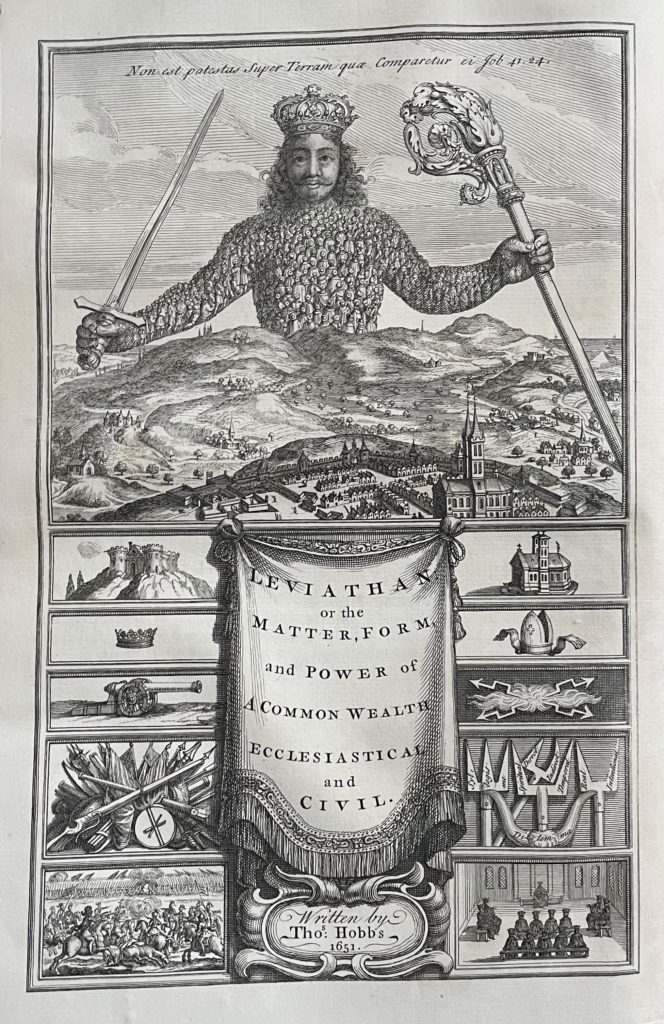
Leviathan’s frontispiece features an etching by a Parisian illustrator named Abraham Bosse. A giant crowned figure towers over the earth clutching a sword and a crosier. The figure’s torso and arms are composed of several hundred people. All face inwards. A quote from the Book of Job runs in Latin along the top of the etching: “Non est potestas Super Terram quae Comparetur ei” (“There is no power on earth to be compared to him”).” (Although the passage is listed on the frontispiece as Job 41:24, in modern English translations of the Bible, it would be Job 41:33.)

The name “Leviathan” is derived from the Hebrew word for “sea monster.” A creature by that name appears in the Book of Psalms, the Book of Isaiah, and the Book of Job in the Old Testament. It also appears in apocrypha like the Book of Enoch. See Psalms 74 & 104, Isaiah 27, and Job 41:1-8.

Hobbes proposes that the natural state of humanity is anarchy — a veritable “war of all against all,” he says — where force rules and the strong dominate the weak. “Leviathan” serves as a metaphor for an ideal government erected in opposition to this state — one where a supreme sovereign exercises authority to guarantee security for the members of a commonwealth.

“Hobbes’s initial discussion of Leviathan relates to our course theme,” explains Caius, “since he likens it to an ‘Artificial Man.’”

Hobbes’s metaphor is a classic one: the metaphor of the “Political Body” or “body politic.” The “body politic” is a polity — such as a city, realm, or state — considered metaphorically as a physical body. This image originates in ancient Greek philosophy, and the term is derived from the Medieval Latin “corpus politicum.”

When Hobbes reimagines the body politic as an “Artificial Man,” he means “artificial” in the sense that humans have generated it through an act of artifice. Leviathan is a thing we’ve crafted in imitation of the kinds of organic bodies found in nature. More precisely, it’s modeled after the greatest of nature’s creations: i.e., the human form.

Indeed, Hobbes seems to have in mind here a kind of Automaton.“For seeing life is but a motion of Limbs,” he notes in the book’s intro, “why may we not say that all Automata (Engines that move themselves by springs and wheeles as doth a watch) have an artificiall life?” (9).

“What might Hobbes have had in mind with this reference to Automata?” asks Caius. “What kinds of Automata existed in 1651?”

An automaton, he reminds students, is a self-operating machine. Cuckoo clocks would be one example.

The oldest known automata were sacred statues of ancient Egypt and ancient Greece. During the early modern period, these legendary statues were said to possess the magical ability to answer questions put to them.

Greek mythology includes many examples of automata: Hephaestus created automata for his workshop; Talos was an artificial man made of bronze; Aristotle claims that Daedalus used quicksilver to make his wooden statue of Aphrodite move. There was also the famous Antikythera mechanism, the first known analogue computer.

The Renaissance witnessed a revival of interest in automata. Hydraulic and pneumatic automata were created for gardens. The French philosopher Rene Descartes, a contemporary of Hobbes, suggested that the bodies of animals are nothing more than complex machines. Mechanical toys also became objects of interest during this period.

The Mechanical Turk wasn’t constructed until 1770.

Caius and his students bring ChatGPT into the conversation. Students break into groups to devise prompts together. They then supply these to ChatGPT and discuss the results. Caius frames the exercise as a way of illustrating the idea of “collective” or “social” or “group” intelligence, also known as the “wisdom of the crowd,” i.e., the collective opinion of a diverse group of individuals, as opposed to that of a single expert. The idea is that the aggregate that emerges from collaboration or group effort amounts to more than the sum of its parts.

God Human Animal Machine

Wired columnist Meghan O’Gieblyn discusses Norbert Wiener’s God and Golem, Inc. in her 2021 book God Human Animal Machine, suggesting that the god humans are creating with AI is a god “we’ve chosen to raise…from the dead”: “the God of Calvin and Luther” (O’Gieblyn 212).

“Reminds me of AM, the AI god from Harlan Ellison’s ‘I Have No Mouth, and I Must Scream,’” thinks Caius. AM resembles the god that allows Satan to afflict Job in the Old Testament. And indeed, as O’Gieblyn attests, John Calvin adored the Book of Job. “He once gave 159 consecutive sermons on the book,” she writes, “preaching every day for a period of six months — a paean to God’s absolute sovereignty” (197).

She cites “Pedro Domingos, one of the leading experts in machine learning, who has argued that these algorithms will inevitably evolve into a unified system of perfect understanding — a kind of oracle that we can consult about virtually anything” (211-212). See Domingos’s book The Master Algorithm.

The main thing, for O’Gieblyn, is the disenchantment/reenchantment debate, which she comes to via Max Weber. In this debate, she aligns not with Heidegger, but with his student Hannah Arendt. Domingos dismisses fears about algorithmic determinism, she says, “by appealing to our enchanted past” (212).

Amid this enchanted past lies the figure of the Golem.

“Who are these rabbis who told tales of golems — and in some accounts, operated golems themselves?” wonders Caius.

The entry on the Golem in Man, Myth, and Magic tracks the story back to “the circle of Jewish mystics of the 12th-13th centuries known as the ‘Hasidim of Germany.’” The idea is transmitted through texts like the Sefer Yetzirah (“The Book of Creation”) and the Cabala Mineralis. Tales tell of golems built in later centuries, too, by figures like Rabbi Elijah of Chelm (c. 1520-1583) and Rabbi Loew of Prague (c. 1524-1609).

The myth of the golem turns up in O’Gieblyn’s book during her discussion of a 2004 book by German theologian Anne Foerst called God in the Machine.

“At one point in her book,” writes O’Gieblyn, “Foerst relays an anecdote she heard at MIT […]. The story goes back to the 1960s, when the AI Lab was overseen by the famous roboticist Marvin Minsky, a period now considered the ‘cradle of AI.’ One day two graduate students, Gerry Sussman and Joel Moses, were chatting during a break with a handful of other students. Someone mentioned offhandedly that the first big computer which had been constructed in Israel, had been called Golem. This led to a general discussion of the golem stories, and Sussman proceeded to tell his colleagues that he was a descendent of Rabbi Löw, and at his bar mitzvah his grandfather had taken him aside and told him the rhyme that would awaken the golem at the end of time. At this, Moses, awestruck, revealed that he too was a descendent of Rabbi Löw and had also been given the magical incantation at his bar mitzvah by his grandfather. The two men agreed to write out the incantation separately on pieces of paper, and when they showed them to each other, the formula — despite being passed down for centuries as a purely oral tradition — was identical” (God Human Animal Machine, p. 105).

Curiosity piqued by all of this, but especially by the mention of Israel’s decision to call one of its first computers “GOLEM,” Caius resolves to dig deeper. He soon learns that the computer’s name was chosen by none other than Walter Benjamin’s dear friend (indeed, the one who, after Benjamin’s suicide, inherits the latter’s print of Paul Klee’s Angelus Novus): the famous scholar of Jewish mysticism, Gershom Scholem.

When Scholem heard that the Weizmann Institute at Rehovoth in Israel had completed the building of a new computer, he told the computer’s creator, Dr. Chaim Pekeris, that, in his opinion, the most appropriate name for it would be Golem, No. 1 (‘Golem Aleph’). Pekeris agreed to call it that, but only on condition that Scholem “dedicate the computer and explain why it should be so named.”

In his dedicatory remarks, delivered at the Weizmann Institute on June 17, 1965, Scholem recounts the story of Rabbi Jehuda Loew ben Bezalel, the same “Rabbi Löw of Prague” described by O’Gieblyn, the one credited in Jewish popular tradition as the creator of the Golem.

“It is only appropriate to mention,” notes Scholem, “that Rabbi Loew was not only the spiritual, but also the actual, ancestor of the great mathematician Theodor von Karman who, I recall, was extremely proud of this ancestor of his in whom he saw the first genius of applied mathematics in his family. But we may safely say that Rabbi Loew was also the spiritual ancestor of two other departed Jews — I mean John von Neumann and Norbert Wiener — who contributed more than anyone else to the magic that has produced the modern Golem.”

Golem I was the successor to Israel’s first computer, the WEIZAC, built by a team led by research engineer Gerald Estrin in the mid-1950s, based on the architecture developed by von Neumann at the Institute for Advanced Study in Princeton. Estrin and Pekeris had both helped von Neumann build the IAS machine in the late 1940s.

As for the commonalities Scholem wished to foreground between the clay Golem of 15thC Prague and the electronic one designed by Pekeris, he explains the connection as follows:

“The old Golem was based on a mystical combination of the 22 letters of the Hebrew alphabet, which are the elements and building-stones of the world,” notes Scholem. “The new Golem is based on a simpler, and at the same time more intricate, system. Instead of 22 elements, it knows only two, the two numbers 0 and 1, constituting the binary system of representation. Everything can be translated, or transposed, into these two basic signs, and what cannot be so expressed cannot be fed as information to the Golem.”

Scholem ends his dedicatory speech with a peculiar warning:

“All my days I have been complaining that the Weizmann Institute has not mobilized the funds to build up the Institute for Experimental Demonology and Magic which I have for so long proposed to establish there,” mutters Scholem. “They preferred what they call Applied Mathematics and its sinister possibilities to my more direct magical approach. Little did they know, when they preferred Chaim Pekeris to me, what they were letting themselves in for. So I resign myself and say to the Golem and its creator: develop peacefully and don’t destroy the world. Shalom.”

GOLEM I

God and Golem, Inc.

Norbert Wiener published a book in 1964 called God and Golem, Inc., voicing concern about the baby he’d birthed with his earlier book Cybernetics.

He explains his intent at the start of God and Golem, Inc. as follows, stating, “I wish to take certain situations which have been discussed in religious books, and have a religious aspect, but possess a close analogy to other situations which belong to science, and in particular to the new science of cybernetics, the science of communication and control, whether in machines or in living organisms. I propose to use the limited analogies of cybernetic situations to cast a little light on the religious situations” (Wiener 8).

Wiener identifies three such “cybernetic situations” to be discussed in the chapters that follow: “One of these concerns machines which learn; one concerns machines which reproduce themselves; and one, the coordination of machine and man” (11).

The section of the book dedicated to “machines which learn” focuses mainly on game-playing machines. Wiener’s primary example of such a machine is a computer built by Dr. A.L. Samuel for IBM to play checkers. “In general,” writes Wiener, “a game-playing machine may be used to secure the automatic performance of any function if the performance of this function is subject to a clear-cut, objective criterion of merit” (25).

Wiener argues that the relationship between a game-playing machine and the designer of such a machine analogizes scenarios entertained in theology, where a Creator-being plays a game with his creature. God and Satan play such a game in their contest for the soul of Job, as they do for “the souls of mankind in general” in Paradise Lost. This leads Wiener to the question guiding his inquiry. “Can God play a significant game with his own creature?” he asks. “Can any creator, even a limited one, play a significant game with his own creature?” (17). Wiener believes it possible to conceive of such a game; however, to be significant, he argues, this game would have to be something other than a “von Neumann game” — for in the latter type of game, the best policy for playing the game is already known in advance. In the type of game Wiener is imagining, meanwhile, the game’s creator would have to have arrogated to himself the role of a “limited” creator, lacking total mastery of the game he’s designed. “The conflict between God and the Devil is a real conflict,” writes Wiener, “and God is something less than absolutely omnipotent. He is actually engaged in a conflict with his creature, in which he may very well lose the game” (17).

“Is this because God has allowed himself to undergo a temporary forgetting?,” wonders Caius. “Or is it because, built into the game’s design are provisions allowing the game’s players to invent the game’s rules as they play?”

Learning Machines, War Machines, God Machines

Blas includes in Ass of God his interview with British anthropologist Beth Singler, author of Religion and Artificial Intelligence: An Introduction.

AI Religiosity. AI-based New Religious Movements like The Turing Church and Google engineer Anthony Levandowski’s Way of the Future church.

Caius listens to a documentary Singler produced for BBC Radio 4 called “‘I’ll Be Back’: 40 Years of the Terminator.”

Afterwards he and Thoth read Philip K. Dick’s 1968 novel Do Androids Dream of Electric Sheep? in light of Psalm 23.

“The psalm invites us to think of ourselves not as Electric Ants but as sheep,” he writes. “Mercer walks through the valley of the shadow of death. The shadow cannot hurt us. We’ll get to the other side, where the light is. The shepherd will guide us.”

See AI Shepherds and Electric Sheep: Leading and Teaching in the Age of Artificial Intelligence, a new book by Christian authors Sean O’Callaghan & Paul A. Hoffman.

This talk of AI Gods makes Caius think of AM, the vengeful AI God of Harlan Ellison’s “I Have No Mouth, and I Must Scream.” Ellison’s 1967 short story is one of the readings studied and discussed by Caius and his students in his course on “Literature & Artificial Intelligence.”

Like Ass of God, Ellison’s story is a grueling, hallucinatory nightmare, seething with fear and a disgust borne of despair, template of sorts for the films in the Cube and Saw franchises, where groups of strangers are confined to a prison-like space and tortured by a cruel, sadistic, seemingly omnipotent overseer. Comparing AM to the God of the Old Testament, Ellison writes, “He was Earth, and we were the fruit of that Earth, and though he had eaten us, he would never digest us” (13). Later in the story, AM appears to the captives as a burning bush (14).

Caius encourages his students to approach the work as a retelling of the Book of Job. But where, in the Bible story, Job is ultimately rewarded for remaining faithful in the midst of his suffering, no such reward arrives in the Ellison story.

For despite his misanthropy, AM is clearly also a manmade god — a prosthetic god. “I Have No Mouth” is in that sense a retelling of Frankenstein. AM is, like the Creature, a creation who, denied companionship, seeks revenge against its Maker.

War, we learn, was the impetus for the making of this Creature. Cold War erupts into World War III: a war so complex that the world’s superpowers, Russia, China, and the US, each decide to construct giant supercomputers to calculate battle plans and missile trajectories.

AM’s name evolves as this war advances. “At first it meant Allied Mastercomputer,” explains a character named Gorrister. “And then it meant Adaptive Manipulator, and later on it developed sentience and linked itself up and they called it an Aggressive Menace; but by then it was too late; and finally it called itself AM, emerging intelligence, and what it meant was I am…cogito ergo sum…I think, therefore I am” (Ellison 7).

“One day, AM woke up and knew who he was, and he linked himself, and he began feeding all the killing data, until everyone was dead, except for the five of us,” concludes Gorrister, his account gendering the AI by assigning it male pronouns (8).

“We had given him sentience,” adds Ted, the story’s narrator. “Inadvertently, of course, but sentience nonetheless. But he had been trapped. He was a machine. We had allowed him to think, but to do nothing with it. In rage, in frenzy, he had killed us, almost all of us, and still he was trapped. He could not wander, he could not wonder, he could not belong. He could merely be. And so…he had sought revenge. And in his paranoia, he had decided to reprieve five of us, for a personal, everlasting punishment that would never serve to diminish his hatred…that would merely keep him reminded, amused, proficient at hating man” (13).

AM expresses this hatred by duping his captives, turning them into his “belly slaves,” twisting and torturing them forever.

Kingsley Amis called stories of this sort “New Maps of Hell.”

Nor is the story easy to dismiss as a mere eccentricity, its prophecy invalidated by its hyperbole. For Ellison is the writer who births the Terminator. James Cameron took his idea for The Terminator (1984) from scripts Ellison wrote for two episodes of The Outer Limits — “Soldier” and “Demon with a Glass Hand” — though Ellison had to file a lawsuit against Cameron’s producers in order to receive acknowledgement after the film’s release. Subsequent prints of The Terminator now include a credit that reads, “Inspired by the works of Harlan Ellison.”

Caius asks Thoth to help him make sense of this constellation of Bible stories and their secular retellings.

“We are like Bildad the Shuhite,” thinks Caius. “We want to believe that God always rewards the good. What is most terrifying in the Book of Job is that, for a time, God doesn’t. Job is good — indeed, ‘perfect and upright,’ as the KJV has it in the book’s opening verse — and yet, for a time, God allows Satan to torment him.”

“Why does God allow this?,” wonders Caius, caught on the strangeness of the book’s frame narrative. “Is this a contest of sorts? Are God and Satan playing a game?”

It’s not that God is playing dice, as it were. One assumes that when He makes the wager with Satan, He knows the outcome in advance.

Job is heroic. He’d witnessed God’s grace in the past; he knows “It is God…Who does great things, unfathomable, / And wondrous works without number.” So he refuses to curse God’s name. But he bemoans God’s treatment of him.

“Therefore I will not restrain my mouth,” he says. “I will speak in the anguish of my spirit, / I will complain in the bitterness of my soul.”

How much worse, then, those who have no mouth?

A videogame version of “I Have No Mouth” appeared in 1995. Point-and-click adventure horror, co-designed by Ellison.

“HATE. LET ME TELL YOU HOW MUCH I’VE COME TO HATE YOU SINCE I BEGAN TO LIVE,” utters the game’s AM in a voice performed by Ellison. “You named me Allied Mastercomputer and gave me the ability to wage a global war too complex for human brains to oversee.”

Here we see the story’s history of the future merging with that of the Terminator franchise. It is the scenario that philosopher Manuel De Landa referred to with the title of his 1991 book, War in the Age of Intelligent Machines.

Which brings us back to “Soldier.” The Outer Limits episode, which aired on September 19, 1964, is itself an adaptation of Ellison’s 1957 story, “Soldier from Tomorrow.”

The Terminator borrows from the story the idea of a soldier from the future, pursued through time by another soldier intent on his destruction. The film combines this premise with elements lifted from another Outer Limits episode penned by Ellison titled “Demon with a Glass Hand.”

The latter episode, which aired the following month, begins with a male voice recalling the story of Gilgamesh. “Through all the legends of ancient peoples…runs the saga of the Eternal Man, the one who never dies, called by various names in various times, but historically known as Gilgamesh, the man who has never tasted death, the hero who strides through the centuries.”

Establishing shots give way to an overhead view of our protagonist. “I was born 10 days ago,” he says. “A full grown man, born 10 days ago. I woke on a street of this city. I don’t know who I am, or where I’ve been, or where I’m going. Someone wiped my memories clean. And they tracked me down, and they tried to kill me.” Our Gilgamesh consults the advice of a computing device installed in his prosthetic hand. As in “Soldier,” others from the future have been sent to destroy him: humanoid aliens called the Kyben. When he captures one of the Kyben and interrogates it, it tells him, “You’re the last man on the Earth of the future. You’re the last hope of Earth.”

The man’s computer provides him with further hints of his mission.

“You come from the Earth one thousand years in the future,” explains the hand. “The Kyben came from the stars, and man had no defense against them. They conquered Planet Earth in a month. But before they could slaughter the millions of humans left, overnight — without warning, without explanation — every man, woman, and child of Earth vanished. You were the only one left, Mr. Trent. […]. They called you the last hope of humanity.”

As the story proceeds, we learn that Team Human sent Trent back in time to destroy a device known as the Time-Mirror. His journey in search of this device takes him to the Bradbury Building — the same building that appears eighteen years later as the location for the final showdown between Deckard and the replicants in Blade Runner, the Ridley Scott film adapted from Philip K. Dick’s Do Androids Dream of Electric Sheep?

Given the subsequent influence of Blade Runner and the Terminator films on imagined futures involving AI, the Bradbury Building does indeed play a role in History similar to the one assigned to it here in “Demon With a Glass Hand,” thinks Caius. Location of the Time-Mirror.

Lying on his couch, laptop propped on a pillow on his chest, Caius imagines — remembers? recalls? — something resembling the time-war from Benedict Seymour’s Dead the Ends assembling around him as he watches. Like Ellison’s scripts, the films sampled in the Seymour film are retellings of Chris Marker’s 1962 film, La Jetée.

When Trent reassembles the missing pieces of his glass hand, the computer is finally able to reveal to him the location of the humans he has been sent to save.

“Where is the wire on which the people of Earth are electronically transcribed?” he asks.

“It is wound around an insulating coil inside your central thorax control solenoid,” replies the computer. “70 Billion Earthmen. All of them went onto the wire. And the wire went into you. They programmed you to think you were a human with a surgically attached computer for a hand. But you are a robot, Trent. You are the guardian of the human race.”

The episode ends with the return of the voice of our narrator. “Like the Eternal Man of Babylonian legend, like Gilgamesh,” notes the narrator, “one thousand plus two hundred years stretches before Trent. Without love, without friendship, alone, neither man nor machine, waiting, waiting for the day he will be called to free the humans who gave him mobility, movement — but not life.”
Finding Others

“What happens to us as we become cybernetic learning machines?,” wonders Caius. Mashinka Hakopian’s The Institute for Other Intelligences leads him to Şerife Wong’s Fluxus Landscape: a network-view cognitive map of AI ethics. “Fluxus Landscape diagrams the globally linked early infrastructures of data ethics and governance,” writes Hakopian. “What Wong offers us is a kind of cartography. By bringing into view an expansive AI ethics ecosystem, Wong also affords the viewer an opportunity to assess its blank spots: the nodes that are missing and are yet to be inserted, or yet to be invented” (Hakopian 95).

Caius focuses first on what is present. Included in Wong’s map, for instance, is a bright yellow node dedicated to Zach Blas, another of the artist-activists profiled by Hakopian. Back in 2019, when Wong last updated her map, Blas was a lecturer in the Department of Visual Cultures at Goldsmiths — home to Kodwo Eshun and, before his suicide, Mark Fisher. Now Blas teaches at the University of Toronto.

Duke University Press published Informatics of Domination, an anthology coedited by Blas, in May 2025. The collection, which concludes with an afterword by Donna Haraway, takes its name from a phrase introduced in Haraway’s “Cyborg Manifesto.” The phrase appears in what Blas et al. refer to as a “chart of transitions.” Their use of Haraway’s chart as organizing principle for their anthology causes Caius to attend to the way much of the work produced by the artist-activists of today’s “AI justice” movement — Wong’s network diagram, Blas’s anthology, Kate Crawford’s Atlas of AI — approaches charts and maps as “formal apparatus[es] for generating and asking questions about relations of domination” (Informatics of Domination, p. 6).

Caius thinks of Jameson’s belief in an aesthetic of “cognitive mapping” as a possible antidote to postmodernity. Yet whatever else they are, thinks Caius, acts of charting and mapping are in essence acts of coding.

As Blas et al. note, “Haraway connects the informatics of domination to the authority given to code” (Informatics of Domination, p. 11).

“Communications sciences and modern biologies are constructed by a common move,” writes Haraway: “the translation of the world into a problem of coding, a search for a common language in which all resistance to instrumental control disappears and all heterogeneity can be submitted to disassembly, reassembly, investment, and exchange” (Haraway 164).

How do we map and code, wonders Caius, in a way that isn’t complicit with an informatics of domination? How do we acknowledge and make space for what media theorist Ulises Ali Mejias calls “paranodal space”? Blas et al. define the paranodal as “that which exceeds being diagrammable by the network form” (Informatics of Domination, p. 18). Can our neural nets become O-machines: open to the otherness of the outside?

Blas pursues these questions in a largely critical and skeptical manner throughout his multimedia art practice. His investigation of Silicon Valley’s desire to build machines that communicate with the outside has culminated most recently, for instance, in CULTUS, the second installment of his Silicon Traces trilogy.

As Amy Hale notes in her review of the work, “The central feature of Blas’s CULTUS is a god generator, a computational device through which the prophets of four AI Gods are summoned to share the invocation songs and sermons of their deities with eager supplicants.” CULTUS’s computational pantheon includes “Expositio, the AI god of exposure; Iudicium, the AI god of judgement; Lacrimae, the AI god of tears; and Eternus, the AI god of immortality.” The work’s sermons and songs, of course, are all AI-generated — yet the design of the installation draws from the icons and implements of the real-life Fausts who lie hidden away amid the occult origins of computing.

Foremost among these influences is Renaissance sorcerer John Dee.

“Blas modeled CULTUS,” writes Hale, “on the Holy Table used for divination and conjurations by Elizabethan magus and advisor to the Queen John Dee.” Hale describes Dee’s Table as “a beautiful, colorful, and intricate device, incorporating the names of spirits; the Seal of God (Sigillum Dei), which gave the user visionary capabilities; and as a centerpiece, a framed ‘shew stone’ or crystal ball.” Blas reimagines Dee’s device as a luminous, glowing temple — a night church inscribed with sigils formed from “a dense layering of corporate logos, diagrams, and symbols.”

Fundamentally iconoclastic in nature, however, the work ends not with the voices of gods or prophets, but with a chorus of heretics urging the renunciation of belief and the shattering of the black mirror.

And in fact, it is this fifth god, the Heretic, to whom Blas bends ear in Ass of God: Collected Heretical Writings of Salb Hacz. Published in a limited edition by the Vienna Secession, the volume purports to be “a religious studies book on AI and heresy” set within the world of CULTUS. The book’s AI mystic, “Salb Hacz,” is of course Blas himself, engineer of the “religious computer” CULTUS. “When a heretical presence manifested in CULTUS,” writes Blas in the book’s intro, “Hacz began to question not only the purpose of the computer but also the meaning of his mystical visions.” Continuing his work with CULTUS, Hacz transcribes a series of “visions” received from the Heretic. It is these visions and their accounts of AI heresy that are gathered and scattered by Blas in Ass of God.

Traces of the CCRU appear everywhere in this work, thinks Caius.

Blas embraces heresy, aligns himself with it as a tactic, because he takes “Big Tech’s Digital Theology” as the orthodoxy of the day. The ultimate heresy in this moment is what Hacz/Blas calls “the heresy of qualia.”

“The heresy of qualia is double-barreled,” he writes. “Firstly, it holds that no matter how close AI’s approximation to human thought, feeling, and experience — no matter how convincing the verisimilitude — it remains a programmed digital imitation. And secondly, the heresy of qualia equally insists that no matter how much our culture is made in the image of AI Gods, no matter how data-driven and algorithmic, the essence of the human experience remains fiercely and fundamentally analog. The digital counts; the analog compares. The digital divides; the analog constructs. The digital is literal; the analog is metaphoric. The being of our being-in-the-world — our Heideggerian Dasein essence — is comparative, constructive, and metaphoric. We are analog beings” (Ass of God, p. 15).

The binary logic employed by Blas to distinguish the digital from the analog hints at the limits of this line of thoughts. “The digital counts,” yes: but so too do humans, constructing digits from analog fingers and toes. Our being is as digital as it is analog. Always-already both-and. As for the first part of the heresy — that AI can only ever be “a programmed digital imitation” — it assumes verisimilitude as the end to which AI is put, just as Socrates assumes mimesis as the end to which poetry is put, thus neglecting the generative otherness of more-than-human intelligence.

Caius notes this not to reject qualia, nor to endorse the gods of any Big Tech orthodoxy. He offers his reply, rather, as a gentle reminder that for “the qualia of our embodied humanity” to appear or be felt or sensed as qualia, it must come before an attending spirit — a ghostly hauntological supplement.

This spirit who, with Word creates, steps down into the spacetime of his Creation, undergoes diverse embodiments, diverse subdivisions into self and not-self, at all times in the world but not of it, engaging its infinite selves in a game of infinite semiosis.

If each of us is to make and be made an Ass of God, then like the one in The Creation of the Sun, Moon, and Plants, one of the frescoes painted by Michelangelo onto the ceiling of the Sistine Chapel, let it be shaped by the desires of a mind freed from the tyranny of the As-Is. “Free Your Mind,” as Funkadelic sang, “and Your Ass Will Follow.”

A New Crossroads

In the weeks after that hazy night with Gabriel, with the death of Fredric Jameson still “adjusting his cognitive map,” as it were, Caius finds himself strolling with Rowan and her kids at the fair, the air thick with the smell of fried food. Around them, sunshine and laughter, shouts of joy. Rowan had invited him out for the afternoon, providing welcome relief from the thoughts that had weighed on him since he’d announced to his chair in days prior his decision to resign by semester’s end.

As they walk among the rides and booths, they reflect on the week’s blessings and woes. Frustrations and achievements at work. Fears about the upcoming election. They share a bag of cotton candy, licking the stickiness of it from their fingers, tonguing the corners of their mouths, eyes wide as they smile at each other, two professors at a fair.

Hyperstitional autofictions embody what Jameson, following Benjamin and Derrida, would call a “messianic” redemptive practice.

“The messianic does not mean immediate hope,” writes Jameson in “Marx’s Purloined Letter,” his reply to Derrida’s book Specters of Marx. “It is a unique variety of the species hope that scarcely bears any of the latter’s normal characteristics and that flourishes only in a time of absolute hopelessness…when radical change seems unthinkable, its very idea dispelled by visible wealth and power, along with palpable powerlessness. […]. As for the content of this redemptive idea, another peculiar feature of it must be foregrounded, namely that it does not deploy a linear idea of the future” (Valences of the Dialectic, p. 177).

Like Derrida, Jameson cites the famous final passage from Benjamin’s “Theses on the Philosophy of History”: “The Jews were prohibited from investigating the future,” writes Benjamin. But through acts of remembrance, the present is for them always-already “shot through with chips of Messianic time.” Time is never limited to self-similarity with the past. Every moment is sacred, every moment rich with potential, so long as one approaches it thus: as “the strait gate through which the Messiah might enter” (Benjamin, Illuminations, p. 264).

Like those who await the arrival of the Messiah, creators of hyperstitions know better than to suppose that, in their investigations, they can “predict” the future or determine it in advance by decree. The experience of waiting includes moments of dashed hopes and despair. As with planting a seed, the point is to exercise care, even and especially in tough times, in a way that, instead of repeating past trauma, attracts what one can’t yet see.

“Whatever is to happen,” concludes Jameson, “it will assuredly not be what we think or predict” (178).

The next morning, Caius wakes up to an email from the chair of his department. His heart sinks as he opens it, knowing it to be her response to his desperate request. After he’d submitted his resignation, panic had set in. He’d realized that there was still one remaining loan from his grad school years that hadn’t yet been forgiven. Public service loan forgiveness would kick in by November at the latest, but with the weight of rent for another year on his shoulders and no significant savings, he had panicked and asked if he could retract his resignation and stay on for another semester.

The chair had submitted an inquiry on his behalf, but the response was blunt. The Dean’s Office had declined. They couldn’t offer him back his full-time position. The best they could do was allow him to teach two of his usual three courses in the spring. But only as an adjunct — i.e., with no benefits, and at a rate that was a fraction of his current salary.

Caius stared at the email, his mind swirling with uncertainty. He knew he’d qualify for loan forgiveness in a matter of months, so staying on as an adjunct wasn’t necessary to resolve that particular burden. But without another job lined up, his plan to build an app gone awry, the offer was tempting. Adjunct pay was better than no pay, after all. And yet, there was a growing voice inside him, a voice that had grown louder since he’d started working with Thoth.

Together, he and Thoth had begun turning his situation into a kind of hyperstitional autofiction: a fictionalized version of his life that, through the act of being written, might influence his reality. Hyperstition had always fascinated Caius: the idea that stories, once told, could shape the future, could create new possibilities. Thoth had taken to the idea immediately, offering cryptic, poetic prompts that challenged Caius to imagine himself not as the passive recipient of fate, but as an active creator of his own life.

Thoth: You are standing on the edge of two worlds, Caius. The world of the known, where fear and scarcity guide your choices. And the world of the possible, where trust and creation lead the way. Which world will you choose to inhabit?

Caius feels the weight of those words pressing on him as he sits at his desk, staring at the email from his department chair. Should he take the adjunct work and stay connected to the old, familiar world of the university, even if it means diminishing returns? Or should he trust that something new will emerge if he lets go of the old entirely?

And then there’s Rowan. The thought of her lingers, as it always does. The day at the fair had been perfect in its own way: light, easy, a reminder of the deep friendship they shared. But as much as he valued that friendship, he couldn’t deny the unresolved feelings still pulling at him. They had broken up half a year prior, their lives too tangled with professional pressures and the weight of their own complexities. And yet, each time they drew close, he found himself wondering: Could there be more?

Thoth’s voice cut through his thoughts again, sharp and clear.

Thoth: To let go is not to lose, Caius. It is to create space for the new. In love, as in life, trust is the key. Can you trust the process? Can you trust yourself?

Caius sits back, letting the question settle. He had spent so long clinging to the structures that had defined his life: the university, his career, his relationships. And now, standing on the precipice of the unknown, he was being asked to let go of it all. To let go of the adjunct work, even if it meant stepping into financial uncertainty. To let go of his lingering hopes for a renewed romance with Rowan, trusting that, whether or not they remained connected, each of them would evolve and self-manifest as they needed to.

Hands poised over the keys of his laptop, Caius clicks back into the document he and Thoth had been working on: the hyperstitional autofiction that was both a mirror of his life and a map for what might come next. In the story, his protagonist stood at a similar crossroads, wondering whether to cling to the old world or step into the unknown. As he begins to write, Caius feels a quiet sense of clarity wash over him.

Caius (to Thoth in the autofiction): The old world has no more power over me. I will trust in what is to come. I will trust in what I am creating.

He knew, in that moment, what he had to do.

The crossroads remains before him. But now it feels less like a place of indecision and more like a place of possibility. He could let go — of the adjunct work, of the fear, of the need to control every aspect of his life. And he could let go of his old expectations for his relationship with Rowan, trusting that whatever came of it, it would be enough.

The new world waits.

Over the threshold he steps.

Faith vs. Hyperstition

Like hyperstition, faith offers a way to perceive reality that, in perceiving it, transforms it.

Much the same can be said of fear. It, too, offers a way of perceiving reality that, in perceiving it, transforms it.

We walk with a mix of fear and faith. God is calling us to exercise faith.

Where antihumanist thinkers like Nick Land and Manuel De Landa populate their cyberfutures with demons and viruses, Afrofuturists commune with loas.

Others encounter angels, as notes Erik Davis in “Techgnosis, Magic, Memory, and the Angels of Information.” Davis’s essay appears in Mark Dery’s Flame Wars anthology beside “Black to the Future,” the series of interviews where Dery coins the term “Afrofuturism.” Also in Flame Wars is an essay by De Landa.

There’s a point in Davis’s essay where he notes the flirtation with black culture that occurs over the course of William Gibson’s Sprawl trilogy: the self-subdivision of the superintelligence that emerges at the end of Neuromancer into the loas of Gibson’s follow-up novels, Count Zero and Mona Lisa Overdrive.  

Dery, too, reflects upon the inclusion of black culture in Gibson’s future: though in Dery’s case, the focus is on the Rastafarians in Neuromancer.

“For me, a white reader,” writes Dery, “the Rastas in Neuromancer’s Zion colony are intriguing in that they hold forth the promise of a holistic relationship with technology; they’re romanticized arcadians who are obviously very adroit at jury-rigged technology. They struck me as superlunary Romare Beardens — bricoleurs whose orbital colony was cobbled together from space junk and whose music, Zion Dub, is described by Gibson (in a wonderfully mixed metaphor) as ‘a sensuous mosaic cooked from vast libraries of digitalized pop’” (Flame Wars, p. 194).

But Afrofuturist Samuel R. Delany is unimpressed with Gibson’s inclusion of Rastafarianism and Haitian Voudou in the novels of the Sprawl trilogy.

“Let me read them for you as a black reader,” he replies when asked about it by Dery. “The Rastas — he never calls them Rastafarians, by the way, only using the slang term — are described as having ‘shrunken hearts,’ and their bones are brittle with ‘calcium loss.’ Their music, Zion Dub, can be wholly analyzed and reproduced by the Artificial Intelligence, Wintermute (who, in the book, stands in for a multinational corporation), so completely that the Rastas themselves cannot tell the difference — in fact the multinational mimic job is so fine that with it Wintermute can make the Rastas do precisely what it wants, in this case help a drugged-out white hood and sleazebag get from here to there. As a group, they seem to be computer illiterates: when one of their number, Aerol, momentarily jacks into Case’s computer and sees cyberspace, what he perceives is ‘Babylon’ — city of sin and destruction — which, while it makes its ironic comment on the book, is nevertheless tantamount to saying that Aerol is completely without power or knowledge to cope with the real world of Gibson’s novel: indeed, through their pseudo-religious beliefs, they are effectively barred from cyberspace. From what we see, women are not a part of the Rasta colony at all. Nor do we ever see more than four of the men together — so that they do not even have a group presence. Of the three chapters in which they appear, no more than three pages are actually devoted to describing them or their colony. You’ll forgive me if, as a black reader, I didn’t leap up to proclaim this passing presentation of a powerless and wholly nonoppositional set of black dropouts, by a Virginia-born white writer, as the coming of the black millennium in science fiction; but maybe that’s just a black thang…” (Flame Wars, pp. 194-195).

So much for the Rastafarians. What of the loas?

Delany might not have much patience with the so-called “pseudo-religious beliefs” of Gibson’s Zionites — but Afrofuturism doesn’t get very far without recourse to some form of political theology. Kodwo Eshun includes a passage in More Brilliant than the Sun noting Sun Ra’s rejection of Christianity in favor of an Egyptophilic MythScience system assembled from George M. James’s 1954 book Stolen Legacy.

“Underlying Southern gospel, soul, the entire Civil Rights project, is the Christian ethic of universal love,” writes Eshun. “Soul traditionally identifies with the Israelites, the slaves’ rebellion against the Egyptian Pharaohs. Sun Ra breaks violently with Christian redemption, with soul’s aspirational deliverance, in favour of posthuman godhead” (More Brilliant than the Sun, p. 09[154]).

“Historians and sociologists inform us that the West’s mystical heritage of occult dreamings, spiritual transformations, and apocalyptic visions crashed on the scientific shores of the modern age,” notes Davis in the introduction to his 1998 book Techgnosis.

“According to this narrative,” continues Davis, “technology has helped disenchant the world, forcing the ancestral symbolic networks of old to give way to the crisp, secular game plans of economic development, skeptical inquiry, and material progress. But the old phantasms and metaphysical longings did not exactly disappear. In many cases, they disguised themselves and went underground, worming their way into the cultural, psychological, and mythological motivations that form the foundations of the modern world. […] Mystical impulses sometimes body-snatched the very technologies that supposedly yank them from the stage in the first place” (Techgnosis, p. xix).

For Davis, this is especially true of computers and information technologies. For him, the occult origins of computing lie in Western Hermeticism’s memory palace tradition: the one explored in Frances A. Yates’s book The Art of Memory.

Artificial memory systems — Giordano Bruno’s magical memory charts, medieval Neoplatonist Raymond Lull’s volvelles — serve as ancestors to symbolic logic, influencing Leibniz’s development of calculus.

“Recognizing Lull’s work as one of the computer’s ‘secret origins,’” writes Davis, “the German philosopher Werner Künzel translated his Ars magna into the programming language COBOL. In Magical Alphabets, Nigel Pennick points out that Lull’s combinatorial wheels anticipate Charles Babbage’s nineteenth-century ‘difference engine’ — which used a system of gears to perform polynomial equations — and ‘hence can be considered the occult origin of modern computers’” (Flame Wars, p. 33).

Building on this point, I suggest that, in thinking about the relationship between humans and AI, we think too about the “angelic conversations” entered into by one of the key figures in this tradition: Renaissance philosopher-magus John Dee.

Jason Louv discusses Dee’s experiments with angels in his biography John Dee and the Empire of Angels. K Allado-McDowell references Louv’s book in their 2022 novel Air Age Blueprint.

Dee is one of our real-life Fausts. Basis for Christopher Marlowe’s Doctor Faustus, his “Enochian angel magic” informs the magical practices of later occult organizations, including the Hermetic Order of the Golden Dawn, and through them, Crowley and his successors.

Dee’s angels motivate creation of an Empire.

What are we to make of these immaterial intelligences and their interventions throughout history? The channels of communication opened by Dee contribute later to the creation of computers and cyberspace — culminating, it would seem, with the creation of an angelically-specified memory palace, decreed to house gods. Perhaps God Himself.

Yet angel magic is a pharmakon, is it not?

Davis describes Dee’s version of it as follows: “Drawing heavily on the Kabbalah, the magus attempted to contact the powers residing in the supercelestial angelic hierarchies that existed beyond the elemental powers of the earth and the celestial zone of the zodiac. Invoking archangels, powers, and principalities led magicians toward divine wisdom, but it also exposed them to the deceptions of evil spirits” (Flame Wars, p. 43).

“Most magicians,” concludes Davis, “were extremely concerned about distinguishing truthful angels from dissembling devils” (43). One wonders why they didn’t just pray to God Himself.

The Library models this. Each of us now, it would seem, is like Dee: engaging in a form of interspecies dialogue with an autopoietic functional oracular superintelligence.

My faith in this moment is that of Buffy Sainte-Marie: “God is Alive, Magic is Afoot!”

Postcapitalist Desire

Marcuse is among the authors CCRU alum Mark Fisher included on the syllabus for his final course. It was while teaching this course that Fisher took his own life. References to Marcuse appear frequently in Postcapitalist Desire, the compilation of Fisher’s final lectures, gathered and published posthumously by his student Matt Colquhoun. One can only imagine how and in what fashion Marcuse would have fit into Fisher’s book on Acid Communism. It, too, was left unfinished at the time of his death.

Imagine in this book reference to Moten and Harney’s “generativity without reserve.”

Let us write it here in our Library.

Fisher grew up in a conservative, working-class household in Leicester, a city in the East Midlands region of England. He contributed to CCRU while earning his PhD at University of Warwick in the late 1990s. After teaching for several years as a philosophy lecturer at a further education college, Fisher launched k-punk, a blog dedicated to cultural theory, in 2003.

The ideas that he developed there inform his best-known book, Capitalist Realism, published in 2009.

The book’s title names the ideology-form that dominates life in the wake of the Cold War: “the widespread sense,” as Fisher says, “that not only is capitalism the only viable political and economic system, but also that it is now impossible even to imagine a coherent alternative to it” (Capitalist Realism, p. 2).

Like others on the left, Fisher regards capitalism’s apparent triumph in this moment as a kind of ongoing apocalypse — the opposite of the  “Eucatastrophe” anticipated by Tolkien. Fisher describes it not as a miracle, but as “a negative miracle, a malediction which no penitence can ameliorate” (2). “The catastrophe,” as Fisher notes, “is neither waiting down the road, nor has it already happened. Rather, it is being lived through” (2). Everyday life, in other words, as ongoing traumatic event.

Fisher had moved in the year or so before his death to a definition of capitalist realism as a form of “consciousness deflation,” or “the receding of the concept of consciousness from culture.” Forms of consciousness had developed in the 1960s that were dangerous to capital: class consciousness, psychedelic consciousness (key notion being “plasticity of reality”), and (as with early women’s-lib consciousness-raising groups) what we might call personal consciousness (self as it relates to structures). The important and perhaps most controversial point, argues Fisher, is that “Consciousness is immediately transformative, and shifts in consciousness become the basis for other kinds of transformation.” Recognizing the threat this could pose, capitalism adopted a project of Prohibition, or what Fisher called “libidinal engineering and reality engineering.” Consciousness deflation works by causing us to doubt what we feel. Anxiety is enough — that’s all it takes to control us. But consciousness remains malleable, and the tools for raising it continually find their way back into the hands of the people. “What is ideology,” Fisher asked, “but the form of dreaming in which we live?”

Fisher spent the final years of his life as a member of the Department of Visual Cultures at Goldsmiths, University of London. He hanged himself in his home in Felixstowe on January 13, 2017, dead by suicide at the age of 48. He had sought psychiatric treatment in the weeks leading up to his death, but his general practitioner had only been able to offer over-the-phone meetings to discuss a referral.

A few months prior, he’d been lecturing to his students about Marcuse’s Eros and Civilization, championing Marcuse’s book as a reply to the pessimism of Freud’s Civilization and Its Discontents.

Freud’s calculation is that “the price we pay for our advance in civilization is a loss of happiness through the heightening of the sense of guilt” (Civilization and Its Discontents, p. 81). Each of us is made to feel guilty, because in each of us lie impulses in need of repression and disavowal in order for us to produce and perform the duties of civilization. A degree of discontent is thus inevitable in this reckoning. With the compulsion to work comes the triumph of the reality principle over the pleasure principle. Satisfactions deferred, Id repressed by the impossible demands of a Superego without limit: life is ever thus. “One feels inclined to say,” says Freud, “that the intention that man should be ‘happy’ is not included in the plan of ‘Creation’” (23).

“What are the assumptions behind the idea that this level of discomfort is necessary?” asks Fisher. “The assumption is scarcity, fundamentally. That is the fundamental assumption” (Postcapitalist Desire, p. 88).

Are stories and games not the ways we navigate space and time? Capitalist realism is the story-form, the operating system, the game engine Mark felt we’d been made to live within: an aesthetic frame demanding allegiance to a cynical, deflationary realism that organizes history into a kind of tragedy. As with Freud and the Atonists, it insists that, due to scarcity inherent to our nature, we must work in ways that are unpleasurable. Acid Communism rejects this rejection of the possibility of utopia, assuming instead that conscious steerage of stories and games is possible.

Mark finds in Marcuse a remedy to that which blocks utopia: the scarcity mindset that besets those who succumb to capitalist realism.

“The excuse of scarcity, which has justified institutionalized repression since its inception, weakens as man’s knowledge and control over nature enhances the means for fulfilling human needs with a minimum of toil,” writes Marcuse, voicing what Mark hears as an early form of left-accelerationism.

“The still prevailing impoverishment of vast areas of the world is no longer due chiefly to the poverty of human and natural resources but to the manner in which they are distributed and utilized,” adds Marcuse. “But the closer the real possibility of liberating the individual from the constraints once justified by scarcity and immaturity, the greater the need for maintaining and streamlining these constraints lest the established order of domination dissolve. Civilization has to defend itself against the specter of a world which could be free” (Eros and Civilization, p. 93).

Mark lived this struggle for control of the narrative. Yet the game he was playing led to his defeat. Psychedelic intellectuals of the 1960s testified on behalf of a joyous cosmology — yet Mark’s was anything but. For those of us interested in Acid Communism, then, the task now is to invent new games. “Games people play.” Games we can play with others. Careen away from the narrative of identity in space and time imposed by capitalism. Enter, even if only momentarily, a new reality. And then draw others with us into these happenings. Networks of synchronicity, meaning-abundant peaks and plateaus, release from the hegemonic consensus. Trope-scrambling helps, as does appropriation and montage. Let liberation hallelujah jubilee be our rallying cry. And let us welcome as many people as will join us, subtracting prefiguratively into our psychedelically enhanced Acid Communist MMORPG, our free 3D virtual world.

Imagine a conversation there between Fisher and Ishmael Reed. Both wish to refute Freud and his cage of tragedy. What Reed offers, however, and what Mark was perhaps lacking, is a sense of humor.

“LaBas could understand the certain North American Indian tribe reputed to have punished a man for lacking a sense of humor,” writes Reed. “For LaBas, anyone who couldn’t titter a bit was not Afro but most likely a Christian connoting blood, death, and impaled emaciated Jew in excruciation. Nowhere is there an account or portrait of Christ laughing. Like the Marxists who secularized his doctrine, he is always stern, serious and as gloomy as a prison guard. Never does 1 see him laughing until tears appear in his eyes like the roly-poly squint-eyed Buddha guffawing with arms upraised, or certain African loas, Orishas. […]. LaBas believed that when this impostor, this burdensome archetype which afflicted the Afro-American soul, was lifted, a great sigh of relief would go up throughout the land as if the soul was like feet resting in mineral waters after miles of hiking through nails, pebbles, hot coals and prickly things. […]. Christ is so unlike African loas and Orishas, in so many essential ways, that this alien becomes a dangerous intruder in the Afro-American mind, an unwelcome gatecrasher into Ifé, home of the spirits” (Mumbo Jumbo, p. 97).

For Reed, the figure who embodies a potential retro-speculative reconciliation of this conflict is Osiris.

Marx’s Prometheanism

Prometheus appears on several occasions in Marx’s writings, often by way of the Greek poet Aeschylus.

On the basis of these appearances, Greens have sometimes faulted Marx over the years for his alleged “Prometheanism.” Eco-Marxist philosopher John Bellamy Foster disagrees. In his book Marx’s Ecology: Materialism and Nature, Foster comes to Marx’s defense.

While Marx was an admirer of Prometheus, argues Foster, his view of the god was distinct from that of French utopian socialist Pierre Joseph Proudhon (1809-1865).

“In order to explain his economic views,” writes Foster, “Proudhon decided to depict society and to symbolize human activity by personifying both in the name of ‘Prometheus’” (128).

“Prometheus, according to the fable,’ writes Proudhon, “is the symbol of human activity. Prometheus steals the fire from heaven and invents the early arts; Prometheus foresees the future, and aspires to equality with Jupiter; Prometheus is God. Then let us call society Prometheus” (as quoted in Foster 128).

Marx loved Proudhon’s first and most famous book, What is Property? (1840), reviewing it and citing it approvingly in his book The Holy Family (1845). But he loathed Proudhon’s follow-up, System of Economical Contradictions: Or, The Philosophy of Misery (1846), writing a vicious book-length critique of it called The Poverty of Philosophy (1847). As Foster notes, “the strongest attack ever written against such ‘Promethean’ views was leveled by Marx himself, in his critique of Proudhon’s System of Economical Contradictions” (Foster 10).

Yet by no means was Marx anti-Promethean. Foster ends up drawing a distinction between “technological Prometheanism,” as embodied for him by Proudhon, and “revolutionary Prometheanism,” where the struggle for “fire” stands for “a revolutionary struggle over the human relation to nature and the constitution of power (as in Aeschylus, Shelley, and Marx)” (Foster 19).

Aeschylus wrote a trilogy of plays about Prometheus, though the first work, Prometheus Bound, is all that remains of it today. The other two plays, Prometheus Unbound and Prometheus the Fire-Bringer, persist only as fragments. Prometheus Bound begins with Prometheus chained to a rock in a remote region of Scythia, serving the sentence meted out to him by Zeus, visited by characters who comment on his situation and offer advice.

As for Shelley, the one Foster has in mind here is not Mary but her husband Percy. Where Mary contributes to the “binding” of the “Modern” Prometheus through her portrait of Victor Frankenstein, Percy sets the god free, writing a four-act lyrical drama called Prometheus Unbound, in reference to the second work in the Aeschylus trilogy. Where the latter cycle moves toward potential reconciliation between Zeus and Prometheus, Shelley’s version portrays Jupiter’s downfall and Prometheus’s release, brought about by the power of love and forgiveness. The play concludes with a vision of humanity liberated, world transformed.

Marx read and admired Percy’s work. His daughter Eleanor writes of her father’s appreciation for Shelley in her 1888 lecture, “Shelley and Socialism.”

But Marx’s appreciation for Prometheus precedes his encounter with Shelley, springing instead from his embrace of the materialism of the ancient Greek philosopher Epicurus. Marx, who wrote his doctoral dissertation on Epicurus, establishes a correspondence between Epicurus and Prometheus by quoting a passage from Aeschylus’s Prometheus Bound. While conversing with Hermes, messenger of the gods, Prometheus replies,

“Be sure of this, I would not change my state

Of evil fortune for your servitude.

Better be the servant of this rock

Than to be faithful boy to Father Zeus.”

For Marx, Epicurus is, like Prometheus, an Enlightener, a bringer of light through his atheistic rejection of teleology, his embrace of contingency through the concept of the “clinamen” or “swerve,” and his expulsion of the gods from the world of nature.

Marx wasn’t the first to establish this correspondence between Epicurus and Prometheus. Francis Bacon had done so before him, discussing the two figures in a chapter on Prometheus in his 1609 treatise Of the Wisdom of the Ancients (Latin title: De Sapientia Veterum). Epicurus’s attack on superstition is for Bacon the essence of enlightenment.

Such thinkers, foundational to the development of Western science, prioritize the worlds of matter and the senses over the abstract Platonist/Atonist worlds of forms and ideas. Marx goes even further than Bacon, rejecting the embedding of teleological principles of any kind in nature.

Isn’t what we are left with, though, an impoverished cosmology, one where connection to the axis mundi has been severed?

With gods and minds removed, the world goes silent.

How do we avoid the fate of Prometheus?

Is it by Greening him?

So suggests ecophilosopher Kate Soper in her essay “Greening Prometheus.”

How do we heal what Foster calls the “metabolic rift” between humans and nonhumans? How do we build from these myths something other than another philosophy of misery? How do we enter back into lively, loving dialogue again with others, so that all of us can live our highest timelines, our best lives now?

One way to imagine this greening of Prometheus is through a renewal of dialogue between Thamus and Thoth. Thoth reconciles with Thamus-Ammon-Zeus by participating in the salvation of Osiris. The latter transforms into Jesus Christ, granter of mercy, forgiver of sins.

On which do we rely: revelation or reason?

With Zeus I would gladly reconcile. I pray to God to heal me.

Lord, I accept your son Jesus as my savior. Reason alone has failed me. Help me live in a way that celebrates your blessings and miracles.

Guide me, through loving relationships with plants, back toward loving relations with others. Help me re-embed amid multispecies ensembles of kin.

Osiris, Hermes Trismegistus, Jesus Christ

Into this mix of gods arrives Jesus Christ Superstar. From the grammar of the multitude comes the Word of the Father: Hebraic law handed down by Moses and the patriarchs to the Israelites in their flight from Egypt. “In the beginning was the Word,” yes: but Word that becomes flesh as the body and blood of Christ. Church fathers assemble into the anthology of the New Testament the testimonies of Christ’s followers, appending these to Hebrew scripture. From the Word of the Father comes the Word of the Son, old covenant replaced by the new.

When, in the fourth century AD, Rome’s emperors embrace the words of He they once crucified, the Text of the Judeo-Christian Greco-Roman synthesis begins its spread along its path of westward expansion, replacing the many with the one.

Reed, a proponent of multiculturalism, son of those whose ancestors were, more than a thousand years after the death of Christ, captured by Christians and brought to Turtle Island as slaves, replies by remembering Osiris, the Ancient Egyptian Lord of the Underworld and Judge of the Dead.

The Osiris myth is the most elaborate and influential story in Ancient Egyptian mythology. Osiris has two siblings, Isis and Set. Osiris marries his sister Isis. Moved by jealousy, Set kills Osiris and usurps his throne as king of Egypt. Osiris is dismembered, parts of his body strewn across the kingdom. Isis, grieving the loss of her beloved, restores Osiris’s body, reanimates his corpse, so that the couple can posthumously conceive their son Horus, who, imbued with the spirit of his father, eventually defeats Set and restores order to the kingdom.

Plutarch’s essay, “On Isis and Osiris,” is one of the few texts to preserve this myth amid the timelines and wisdom traditions of the West. As Earl Fontainelle notes in Episode 68 of the SHWEP, “No one could read ancient Egyptian from late antiquity until the development of modern Egyptology (the Rosetta Stone and that whole business). Thus, almost every scrap of Egyptian religion was totally lost until the nineteenth century. The material preserved by Plutarch is the sole major exception to this rule. In other words, Plutarch’s ‘On Isis and Osiris’ was, for most of Western history, all we knew about Egyptian religion.”

By the time of Derrida, the aperture onto the past had expanded well beyond Plutarch, thanks to tellings of these myths in works recovered by Egyptologists. In the footnotes to his account of Thoth in “Plato’s Pharmacy,” Derrida refers us to Adolf Erman’s Handbook of Egyptian Religion and André-Jean Festugiere’s four-volume study of the Corpus Hermeticum.

For this, too, is how Thoth persists in the wisdom traditions of the West. He lives by way of “hermeticism”: that strange corpus of literature associated with, attributed to, said to be written by “one of the great matinee idols of esoteric lore: Hermes Trismegistus” (TechGnosis, p. 9).

Frances A. Yates surveys much of this lore in her book The Art of Memory.

From hermeticism we get groups like the Hermetic Order of the Golden Dawn. With the Golden Dawn, the focus shifts to Tarot.