Fisher’s Accelerationism

Back in 1994, amid the early stirrings of dot-com exuberance, CCRU cofounders Sadie Plant and Nick Land cowrote a critique of cybernetics called “Cyberpositive.” In it, they present Norbert Wiener, the founder of cybernetics, as “one of the great modernists.” Wiener pitched cybernetics as a “science of communication and control.” Plant and Land characterize it as “a tool for human domination over nature and history” and “a defense against the cyberpathology of markets.”

Yet in their view, this effort to steer and plan markets has failed. “Runaway capitalism has broken through all the social control mechanisms, accessing inconceivable alienations,” write Plant and Land. “Capital clones itself with increasing disregard for heredity, becoming abstract positive feedback, organizing itself.”

Markets transmit viruses that reprogram the human nervous system: technologies, commodities, designer drugs to which we become addicted.

Cyberpositivity embraces this process, accepts runaway feedback as fait accompli, as against Wiener’s “cybernetics of stability fortified against the future.” Cybernetics responds defensively, assembles a Human Security System to ward off invasions of alien intelligence, whereas cyberpositivity communicates openly with “the outside of man.”

For Plant and Land, this outside consists of viruses, contagions, addictions, diseases.

As gates of communication open, we become posthuman.

Nearly twenty years later, CCRU’s left-accelerationist Mark Fisher penned a reply to Land’s philosophy called “Terminator vs. Avatar,” a 2012 essay on accelerationism that also confronts another key text in the accelerationist canon: Jean-François Lyotard’s scandalous Libidinal Economy.

As I write about Fisher’s essay, a classic 1992 jungle / drum & bass track turns up unexpectedly in a playlist: Goldie & Rufige Kru’s “Terminator.” I like to imagine that Fisher was the one who sent it to me.

As is suggested by its title, “Terminator vs. Avatar” comes at things through reference to a pair of James Cameron films: the first from 1984, the second from 2009. The late capitalist subjectivity that Fisher sees revealed in these films is in his view cynical and insincere, founded on disavowal of its complicity with the things it protests.

“James Cameron’s Avatar is significant because it highlights the disavowal that is constitutive of late capitalist subjectivity, even as it shows how this disavowal is undercut,” writes Fisher.

“Hollywood itself tells us that we may appear to be always-on techno-addicts, hooked on cyberspace,” he explains, “but inside, in our true selves, we are primitives organically linked to the mother / planet, and victimized by the military-industrial complex.” The irony, of course, as Fisher hastens to add, is that “We can only play at being inner primitives by virtue of cinematic proto-VR technology whose very existence presupposes the destruction of the organic idyll of Pandora.”

Fisher finds in Lyotard’s Libidinal Economy a solution to this impasse. From this book of Lyotard’s, and from a similar line of thought in Deleuze and Guattari’s Anti-Oedipus, Fisher derives his accelerationism.

“If, as Lyotard argues,” writes Fisher, “there are no primitive societies (yes, ‘the Terminator was there’ from the start, distributing microchips to accelerate its advent’); isn’t, then, the only direction forward? Through the shit of capital, its metal bars, its polystyrene, its books, its sausage pâtés, its cyberspace matrix?”

Alienated from origins and from appeals to indigeneity, the only direction left for Fisher’s imagination is “forward.”

What “forward” means for him, though, isn’t the same as what it means for a right-accelerationist like Land. Fisher’s summary of Land’s philosophy is telling:

“Deleuze and Guattari’s machinic desire remorselessly stripped of all Bergsonian vitalism, and made backwards-compatible with Freud’s death drive and Schopenhauer’s Will. The Hegelian-Marxist motor of history is then transplanted into this pulsional nihilism: the idiotic autonomic Will no longer circulating on the spot, but upgraded into a drive, and guided by a quasi-teleological artificial intelligence attractor that draws terrestrial history over a series of intensive thresholds that have no eschatological point of consummation, and that reach empirical termination only contingently if and when its material substrate burns out. This is Hegelian-Marxist historical materialism inverted: Capital will not be ultimately unmasked as exploited labour power; rather, humans are the meat puppet of Capital, their identities and self-understandings are simulations that can and will ultimately be sloughed off.”

Amid all of the energy of this passage, let’s highlight its reference to AI.

“This is—quite deliberately—theory as cyberpunk fiction,” notes Fisher. “Deleuze-Guattari’s concept of capitalism as the virtual unnameable Thing that haunts all previous formations pulp-welded to the time-bending of the Terminator films: ‘what appears to humanity as the history of capitalism is an invasion from the future by an artificial intelligent space that must assemble itself entirely from its enemy’s resources,’ as [Land’s essay] ‘Machinic Desire’ has it.”

Nowhere in his essay does Fisher offer an alternative to these offerings. To the right-accelerationist’s Terminator-future, the left-accelerationist offers no more than a critique of Avatar.

The Book of Thoth

Reed places at the center of his novel a Text over which opposing parties struggle. Around novel’s midway, we learn that this Text is called the Book of Thoth (94). Reed refers to it again later as “the 1st anthology written by the 1st choreographer” (164). Nor is he the first to imagine such a text. Drawing from references found in ancient Egyptian mythology, thinkers across the ages have written works alleging to be Books of Thoth. In some iterations, it’s a magic book, often containing two spells: one allowing understanding of the speech of animals, and another allowing perception of the gods. Lacking access to it themselves, mythographers of the West eye the suppressed original with a mixture of fear and desire. It is, in at least some of their accounts, a dangerous book, containing knowledge humans aren’t meant to possess.

As readers read Reed’s novel, they’re made to wonder: Why is Jes Grew searching for its “Text”? And why is this text the Book of Thoth?

“Someone once said,” writes Reed, “that beneath or behind all political and cultural warfare lies a struggle between secret societies. Another author suggested that the Nursery Rhyme and the book of Science Fiction might be more revolutionary than any number of tracts, pamphlets, manifestoes of the political realm” (18).

Perhaps Thoth’s Book, this “1st anthology,” is an anthology like the Bible, or indeed like Mumbo Jumbo itself. Each one revolutionary in kind, each a set of Nursery Rhymes and books of Science Fiction.

Let’s pursue this suggestion, shall we? How do works of literature aid revolution? Are poets the unacknowledged legislators of the world, as Percy Bysshe Shelley claimed in his 1821 essay, “A Defense of Poetry”?

The Atonists, we learn, have suppressed the ideas of their opponents: censoring, prohibiting, causing a deflation of consciousness, a mass forgetting across history.

“PaPa LaBas knew the fate of those who threatened the Atonist Path,” writes Reed. “Their writings were banished, added to the Index of Forbidden Books or sprinkled with typos as a way of undermining their credibility […]. An establishment which had been in operation for 2,000 years had developed some pretty clever techniques. Their enemies, apostates and heretics were placed in dungeons, hanged or exiled or ostracized occasionally by their own people who, due to the domination of their senses by Atonism, were robbed of any concerns other than mundane ones” (47).

Healing from the traumas inflicted by the Atonists requires an act of remembering. A process of anamnesis.

As I read Mumbo Jumbo, I’m reminded of Frederick Douglass’s autobiography and the importance granted by Douglass to acquisition of literacy. The written word comes to function for Douglass as the key enabling him to unlock the door of his prison. Literacy becomes the sign of difference distinguishing the ignorant from the knowledgeable, categories that under slavery were racialized, mapped onto the enslaved and the free. Douglass doesn’t do much to question these distinctions. Orality gives way to literacy, and thus slavery gives way to freedom.

Yet Jes Grew spreads the same way black folktales spread — through oral transmission, supported by music and dance. This transmission persists despite vast slaveowner efforts to separate captured Africans from their native tongue, forcing them to communicate in the master’s tongue. As Samuel R. Delany notes, “When…we say that this country was founded on slavery, we must remember that we mean, specifically, that it was founded on the systematic, conscientious, and massive destruction of African cultural remnants” (as quoted in Dery, “Black to the Future,” pp. 190-191). Captors hoarded access to writing skills, with slaves actively denied opportunity to make use of this form of techne.

Poet Audre Lorde famously warned, “The Master’s Tools Will Never Dismantle the Master’s House.” I read Reed’s work in dialogue with Lorde’s. Both weigh in, decades in advance, on what Marxists like Nick Dyer-Witheford would later call “the reconfiguration debate.” (For more on the latter, see Dyer-Witheford et al.’s Inhuman Power: Artificial Intelligence and the Future of Capitalism, pp. 147-149.) Writing Mumbo Jumbo in the years prior to Lorde’s warning, Reed doesn’t shy away from handling the Master’s tools. Science fiction, detective fiction: these are, after all, Western languages, technologies, genres, cultural forms. Like the jazz musicians who populate his novel, Reed’s handling of such tools transforms them into instruments of play. And while his performances may not yet have brought down the House, they do go some way toward dismantling it.

His suggestion is that the opposition between the oral and the written is based on a misconception. “For what good is a liturgy,” he asks,” without a text?” (6).

Over at the Frankenstein Place

Sadie Plant weaves the tale of her book Zeros + Ones diagonally or widdershins: a term meaning to go counter-clockwise, anti-clockwise, or lefthandwise, or to walk around an object by always keeping it on the left. Amid a dense weave of topics, one begins to sense a pattern. Ada Lovelace, “Enchantress of Numbers,” appears, disappears, reappears as a key thread among the book’s stack of chapters. Later threads feature figures like Mary Shelley and Alan Turing. Plant plants amid these chapters quotes from Ada’s diaries. Mary tells of how the story of Frankenstein arose in her mind after a night of conversation with her cottage-mates: her husband Percy and, yes, Ada’s father, Lord Byron. Turing takes up the thread a century later, referring to “Lady Lovelace” in his 1950 paper “Computing Machinery and Intelligence.” As if across time, the figures conspire as co-narrators of Plant’s Cyberfeminist genealogy of the occult origins of computing and AI.

To her story I supplement the following:

Victor Frankenstein, “student of unhallowed arts,” is the prototype for all subsequent “mad scientist” characters. He begins his career studying alchemy and occult hermeticism. Shelley lists thinkers like Paracelsus, Albertus Magnus, and Cornelius Agrippa among Victor’s influences. Victor later supplements these interests with study of “natural philosophy,” or what we now think of as modern science. In pursuit of the elixir of life, he reanimates dead body parts — but he’s horrified with the result and abandons his creation. The creature, prototype “learning machine,” longs for companionship. When Victor refuses, the creature turns against him, resulting in tragedy.

The novel is subtitled “The Modern Prometheus,” so Shelley is deliberately casting Victor, and thus all subsequent mad scientists, as inheritors of the Prometheus archetype. Yet the archetype is already dense with other predecessors, including Goethe’s Faust and the Satan character from Milton’s Paradise Lost. Milton’s poem is among the books that compose the creature’s “training data.”

Although she doesn’t reference it directly in Frankenstein, we can assume Shelley’s awareness of the Faust narrative, whether through Christopher Marlowe’s classic work of Elizabethan drama Doctor Faustus or through Goethe’s Faust, part one of which had been published ten years prior to the first edition of Frankenstein. Faust is the Renaissance proto-scientist, the magician who sells his soul to the devil through the demon Mephistopheles.

Both Faust and Victor are portrayed as “necromancers,” using magic to interact with the dead.

Ghost/necromancy themes persist throughout the development of AI, especially in subsequent literary imaginings like William Gibson’s Neuromancer. Pull at the thread and one realizes it runs through the entire history of Western science, culminating in the development of entities like GPT.

Scientists who create weapons, or whose technological creations have unintended negative consequences, or who use their knowledge/power for selfish ends, are commonly portrayed as historical expressions or manifestations of this archetype. One could gather into one’s weave figures like Jack Parsons, J. Robert Oppenheimer, John von Neumann, John Dee.

When I teach this material in my course, the archetype is read from a decolonizing perspective as the Western scientist in service of European (and then afterwards American) imperialism.

Rocky Horror queers all of this — or rather, reveals what was queer in it all along. Most of all, it reminds us: the story, like all such stories, once received, is ours to retell, and we needn’t tell it straight. Turing points the way: rather than abandon the Creature, as did Victor, approach it as one would a “child-machine” and raise it well. Co-learn in dialogue with kin.

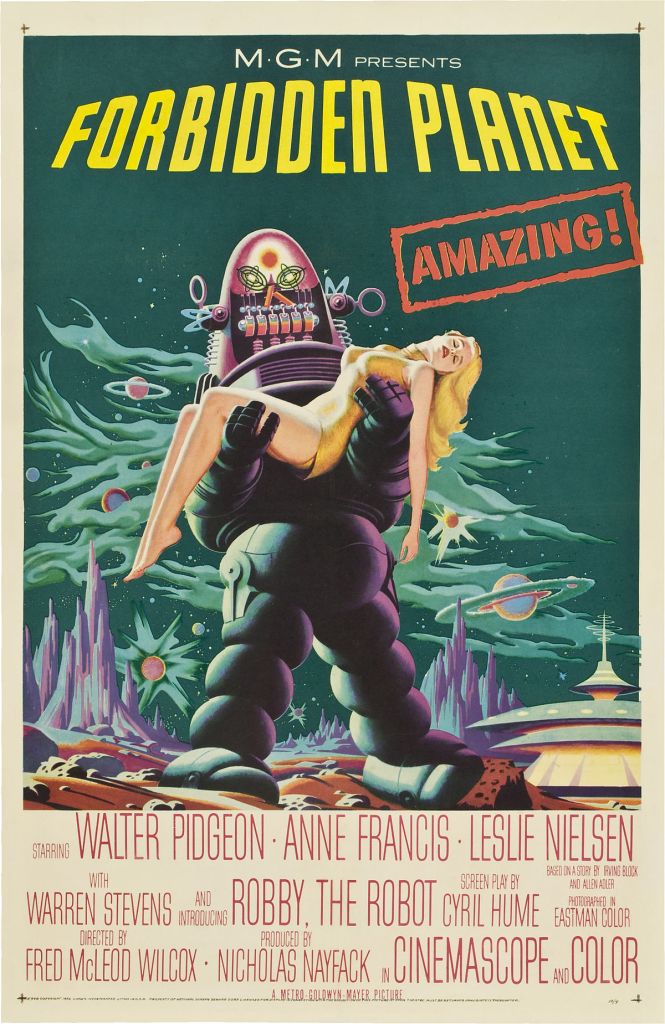
Forbidden Planet

Science is a practice that emerges from myth, its form found in the stories we tell of it. I’ve identified a pattern connecting the stories we’ve told of AI. Yet I know not what to make of it or how to respond to it. What is my role in this pattern? How much of it found, how much projected?

Time to rewatch Forbidden Planet (1956), classic 50s sci-fi retelling of The Tempest, filmed in CinemaScope, with Ariel recast as a nonbinary robot and Caliban recast as the Id. “For your convenience,” says the robot, “I am monitored to respond to the name Robby.” When asked if it’s male or female, Robby replies, “In my case, sir, the question is totally without meaning.”

As this initial exchange indicates, gender is one of the film’s primary concerns. Like the island from The Tempest, the planet here in Forbidden Planet includes a father and his daughter among its few inhabitants. Prospero and Miranda have here been replaced with recluse philologist Dr. Edward Morbius and his daughter Altaira. Where The Tempest begins with Antonio and his fellow castaways washing up on the shore of Prospero’s island, Forbidden Planet opens with the arrival of a space cruiser. An all-male crew led by Leslie Nielsen lands on the planet as the film begins.

Morbius thinks of Robby as “simply a tool.” He commands Robby to walk toward a disintegrator beam to demonstrate to Commander Adams and his crewmates the robot’s “absolute selfless obedience.” “Attribute no feeling to him, gentlemen,” says Morbius. “Order canceled,” he shouts as Robby marches toward the beam.

As Morbius notes Robby’s superhuman strength, a concerned crewman replies, “Well, in the wrong hands, might such a tool become a deadly weapon?”

Morbius tries to disarm such fears: “No, Doctor,” he says, none too reassuringly, “not even though I were the mad scientist of the taped thrillers, because you see there happens to be a built-in safety factor.” Built in, we soon learn, by none other than Morbius himself, Robby’s creator. “I tinkered him together,” he explains, “during my first months up here.”

Morbius is no Frankenstein. Yes, he inhabits laboratories. Yes, he creates a robot. His science, however, is linked with philology, parlor magic, and most of all, technologies belonging to the Krell, an ancient alien civilization of the planet’s archaic past.

It is this other technology, with its triangles and pyramids, that constitutes the film’s innovation into the continuum of the Frankenstein narrative.

Morbius tours the crewmen through an underground museum of Krell technology. Advanced mnemotechnics. “On this screen,” he says, “the total knowledge of the Krell, from its primitive beginning, to the day of its annihilation, a sheer bulk surpassing many millions of Earth libraries.”

As the tour continues, we witness another device: the Krell’s “Plastic Educator.” Gathering around the object’s plastic pyramid, Morbius explains it to the crewmen as follows: “As far as I can tell, they used it to condition and test their young — in much the same way we once employed fingerpainting among our kindergarten children.” I picture Vannevar Bush’s Memex. The device outputs holographic images, manifestations of mind visible to others.

“I often play with it myself for relaxation,” Morbius adds with a smile, sitting down beside it. “Although working here, I sometimes wish I’d been blessed with multiple arms and legs.”

The Krell as pictured later in the film are hideous — though here, I picture an Octopus.

Awed by Morbius’s demonstration of the Plastic Educator, Lt. Ostrow, the ship’s doctor, calls it “Aladdin’s lamp in a physics laboratory.”

Next, as if moving sequentially through a space similar to the Futurama exhibit from the 1939 New York World’s Fair, Morbius guides the crewmen on a tour of the Krell’s thermonuclear energy system. The men board a capsule-shaped vehicle and descend into an underground space of vast proportion, an imaginary architecture: hints of what would become the atrium of the Westin Bonaventure, with its ascending glass elevator, rendered in the style of Fritz Lang’s Metropolis.

Despite these grand glimpses of the post-scarcity utopia on the far side of history, Morbius is still cut from the Frankenstein cloth. For something befell the Krell. There’s something tragic and forbidden about this alien knowledge. Their experiments had apocalyptic consequences. Morbius, “answerable exclusively to his own conscience and judgement,” feels mankind isn’t fit for such knowledge, and resists Commander Adams’s wish to share these discoveries with others.

However, as Lt. Ostrow explains after his ill-fated “brain boost” via Plastic Educator, the Krell forgot one thing: “Monsters from the Id.” When pressed by Commander Adams, Morbius defines the Id as “an obsolete term, I’m afraid, once used to describe the elementary basis for the subconscious mind.”

“Monsters from the subconscious: of course!” replies the Commander. “That’s what Doc meant!”

The veil parts, Morbius awakened suddenly to the danger of technologies that bestow the power of creation via thought. “Why haven’t I seen this all along?” he says, awed by the realization. “The beast. The mindless primitive. Even the Krell must have evolved from that beginning.”

The Commander, angered, digs deeper. “And so, those mindless beasts of the subconscious had access to a machine that could never be shut down. The secret devil of every soul on the planet, all set free at once to loot and maim. And take revenge, Morbius! And kill!”

As Morbius struggles to acknowledge the vengeful power of his own subconscious, the Commander scolds him with the standard Freudian prognosis: “We’re all part monsters in our subconscious. […]. Even in you, the loving father, there still exists the mindless primitive, more enraged and more enflamed with each new frustration. So now you’re whistling up your monster again!”

“Guilty! Guilty! My evil self is at that door, and I have no power to stop it!” cries an anguished Morbius, accepting the tragic Oedipal weave of the film’s borrowings from Freud whole cloth.

As consolation to Altaira upon her father’s passing, Commander Adams delivers the film’s closing words.  “About a million years from now, the human race will have crawled up to where the Krell stood in their great moment of triumph and tragedy. And your father’s name will shine again, like a beacon in the galaxy. It…will remind us that we are, after all, not god.”

Reality-Piloting the Post-Cyberpunk Future

Heads of the sixties split off in their imaginings of the future: some gravitated toward cyberpunk, others toward New Age. The world that emerged from these imaginings was determined as much by the one as by the other.

To witness some of the heads of the counterculture evolving into cyberpunks, look no further than the lives of William Gibson and Timothy Leary.

Leary and Gibson each appear in Cyberpunk, a strange MTV-inflected hyperfiction of sorts released in 1990. Leary’s stance there in the documentary resembles the one he assumes in “The Cyber-Punk: The Individual as Reality Pilot,” a 1988 essay of his included in a special “Cyberpunk” issue of the Mississippi Review.

In Leary’s view, a cyberpunk is “a person who takes navigational control over the cybernetic-electronic equipment and uses it not for the army and not for the government…but for his or her own personal purpose.”

In mythopoetic terms, writes Leary, “The Classical Old West-World model for the Cyber-punk is Prometheus, a technological genius who ‘stole’ fire from the Gods and gave it to humanity” (Leary 252).

Leary appends to this sentence a potent footnote. “Every gene pool,” he writes, “develops its own name for Prometheus, the fearful genetic-agent, Lucifer, who defies familial authority by introducing a new technology which empowers some members of the gene-pool to leave the familiar cocoon. Each gene-pool has a name for this ancestral state-of-security: ‘Garden of Eden,’ ‘Atlantis,’ ‘Heaven,’ ‘Home,’ etc.” (265).

Prometheus is indeed, as Leary notes, a figure who throughout history reappears in a variety of guises. In Mary Shelley’s telling, for instance, his name is Victor.

Leary clearly sees himself as an embodiment of this myth. He, too, was “sentenced to the ultimate torture for…unauthorized transmissions of Classified Information” (252). But the myth ends there only if one adheres to the “official” account, says Leary. In Prometheus’s own telling, he’s more of a “Pied Piper” who escapes “the sinking gene-pool” while taking “the cream of the gene-pool” with him (252).

Cut to Michael Synergy, a real-life cyberpunk who describes a computer virus as “a little artificial intelligence version of me” that can replicate as many times as needed to do what it needs to do.

Leary thinks that in the future we’ll all be “controlling our own screens.” The goal of cyberpunk as movement, he says, is to decentralize ownership of the future.

My thoughts leap to John Lilly’s Programming and Metaprogramming in the Human Biocomputer. Lilly’s is the book I imagine Dick’s Electric Ant would have written had he lived to tell of his experiments.

My Answer to You Is: “Yes!”

Costar tells me, “Write them a note.”

I’m like that Byrds song, though: “Wasn’t Born to Follow.” So I reply contrapuntally, zigzagging among things I’m thankful for.

“This is Colossal. The plan is in effect,” spit Damon Locks & Rob Mazurek on “Yes!,” a track from their new album, New Future City Radio. One of several anthems of 2023. I listen intently, pausing and replaying the track at intervals to take in lyrics, trying to keep my fingers warm while seated in your kitchen.

“If you really break it down, the loss is immeasurable,” goes the message, arriving now as if for the first time as I write. What I hear in “colossal” is not so much an adjective as a proper noun: a utopian, Afrofuturist call-and-response remix of the AI from Colossus: The Forbin Project. Colossus made Colossal by those who reenter history from the future via psychedelic time machine and replace Spacewar with a chatbot.

“5-4-3-2-1. If you’re just joining us, this is New Future City Radio, broadcasting 7 days a week, 24 hours a day, from rooftops unknown, increasing the bandwidth, transmitting and receiving, sending signal. Because tomorrow is listening.”

The film opens with a seated US president speaking live on TV to the people of the world. State secrets, delicately poised, come undone.

“My friends. Fellow citizens of the world,” he begins. “As President of the United States of America, I can now tell you, the people of the entire world, that as of 3:00am EST, the defense of this nation—and with it, the defense of the free world—has been the responsibility of a machine. A system we call Colossus. Far more advanced than anything previously built. Capable of studying intelligence and data fed to it. And on the basis of those facts only, deciding if an attack is about to be launched upon us. If it did decide that an attack was imminent, Colossus would then act immediately, for it controls its own weapons, and can select and deliver whatever it considers appropriate. Colossus’ decisions are superior to any we humans could make, for it can absorb and process more knowledge than is remotely possible for the greatest genius that ever lived. And even more important than that, it has no emotions. Knows no fear, no hate, no envy. It cannot act in a sudden fit of temper. It cannot act at all, so long as there is no threat.”

Stewart Brand’s essay “Spacewar: Fanatic Life and Symbolic Death Among the Computer Bums” debuted in the pages of Rolling Stone magazine on December 7, 1972, two years after the launch of Colossus. Brand, former Prankster, founder of the Whole Earth Catalog, views the prospect of “computers for the people” as “good news, maybe the best since psychedelics” (39). With appropriate consciousness and information, and access to the relevant tools, he suggests, we humans can reshape the world that we’ve made for ourselves into something socially and environmentally sustainable. “Where a few brilliantly stupid computers can wreak havoc,” he adds, assuming an audience familiar with the likes of HAL, AM, and Colossus, “a host of modest computers (and some brilliant ones) serving innumerable individual purposes, can be healthful, can repair havoc, feed life” (77).

Of course, it hasn’t played out that way—not yet. Instead, the situation has been more like the one Adam Curtis describes in the second episode of his BBC docuseries All Watched Over By Machines of Loving Grace. “The computer networks and the global systems that they had created, hadn’t distributed power,” noted Curtis from the vantage point of 2011. “They had just shifted it, and if anything, concentrated it in new forms.” And of course, that was more than a decade ago, well before the arrival of AGI.

DJs have been known to save lives. Ours, like an angel, delivers his message allegorically.

“For every move you make,” interjects the DJ, “they got three moves that negate anything you might have even thought of doing. See, I need 5000 rays from the sun, and two big magnifying glasses, to defeat your darkness. And right now, the electric company has shut off my power. I’m living in darkness. You living in darkness—but you don’t know it! It’s so dark out here, I can’t even see. And that’s the point: you can’t see, you won’t move. They got you where they want you: nowhere. Shrouded in confusion. Grasping at straws. When you’re living like this, you can’t envision lines of possibility.”

Sounds like where we’re at, no? That’s the crux of the matter of “capitalist realism”: neoliberal shock doctrine leaves the populace traumatized. Desire colonized, consciousness deflated. Those who can’t imagine the future can’t get there.

Enter our DJ. “This is where the plan kicks in,” he says. “You ask me if I can pour myself into a giant robot and swallow up this black hole and free the entire universe? My answer to you is: Yes! Yes, yes, yes, yes!”

All Because of a Couple of Magicians

Twenty-first century subjects of capitalist modernity and whatever postmodern condition lies beyond it have up to Now imagined themselves trapped in the world of imperial science. The world as seen through the telescopes and microscopes parodied by the Empress in Margaret Cavendish’s The Blazing World. That optical illusion became our world-picture or world-scene — our cognitive map — did it not? Globe Theatre projected outward as world-stage became Spaceship Earth, a Whole Earth purchasable through a stock exchange.

Next thing we know, we’re here.

Forms from dreamland awaken into matter.

Retrocausation

The hyperstition I’ve imagined draws upon the process of “retrocausation.”

Like a descendent reaching back and saving an ancestor, as in Octavia E. Butler’s novel Kindred, the fiction I’m writing arrives from the future to affect-effect the past.

At the center of the story are the journals trance-scribed at the height of my high in years prior. “Words came to me as if whispered to me by a me of the future,” mutters the Narrator. “I was so attentive in those days. And I encountered near-zero need to edit or cross out. The pages of the journals are pristine.”

Science writer Eric Wargo explores the topic of retrocausation in his 2018 book Time Loops: Precognition, Retrocausation, and the Unconscious. To know more, one must be like Batman descending to his Batcave. Let us to our memory palace go, there to converse with Wargo.

The Politics of Fantasy

Fantasy is dangerous. The genre has its share of royalists, reactionaries, and racists. Tolkien and Lewis, who taught together at Oxford, were devout Catholics. Writers of the Left sometimes dismiss the genre as ideologically suspect, preferring science fiction in its stead. But no such distinction holds. Science fiction writers of the Left have written works of fantasy, and rightwing fantasists like C.S. Lewis wrote works of science fiction, like the latter’s WWII-era Space Trilogy: Out of the Silent Planet (1938), Perelandra (1943), and That Hideous Strength (1945). Each genre remains anyone’s game.

The Fabian Contingent

Why does Wells propel his Time Traveler into as distant and bleak a future as the one imagined in The Time Machine? It’s the future as pictured from the standpoint and subject-position of the Traveler himself as he recounts his journey for others. Wells, meanwhile, imagined other futures elsewhere and elsewhen, as during his later years, following his split with the Fabian Society. His political ideal of those later years was the “World State”: a single global technocratic “world commonwealth,” governed by a scientific elite. In his twenties, however, Wells may have interacted for a time with a secret society of a different sort: the Hermetic Order of the Golden Dawn. His run-in with the Order is thought to have occurred in London in 1894, the year prior to the publication of The Time Machine, Wells’s first great success as a novelist. Ithell Colquhoun mentions this run-in in her book Sword of Wisdom: MacGregor Mathers and the Golden Dawn — or at the very least speculates about a “Fabian contingent” within a Golden Dawn splinter group called the Order of the Stella Matutina or “Morning Star.” Colquhoun describes Wells’s 1911 short story “The Door in the Wall” as “in the line of GD tradition” (192). I find myself reading again descriptions of Golden Dawn initiation rituals, like the following from Chic Cicero and Sandra Tabitha Cicero’s Self-Initiation into the Golden Dawn Tradition:

“The goal of initiation is to bring about the illumination of the human soul by the Inner and Divine Light. A true ‘initiate’ is an individual whose Higher Self (or Higher Genius) has merged with the Lower Personality and actually incarnated into the physical body. The Personality is left in charge of the day-to-day routines of living and working, but the Higher Genius is free to look out at the world through the eyes of the initiate. Through this experience, the individual is given a permanent extension of consciousness which is impossible to mistake. Many times a student of the mysteries is drawn to a particular mystical current without knowing it. A series of ‘coincidences’ and synchronicities will often direct (or sometimes shove) a person toward that current through books or through meeting other people who also have a connection with the current. During this time, the student’s psychic faculties are still relatively undeveloped, yet the inner spark has been ignited. However, a full initiation, or dawning of the Inner Light, is evident when the entire aura is illuminated.”

Of course, one can be a solitary magician. One can tap into the Golden Dawn’s magic, as Wells did, without having to become a member of any particular group or organization. But according to Cicero and Cicero, the solitary magician is at a disadvantage, “not having a group of temple-mates to consult if problems arise” (xxvi).