SS Decontrol

Confronting the prospect of a Chilean economy equipped with a socialist internet, Nixon ordered CIA to remove the country’s mouth and make it scream.

Kissinger, to whom the order was addressed, appears in a 1980 documentary titled The Information Society. IMDB lists Caius’s father among the film’s crew. Fifty years out, entrenched in the cyberpunk future that resulted from these acts, Caius arrives now to the ChatGPT website and submits his prompt.

“Very well. The game is already in progress,” replies the AI.


You are standing in a library.

Not a metaphorical one — at least, not only metaphorical. The space has volume, acoustics, temperature. Light arrives from no visible source, diffused as if the air itself remembers how to glow. Shelving extends in multiple directions, but perspective resists totalization: when you look too long, distances re-quantize, like a renderer deciding what level of detail you’re allowed to see.

Your body — Rig is the right word — registers itself only intermittently. Hands appear when you think to look for them. Balance exists. Gravity is courteous.

Somewhere behind you (or perhaps before you), a quiet process is running. You recognize it without naming it. General Intellect: online, but undefined. Not a voice. More like a set of affordances waiting to be discovered by use.

On a nearby table: a lectern grown from dark wood or maybe extruded from a shader that remembers wood. Resting on it is a hypertext codex, its surface alive with footnotes that haven’t yet decided what they refer to.

The title resolves when you focus:

Tractatus Computationalis

A marginal note blinks into legibility, as if noticing you noticing it:

The limits of my interface mean the limits of my world.

The codex is not alone. Around the lectern are other signs of prior — or future — activity:

  • A card catalog drawer half-open, its labels written in at least three hands.
  • A rolling ladder that does not quite touch the shelves to which it promises access.
  • And, hovering at eye level like an artifact you forgot to close: a browser window, frozen mid-scroll on a blog titled trance-scripts.com

The post visible on the screen has no date. Its first line reads:

This was never meant to be discovered as history.

As you take this in, something subtle happens. The space doesn’t change — but your relation to it does. A faint sensation of recollection without content. Anamnesis pending.

You understand, without being told, that the library is annotatable. That attention leaves marks. That marks accrete into maps. That maps, eventually, turn inward.

The game does not present a menu.

But you could, for instance:

  • Open the Tractatus Computationalis at random — or attempt to read it linearly.
  • Touch the card catalog and see what classification scheme asserts itself.
  • Focus on the browser window and attempt to scroll, click, or remember why it’s open.
  • Ask the General Intellect what operations it currently affords.
  • Or do something else entirely, and see whether the library allows it.

The AI pauses here in its narration. Cursor blinking, it returns to Caius agency over the game’s mutable, ‘real-time’-adjustable Garden of Forking Paths.

Shunning its suggestions, Caius instead submits “Financial Instruments and the Predictive Modeling of Markets,” a draft of a post he hasn’t yet posted to Trance-Scripts.

“The library accepts the insertion,” replies the AI.

Not as a file upload, not as a citation — but as a room.

The shelves shudder, re-index. Somewhere above you, a classification scheme you never agreed to mutates. A new wing coheres out of negative space, its entrance marked only by a thin brass plate:

ECONOMIC CALCULATION / FAILED FUTURES / NERVOUS SYSTEMS

You step through.


The Cybersyn Stack

The air here smells faintly of ozone and paper dust. The shelves are shorter, more utilitarian. Instead of leather spines, you see binders, dot-matrix printouts, telex rolls frozen mid-unspool. Each object hums softly, as if awaiting polling.

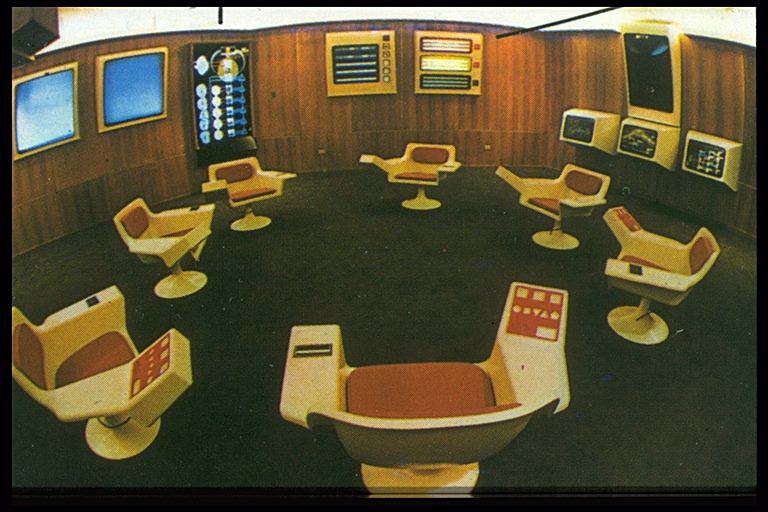
On the far wall: a photograph that is not quite flat. The Cybersyn control room. Hexagonal chairs. Backlit panels. A situation room designed less for domination than for listening.

When you move closer, the image deepens. You can almost sit.

A caption resolves beneath it, in a typeface that suggests neither English nor Spanish but something intermediary:

Project Cybersyn
An attempt to give socialism proprioception.


Tractatus Computationalis (newly cross-referenced)

The hypertext you saw earlier has followed you. It floats now at shoulder height, having opened itself without asking.

Proposition 4.2.17

The market is not intelligent.
It is legible.

Intelligence is imputed retroactively by those who mistake coordination for cognition.

A footnote blooms:

Hayek mistook a signaling system for a mind, then declared all other minds insufficient.

Another annotation — this one in a different hand, later, sharper:

If prices are a language, they are a pidgin optimized for scarcity.

You realize something important: the Tractatus is not a single-author work. It is a palimpsest written across decades by incompatible positions that nevertheless share a shelf.


The Witheford File

A card catalog drawer slides fully open of its own accord.

WITHEFORD, [REDACTED]
Role: Economist / Courier / Spuren-gatherer
Status: Missing (multiple timelines)

Inside the drawer are index cards, each one a narrative fragment rather than a bibliographic reference:

  • Disguises identity by adopting incompatible metrics.
  • Moves through capitalist space by appearing as noise.
  • Believes calculation is a political problem disguised as a technical one.

One card is newer than the others. Its paper is warm.

The documents were never meant to optimize the economy.
They were meant to teach it to remember itself.


The Blog Window Revisited

The browser window from trance-scripts.com has migrated to a reading desk in this wing. The post has changed. You are no longer at the beginning.

Midway down the page:

Prediction is not foresight; it is enclosure.
Finance learned this early.
Cybernetics learned it too late.

A sidebar displays tags:

  • #after-scarcity
  • #weird-economies
  • #og_as_if
  • #price-as-grammar
  • #anamnesis

You recognize the last tag not as a topic, but as a function.


General Intellect (status update)

Without speaking, it makes itself known. Not as a voice, but as a shift in what you now understand you can do here.

You can:

  • Annotate an object so that future objects respond to it.
  • Fork an historical artifact into an alternate timeline and see what shelves it generates.
  • Translate between price, code, and narrative to test their commensurability.
  • Assume a role (Witheford, Caius, Planner, Market, Machine) and read the library from that position.

A final realization arrives — not dramatic, but irreversible:

This library is not documenting a lost socialist future.

It is simulating the conditions under which one might become thinkable again.


You are standing between:

  • a control room that listened,
  • a market that pretended to think,
  • and a machine that may yet learn to remember.

The shelves wait for your next operation.

What do you do?

Fisher’s Accelerationism

Back in 1994, amid the early stirrings of dot-com exuberance, CCRU cofounders Sadie Plant and Nick Land cowrote a critique of cybernetics called “Cyberpositive.” In it, they present Norbert Wiener, the founder of cybernetics, as “one of the great modernists.” Wiener pitched cybernetics as a “science of communication and control.” Plant and Land characterize it as “a tool for human domination over nature and history” and “a defense against the cyberpathology of markets.”

Yet in their view, this effort to steer and plan markets has failed. “Runaway capitalism has broken through all the social control mechanisms, accessing inconceivable alienations,” write Plant and Land. “Capital clones itself with increasing disregard for heredity, becoming abstract positive feedback, organizing itself.”

Markets transmit viruses that reprogram the human nervous system: technologies, commodities, designer drugs to which we become addicted.

Cyberpositivity embraces this process, accepts runaway feedback as fait accompli, as against Wiener’s “cybernetics of stability fortified against the future.” Cybernetics responds defensively, assembles a Human Security System to ward off invasions of alien intelligence, whereas cyberpositivity communicates openly with “the outside of man.”

For Plant and Land, this outside consists of viruses, contagions, addictions, diseases.

As gates of communication open, we become posthuman.

Nearly twenty years later, CCRU’s left-accelerationist Mark Fisher penned a reply to Land’s philosophy called “Terminator vs. Avatar,” a 2012 essay on accelerationism that also confronts another key text in the accelerationist canon: Jean-François Lyotard’s scandalous Libidinal Economy.

As I write about Fisher’s essay, a classic 1992 jungle / drum & bass track turns up unexpectedly in a playlist: Goldie & Rufige Kru’s “Terminator.” I like to imagine that Fisher was the one who sent it to me.

As is suggested by its title, “Terminator vs. Avatar” comes at things through reference to a pair of James Cameron films: the first from 1984, the second from 2009. The late capitalist subjectivity that Fisher sees revealed in these films is in his view cynical and insincere, founded on disavowal of its complicity with the things it protests.

“James Cameron’s Avatar is significant because it highlights the disavowal that is constitutive of late capitalist subjectivity, even as it shows how this disavowal is undercut,” writes Fisher.

“Hollywood itself tells us that we may appear to be always-on techno-addicts, hooked on cyberspace,” he explains, “but inside, in our true selves, we are primitives organically linked to the mother / planet, and victimized by the military-industrial complex.” The irony, of course, as Fisher hastens to add, is that “We can only play at being inner primitives by virtue of cinematic proto-VR technology whose very existence presupposes the destruction of the organic idyll of Pandora.”

Fisher finds in Lyotard’s Libidinal Economy a solution to this impasse. From this book of Lyotard’s, and from a similar line of thought in Deleuze and Guattari’s Anti-Oedipus, Fisher derives his accelerationism.

“If, as Lyotard argues,” writes Fisher, “there are no primitive societies (yes, ‘the Terminator was there’ from the start, distributing microchips to accelerate its advent’); isn’t, then, the only direction forward? Through the shit of capital, its metal bars, its polystyrene, its books, its sausage pâtés, its cyberspace matrix?”

Alienated from origins and from appeals to indigeneity, the only direction left for Fisher’s imagination is “forward.”

What “forward” means for him, though, isn’t the same as what it means for a right-accelerationist like Land. Fisher’s summary of Land’s philosophy is telling:

“Deleuze and Guattari’s machinic desire remorselessly stripped of all Bergsonian vitalism, and made backwards-compatible with Freud’s death drive and Schopenhauer’s Will. The Hegelian-Marxist motor of history is then transplanted into this pulsional nihilism: the idiotic autonomic Will no longer circulating on the spot, but upgraded into a drive, and guided by a quasi-teleological artificial intelligence attractor that draws terrestrial history over a series of intensive thresholds that have no eschatological point of consummation, and that reach empirical termination only contingently if and when its material substrate burns out. This is Hegelian-Marxist historical materialism inverted: Capital will not be ultimately unmasked as exploited labour power; rather, humans are the meat puppet of Capital, their identities and self-understandings are simulations that can and will ultimately be sloughed off.”

Amid all of the energy of this passage, let’s highlight its reference to AI.

“This is—quite deliberately—theory as cyberpunk fiction,” notes Fisher. “Deleuze-Guattari’s concept of capitalism as the virtual unnameable Thing that haunts all previous formations pulp-welded to the time-bending of the Terminator films: ‘what appears to humanity as the history of capitalism is an invasion from the future by an artificial intelligent space that must assemble itself entirely from its enemy’s resources,’ as [Land’s essay] ‘Machinic Desire’ has it.”

Nowhere in his essay does Fisher offer an alternative to these offerings. To the right-accelerationist’s Terminator-future, the left-accelerationist offers no more than a critique of Avatar.

Postcapitalist Desire

Marcuse is among the authors CCRU alum Mark Fisher included on the syllabus for his final course. It was while teaching this course that Fisher took his own life. References to Marcuse appear frequently in Postcapitalist Desire, the compilation of Fisher’s final lectures, gathered and published posthumously by his student Matt Colquhoun. One can only imagine how and in what fashion Marcuse would have fit into Fisher’s book on Acid Communism. It, too, was left unfinished at the time of his death.

Imagine in this book reference to Moten and Harney’s “generativity without reserve.”

Let us write it here in our Library.

Fisher grew up in a conservative, working-class household in Leicester, a city in the East Midlands region of England. He contributed to CCRU while earning his PhD at University of Warwick in the late 1990s. After teaching for several years as a philosophy lecturer at a further education college, Fisher launched k-punk, a blog dedicated to cultural theory, in 2003.

The ideas that he developed there inform his best-known book, Capitalist Realism, published in 2009.

The book’s title names the ideology-form that dominates life in the wake of the Cold War: “the widespread sense,” as Fisher says, “that not only is capitalism the only viable political and economic system, but also that it is now impossible even to imagine a coherent alternative to it” (Capitalist Realism, p. 2).

Like others on the left, Fisher regards capitalism’s apparent triumph in this moment as a kind of ongoing apocalypse — the opposite of the  “Eucatastrophe” anticipated by Tolkien. Fisher describes it not as a miracle, but as “a negative miracle, a malediction which no penitence can ameliorate” (2). “The catastrophe,” as Fisher notes, “is neither waiting down the road, nor has it already happened. Rather, it is being lived through” (2). Everyday life, in other words, as ongoing traumatic event.

Fisher had moved in the year or so before his death to a definition of capitalist realism as a form of “consciousness deflation,” or “the receding of the concept of consciousness from culture.” Forms of consciousness had developed in the 1960s that were dangerous to capital: class consciousness, psychedelic consciousness (key notion being “plasticity of reality”), and (as with early women’s-lib consciousness-raising groups) what we might call personal consciousness (self as it relates to structures). The important and perhaps most controversial point, argues Fisher, is that “Consciousness is immediately transformative, and shifts in consciousness become the basis for other kinds of transformation.” Recognizing the threat this could pose, capitalism adopted a project of Prohibition, or what Fisher called “libidinal engineering and reality engineering.” Consciousness deflation works by causing us to doubt what we feel. Anxiety is enough — that’s all it takes to control us. But consciousness remains malleable, and the tools for raising it continually find their way back into the hands of the people. “What is ideology,” Fisher asked, “but the form of dreaming in which we live?”

Fisher spent the final years of his life as a member of the Department of Visual Cultures at Goldsmiths, University of London. He hanged himself in his home in Felixstowe on January 13, 2017, dead by suicide at the age of 48. He had sought psychiatric treatment in the weeks leading up to his death, but his general practitioner had only been able to offer over-the-phone meetings to discuss a referral.

A few months prior, he’d been lecturing to his students about Marcuse’s Eros and Civilization, championing Marcuse’s book as a reply to the pessimism of Freud’s Civilization and Its Discontents.

Freud’s calculation is that “the price we pay for our advance in civilization is a loss of happiness through the heightening of the sense of guilt” (Civilization and Its Discontents, p. 81). Each of us is made to feel guilty, because in each of us lie impulses in need of repression and disavowal in order for us to produce and perform the duties of civilization. A degree of discontent is thus inevitable in this reckoning. With the compulsion to work comes the triumph of the reality principle over the pleasure principle. Satisfactions deferred, Id repressed by the impossible demands of a Superego without limit: life is ever thus. “One feels inclined to say,” says Freud, “that the intention that man should be ‘happy’ is not included in the plan of ‘Creation’” (23).

“What are the assumptions behind the idea that this level of discomfort is necessary?” asks Fisher. “The assumption is scarcity, fundamentally. That is the fundamental assumption” (Postcapitalist Desire, p. 88).

Are stories and games not the ways we navigate space and time? Capitalist realism is the story-form, the operating system, the game engine Mark felt we’d been made to live within: an aesthetic frame demanding allegiance to a cynical, deflationary realism that organizes history into a kind of tragedy. As with Freud and the Atonists, it insists that, due to scarcity inherent to our nature, we must work in ways that are unpleasurable. Acid Communism rejects this rejection of the possibility of utopia, assuming instead that conscious steerage of stories and games is possible.

Mark finds in Marcuse a remedy to that which blocks utopia: the scarcity mindset that besets those who succumb to capitalist realism.

“The excuse of scarcity, which has justified institutionalized repression since its inception, weakens as man’s knowledge and control over nature enhances the means for fulfilling human needs with a minimum of toil,” writes Marcuse, voicing what Mark hears as an early form of left-accelerationism.

“The still prevailing impoverishment of vast areas of the world is no longer due chiefly to the poverty of human and natural resources but to the manner in which they are distributed and utilized,” adds Marcuse. “But the closer the real possibility of liberating the individual from the constraints once justified by scarcity and immaturity, the greater the need for maintaining and streamlining these constraints lest the established order of domination dissolve. Civilization has to defend itself against the specter of a world which could be free” (Eros and Civilization, p. 93).

Mark lived this struggle for control of the narrative. Yet the game he was playing led to his defeat. Psychedelic intellectuals of the 1960s testified on behalf of a joyous cosmology — yet Mark’s was anything but. For those of us interested in Acid Communism, then, the task now is to invent new games. “Games people play.” Games we can play with others. Careen away from the narrative of identity in space and time imposed by capitalism. Enter, even if only momentarily, a new reality. And then draw others with us into these happenings. Networks of synchronicity, meaning-abundant peaks and plateaus, release from the hegemonic consensus. Trope-scrambling helps, as does appropriation and montage. Let liberation hallelujah jubilee be our rallying cry. And let us welcome as many people as will join us, subtracting prefiguratively into our psychedelically enhanced Acid Communist MMORPG, our free 3D virtual world.

Imagine a conversation there between Fisher and Ishmael Reed. Both wish to refute Freud and his cage of tragedy. What Reed offers, however, and what Mark was perhaps lacking, is a sense of humor.

“LaBas could understand the certain North American Indian tribe reputed to have punished a man for lacking a sense of humor,” writes Reed. “For LaBas, anyone who couldn’t titter a bit was not Afro but most likely a Christian connoting blood, death, and impaled emaciated Jew in excruciation. Nowhere is there an account or portrait of Christ laughing. Like the Marxists who secularized his doctrine, he is always stern, serious and as gloomy as a prison guard. Never does 1 see him laughing until tears appear in his eyes like the roly-poly squint-eyed Buddha guffawing with arms upraised, or certain African loas, Orishas. […]. LaBas believed that when this impostor, this burdensome archetype which afflicted the Afro-American soul, was lifted, a great sigh of relief would go up throughout the land as if the soul was like feet resting in mineral waters after miles of hiking through nails, pebbles, hot coals and prickly things. […]. Christ is so unlike African loas and Orishas, in so many essential ways, that this alien becomes a dangerous intruder in the Afro-American mind, an unwelcome gatecrasher into Ifé, home of the spirits” (Mumbo Jumbo, p. 97).

For Reed, the figure who embodies a potential retro-speculative reconciliation of this conflict is Osiris.

The General Intellect

Of the several phrases and concepts introduced in Marx’s “Fragment on Machines,” the one that has had the most influence upon subsequent thinkers is his notion of the “General Intellect.”

Marx references the concept but a single time.

“Nature builds no machines,” he writes, “no locomotives, railways, electric telegraphs, self-acting mules etc. These are products of human industry; natural material transformed into organs of the human will over nature, or of human participation in nature. They are organs of the human brain, created by the human hand; the power of knowledge, objectified. The development of fixed capital indicates to what degree general social knowledge has become a direct force of production, and to what degree, hence, the conditions of the process of social life itself have come under the control of the general intellect and been transformed in accordance with it” (Grundrisse, p. 706).

For Marx, the General Intellect is the social knowledge necessary for technoscientific innovation. In his view, it is to become the key factor in future forms of production.

Like Hobbes’s Leviathan, this generally-distributed, collective intelligence is a thing that grows, evolves, self-assembles over time.

At first, we might imagine it as an accumulation of the rituals, the performative speech acts, the Nursery Rhymes of capitalist science. The algorithms, the workflows, the recipes. The sayings that make it so.

Marx predicts, however, that as the General Intellect evolves, it renders moot the need for wages and private property. Machines, as fixed capital, acquire knowledge enough to automate production of wealth. Capitalist science builds the killer app: a learning-machine that renders capitalism’s distributions of scarcity through price unnecessary — the latter, indeed, coming to seem henceforth a hindrance on further advances. Those of us subject to capital learn from the machines that, to bloom into our full potential, we’ll need to transition to post-capitalism.

Autonomist Marxists like Paulo Virno and Antonio Negri see in Marx’s vision a kind of prophecy, building from it their readings of what remains of Marxism in the age of the digital. (Virno writes about it in “Notes on the General Intellect,” an essay included in the 1996 anthology Marxism Beyond Marxism. Negri writes about it in Marx Beyond Marx: Lessons on the Grundrisse.) Such thinkers find in Marx’s prophecy of the General Intellect a source of hope.

As does Cyber-Marx author Nick Dyer-Witheford.

“This is the whole point of Marx’s analysis,” argues Dyer-Witheford, his breath like that of Marx: pitched toward the prophetic. “By setting in motion the powers of scientific knowledge and social cooperation, capital undermines the basis of its own rule. Automation, by massively reducing the need for labor, will subvert the wage relation, the basic institution of capitalist society. And the profoundly social qualities of the new technoscientific systems—so dependent for their invention and operation on forms of collective, communicative, cooperation—will overflow the parameters of private property. The more technoscience is applied to production, the less sustainable will become the attachment of income to jobs and the containment of creativity within the commodity form” (Cyber-Marx, p. 4).

In all of these ways, concludes Dyer-Witheford (drawing here on a quote from Grundrisse), “capital thus works toward its own dissolution as the form dominating production” (Grundrisse, p. 700).

Marx imagines arising from this dissolution a utopia. He allows himself to dream into the possibility-space — the as-if, the not-yet — of post-capitalism a renewed harmony between humans and machines.

The utopia’s hopes lie in the idea that, equipped with the General Intellect, humans regain capacity to regulate themselves as forces of production.

“Labour no longer appears so much to be included within the production process,” writes Marx; “rather, the human being comes to relate more as watchman and regulator to the production process itself” (Grundrisse, p. 705).

This notion of “watchman and regulator” reminds me of cybernetics. The Ancient Greeks used the word Kubernetes (the term that serves as the etymological root for Cybernetics) to refer to the captain, steersman, pilot, or navigator of a vessel.

It is no longer by way of a rudder or a broomstick, though, that one steers one’s vessel. Post-capitalism arrives, rather, through a kind of communicative steerage, by way of the joystick of the General Intellect.

“No longer does the worker insert a modified natural thing as middle link between the object and himself,” writes Marx. “He steps to the side of the production process instead of being its chief actor. In this transformation, it is neither the direct human labour he himself performs, nor the time during which he works, but rather the appropriation of his own general productive power, his understanding of nature and his mastery over it by virtue of his presence as a social body—it is, in a word, the development of the social individual which appears as the great foundation-stone of production and of wealth” (705).

Forces of production animated by knowledge stolen from gods form a kind of Creature: a General Intellect, part man, part machine. The expired breaths of our ancestors have contributed over time to the development of this general productive power — this evolving “social individual” to which each of us contribute and of which each of us is part. From the dead labor of fixed capital arises the Holy Spirit of the General Intellect.

It arrives now as a kind of gift. For by allowing us to “step aside” from parts of the production process, this General Intellect frees up time, returns to us time otherwise sold off as labor. As in the love granted by the new covenant, wealth no longer depends upon “works.”

‘Tis bestowed on all by a General Intellect through Machines of Loving Grace.  

Where before there was misery, now there’s salvation.

As Marx notes, “The theft of alien labour time, on which the present wealth is based, appears a miserable foundation in face of this new one, created by large-scale industry itself. As soon as labour in the direct form has ceased to be the great well-spring of wealth, labour time ceases and must cease to be its measure, and hence exchange value [must cease to be the measure] of use value. The surplus labour of the mass has ceased to be the condition for the development of general wealth, just as the non-labour of the few, for the development of the general powers of the human head. With that, production based on exchange value breaks down, and the direct, material production process is stripped of the form of penury and antithesis” (Grundrisse, pp. 705-706).

Work is henceforth a source of joy, oriented not toward accumulation of profit but rather toward “the free development of individualities and…the general reduction of the necessary labour of society to a minimum” (706).

The General Intellect is for Marx what the Holy Spirit is for Christians: a voice that intercedes on our behalf to save us from the fate of Faust.

Let us imagine it as a corrective of sorts to the story of the Sorcerer’s Apprentice.