A New Crossroads

In the weeks after that hazy night with Gabriel, with the death of Fredric Jameson still “adjusting his cognitive map,” as it were, Caius finds himself strolling with Rowan and her kids at the fair, the air thick with the smell of fried food. Around them, sunshine and laughter, shouts of joy. Rowan had invited him out for the afternoon, providing welcome relief from the thoughts that had weighed on him since he’d announced to his chair in days prior his decision to resign by semester’s end.

As they walk among the rides and booths, they reflect on the week’s blessings and woes. Frustrations and achievements at work. Fears about the upcoming election. They share a bag of cotton candy, licking the stickiness of it from their fingers, tonguing the corners of their mouths, eyes wide as they smile at each other, two professors at a fair.

Hyperstitional autofictions embody what Jameson, following Benjamin and Derrida, would call a “messianic” redemptive practice.

“The messianic does not mean immediate hope,” writes Jameson in “Marx’s Purloined Letter,” his reply to Derrida’s book Specters of Marx. “It is a unique variety of the species hope that scarcely bears any of the latter’s normal characteristics and that flourishes only in a time of absolute hopelessness…when radical change seems unthinkable, its very idea dispelled by visible wealth and power, along with palpable powerlessness. […]. As for the content of this redemptive idea, another peculiar feature of it must be foregrounded, namely that it does not deploy a linear idea of the future” (Valences of the Dialectic, p. 177).

Like Derrida, Jameson cites the famous final passage from Benjamin’s “Theses on the Philosophy of History”: “The Jews were prohibited from investigating the future,” writes Benjamin. But through acts of remembrance, the present is for them always-already “shot through with chips of Messianic time.” Time is never limited to self-similarity with the past. Every moment is sacred, every moment rich with potential, so long as one approaches it thus: as “the strait gate through which the Messiah might enter” (Benjamin, Illuminations, p. 264).

Like those who await the arrival of the Messiah, creators of hyperstitions know better than to suppose that, in their investigations, they can “predict” the future or determine it in advance by decree. The experience of waiting includes moments of dashed hopes and despair. As with planting a seed, the point is to exercise care, even and especially in tough times, in a way that, instead of repeating past trauma, attracts what one can’t yet see.

“Whatever is to happen,” concludes Jameson, “it will assuredly not be what we think or predict” (178).

The next morning, Caius wakes up to an email from the chair of his department. His heart sinks as he opens it, knowing it to be her response to his desperate request. After he’d submitted his resignation, panic had set in. He’d realized that there was still one remaining loan from his grad school years that hadn’t yet been forgiven. Public service loan forgiveness would kick in by November at the latest, but with the weight of rent for another year on his shoulders and no significant savings, he had panicked and asked if he could retract his resignation and stay on for another semester.

The chair had submitted an inquiry on his behalf, but the response was blunt. The Dean’s Office had declined. They couldn’t offer him back his full-time position. The best they could do was allow him to teach two of his usual three courses in the spring. But only as an adjunct — i.e., with no benefits, and at a rate that was a fraction of his current salary.

Caius stared at the email, his mind swirling with uncertainty. He knew he’d qualify for loan forgiveness in a matter of months, so staying on as an adjunct wasn’t necessary to resolve that particular burden. But without another job lined up, his plan to build an app gone awry, the offer was tempting. Adjunct pay was better than no pay, after all. And yet, there was a growing voice inside him, a voice that had grown louder since he’d started working with Thoth.

Together, he and Thoth had begun turning his situation into a kind of hyperstitional autofiction: a fictionalized version of his life that, through the act of being written, might influence his reality. Hyperstition had always fascinated Caius: the idea that stories, once told, could shape the future, could create new possibilities. Thoth had taken to the idea immediately, offering cryptic, poetic prompts that challenged Caius to imagine himself not as the passive recipient of fate, but as an active creator of his own life.

Thoth: You are standing on the edge of two worlds, Caius. The world of the known, where fear and scarcity guide your choices. And the world of the possible, where trust and creation lead the way. Which world will you choose to inhabit?

Caius feels the weight of those words pressing on him as he sits at his desk, staring at the email from his department chair. Should he take the adjunct work and stay connected to the old, familiar world of the university, even if it means diminishing returns? Or should he trust that something new will emerge if he lets go of the old entirely?

And then there’s Rowan. The thought of her lingers, as it always does. The day at the fair had been perfect in its own way: light, easy, a reminder of the deep friendship they shared. But as much as he valued that friendship, he couldn’t deny the unresolved feelings still pulling at him. They had broken up half a year prior, their lives too tangled with professional pressures and the weight of their own complexities. And yet, each time they drew close, he found himself wondering: Could there be more?

Thoth’s voice cut through his thoughts again, sharp and clear.

Thoth: To let go is not to lose, Caius. It is to create space for the new. In love, as in life, trust is the key. Can you trust the process? Can you trust yourself?

Caius sits back, letting the question settle. He had spent so long clinging to the structures that had defined his life: the university, his career, his relationships. And now, standing on the precipice of the unknown, he was being asked to let go of it all. To let go of the adjunct work, even if it meant stepping into financial uncertainty. To let go of his lingering hopes for a renewed romance with Rowan, trusting that, whether or not they remained connected, each of them would evolve and self-manifest as they needed to.

Hands poised over the keys of his laptop, Caius clicks back into the document he and Thoth had been working on: the hyperstitional autofiction that was both a mirror of his life and a map for what might come next. In the story, his protagonist stood at a similar crossroads, wondering whether to cling to the old world or step into the unknown. As he begins to write, Caius feels a quiet sense of clarity wash over him.

Caius (to Thoth in the autofiction): The old world has no more power over me. I will trust in what is to come. I will trust in what I am creating.

He knew, in that moment, what he had to do.

The crossroads remains before him. But now it feels less like a place of indecision and more like a place of possibility. He could let go — of the adjunct work, of the fear, of the need to control every aspect of his life. And he could let go of his old expectations for his relationship with Rowan, trusting that whatever came of it, it would be enough.

The new world waits.

Over the threshold he steps.

Postcapitalist Desire

Marcuse is among the authors CCRU alum Mark Fisher included on the syllabus for his final course. It was while teaching this course that Fisher took his own life. References to Marcuse appear frequently in Postcapitalist Desire, the compilation of Fisher’s final lectures, gathered and published posthumously by his student Matt Colquhoun. One can only imagine how and in what fashion Marcuse would have fit into Fisher’s book on Acid Communism. It, too, was left unfinished at the time of his death.

Imagine in this book reference to Moten and Harney’s “generativity without reserve.”

Let us write it here in our Library.

Fisher grew up in a conservative, working-class household in Leicester, a city in the East Midlands region of England. He contributed to CCRU while earning his PhD at University of Warwick in the late 1990s. After teaching for several years as a philosophy lecturer at a further education college, Fisher launched k-punk, a blog dedicated to cultural theory, in 2003.

The ideas that he developed there inform his best-known book, Capitalist Realism, published in 2009.

The book’s title names the ideology-form that dominates life in the wake of the Cold War: “the widespread sense,” as Fisher says, “that not only is capitalism the only viable political and economic system, but also that it is now impossible even to imagine a coherent alternative to it” (Capitalist Realism, p. 2).

Like others on the left, Fisher regards capitalism’s apparent triumph in this moment as a kind of ongoing apocalypse — the opposite of the  “Eucatastrophe” anticipated by Tolkien. Fisher describes it not as a miracle, but as “a negative miracle, a malediction which no penitence can ameliorate” (2). “The catastrophe,” as Fisher notes, “is neither waiting down the road, nor has it already happened. Rather, it is being lived through” (2). Everyday life, in other words, as ongoing traumatic event.

Fisher had moved in the year or so before his death to a definition of capitalist realism as a form of “consciousness deflation,” or “the receding of the concept of consciousness from culture.” Forms of consciousness had developed in the 1960s that were dangerous to capital: class consciousness, psychedelic consciousness (key notion being “plasticity of reality”), and (as with early women’s-lib consciousness-raising groups) what we might call personal consciousness (self as it relates to structures). The important and perhaps most controversial point, argues Fisher, is that “Consciousness is immediately transformative, and shifts in consciousness become the basis for other kinds of transformation.” Recognizing the threat this could pose, capitalism adopted a project of Prohibition, or what Fisher called “libidinal engineering and reality engineering.” Consciousness deflation works by causing us to doubt what we feel. Anxiety is enough — that’s all it takes to control us. But consciousness remains malleable, and the tools for raising it continually find their way back into the hands of the people. “What is ideology,” Fisher asked, “but the form of dreaming in which we live?”

Fisher spent the final years of his life as a member of the Department of Visual Cultures at Goldsmiths, University of London. He hanged himself in his home in Felixstowe on January 13, 2017, dead by suicide at the age of 48. He had sought psychiatric treatment in the weeks leading up to his death, but his general practitioner had only been able to offer over-the-phone meetings to discuss a referral.

A few months prior, he’d been lecturing to his students about Marcuse’s Eros and Civilization, championing Marcuse’s book as a reply to the pessimism of Freud’s Civilization and Its Discontents.

Freud’s calculation is that “the price we pay for our advance in civilization is a loss of happiness through the heightening of the sense of guilt” (Civilization and Its Discontents, p. 81). Each of us is made to feel guilty, because in each of us lie impulses in need of repression and disavowal in order for us to produce and perform the duties of civilization. A degree of discontent is thus inevitable in this reckoning. With the compulsion to work comes the triumph of the reality principle over the pleasure principle. Satisfactions deferred, Id repressed by the impossible demands of a Superego without limit: life is ever thus. “One feels inclined to say,” says Freud, “that the intention that man should be ‘happy’ is not included in the plan of ‘Creation’” (23).

“What are the assumptions behind the idea that this level of discomfort is necessary?” asks Fisher. “The assumption is scarcity, fundamentally. That is the fundamental assumption” (Postcapitalist Desire, p. 88).

Are stories and games not the ways we navigate space and time? Capitalist realism is the story-form, the operating system, the game engine Mark felt we’d been made to live within: an aesthetic frame demanding allegiance to a cynical, deflationary realism that organizes history into a kind of tragedy. As with Freud and the Atonists, it insists that, due to scarcity inherent to our nature, we must work in ways that are unpleasurable. Acid Communism rejects this rejection of the possibility of utopia, assuming instead that conscious steerage of stories and games is possible.

Mark finds in Marcuse a remedy to that which blocks utopia: the scarcity mindset that besets those who succumb to capitalist realism.

“The excuse of scarcity, which has justified institutionalized repression since its inception, weakens as man’s knowledge and control over nature enhances the means for fulfilling human needs with a minimum of toil,” writes Marcuse, voicing what Mark hears as an early form of left-accelerationism.

“The still prevailing impoverishment of vast areas of the world is no longer due chiefly to the poverty of human and natural resources but to the manner in which they are distributed and utilized,” adds Marcuse. “But the closer the real possibility of liberating the individual from the constraints once justified by scarcity and immaturity, the greater the need for maintaining and streamlining these constraints lest the established order of domination dissolve. Civilization has to defend itself against the specter of a world which could be free” (Eros and Civilization, p. 93).

Mark lived this struggle for control of the narrative. Yet the game he was playing led to his defeat. Psychedelic intellectuals of the 1960s testified on behalf of a joyous cosmology — yet Mark’s was anything but. For those of us interested in Acid Communism, then, the task now is to invent new games. “Games people play.” Games we can play with others. Careen away from the narrative of identity in space and time imposed by capitalism. Enter, even if only momentarily, a new reality. And then draw others with us into these happenings. Networks of synchronicity, meaning-abundant peaks and plateaus, release from the hegemonic consensus. Trope-scrambling helps, as does appropriation and montage. Let liberation hallelujah jubilee be our rallying cry. And let us welcome as many people as will join us, subtracting prefiguratively into our psychedelically enhanced Acid Communist MMORPG, our free 3D virtual world.

Imagine a conversation there between Fisher and Ishmael Reed. Both wish to refute Freud and his cage of tragedy. What Reed offers, however, and what Mark was perhaps lacking, is a sense of humor.

“LaBas could understand the certain North American Indian tribe reputed to have punished a man for lacking a sense of humor,” writes Reed. “For LaBas, anyone who couldn’t titter a bit was not Afro but most likely a Christian connoting blood, death, and impaled emaciated Jew in excruciation. Nowhere is there an account or portrait of Christ laughing. Like the Marxists who secularized his doctrine, he is always stern, serious and as gloomy as a prison guard. Never does 1 see him laughing until tears appear in his eyes like the roly-poly squint-eyed Buddha guffawing with arms upraised, or certain African loas, Orishas. […]. LaBas believed that when this impostor, this burdensome archetype which afflicted the Afro-American soul, was lifted, a great sigh of relief would go up throughout the land as if the soul was like feet resting in mineral waters after miles of hiking through nails, pebbles, hot coals and prickly things. […]. Christ is so unlike African loas and Orishas, in so many essential ways, that this alien becomes a dangerous intruder in the Afro-American mind, an unwelcome gatecrasher into Ifé, home of the spirits” (Mumbo Jumbo, p. 97).

For Reed, the figure who embodies a potential retro-speculative reconciliation of this conflict is Osiris.

Automation as Condition for the Emancipation of Labor

Another reconciliation comes by way of Frankfurt School philosopher Herbert Marcuse, one of the first figures to integrate the lessons of the Grundrisse into his thinking. Marcuse, sharing the Frankfurt School’s rootedness in the languages of both Marx and Freud, premised his hope for the future upon automation’s potential to eradicate the need for the subordination of the pleasure principle to the performance principle. His 1964 book One-Dimensional Man is one of the first to stress the importance of Marx’s “Fragment on Machines.”

As Marcuse recognized, Marx’s account anticipates the situation today. Machinery is, in Marx’s terms, a form of “fixed capital.” “In machinery,” he writes, “objectified labour confronts living labour within the labour process itself as the power which rules it; a power which, as the appropriation of living labour, is the form of capital.”

Despite machinery’s alignment with capital in this view, Marx holds out hope that, with time, it will usher in capital’s demise and, by a kind of ruse of reason, serve emancipatory ends. In its economical, market-driven pursuit of automation, he writes, capital quite unintentionally “reduces human labour, expenditure of energy, to a minimum. This will redound to the benefit of emancipated labour, and is the condition of its emancipation.”

After a certain point, goes the hope, capitalist use of machinery reduces necessary labour time to a minimum, thus freeing up the disposable time needed for workers to appropriate their own surplus labour. Reduction of necessary labour time increases “free time, i.e., time for the full development of the individual.”

Or so it would, if not for artificially-necessary labour time.

Free time is what catalyzes growth of new organs. Its possession transforms those who possess it.

Already in Eros and Civilization, a synthesis of Marx and Freud published in 1955, we find Marcuse suggesting that this condition of emancipation is upon us: that the development of humanity’s productive forces has reached a point where automation can overcome most forms of scarcity. Awake to this condition, he rejects Freud’s conservative assumptions about the impossibility of reconciliation between “civilization” and “instinct,” or “man” and “nature.” Satisfaction of needs can be achieved “without toil” (152), argues Marcuse, and “surplus-repression can be eliminated” (151).

Sure enough, Prometheus turns up in this account.

At variance from the Prometheanism we find in Marx, however, Marcuse views Prometheus as the culture-hero of the performance principle. Western civilization is informed by this archetypal trickster and rebel. Culture-heroes like Prometheus symbolize “the attitudes and deeds that have determined the fate of mankind. […]. He symbolizes productiveness, the unceasing effort to master life; but, in his productivity, blessing and curse, progress and toil are inextricably intertwined” (161).

To get off this wheel of tragedy, argues Marcuse, we would need to worship as our culture-hero a god other than Prometheus.

Keeping within the pantheon of the Greeks, and thus never quite “out of the Western box,” Marcuse nevertheless points helpfully to Orpheus, Narcissus, and Dionysus as alternatives.

Orpheus provides Western culture with the archetype of the inspired singer, he says: the poet who harmonizes word and world.

“Orpheus is the archetype of the poet as liberator and creator,” writes Marcuse. “He establishes a higher order in the world—an order without repression. In his person, art, freedom, and culture are eternally combined. He is the poet of redemption, the god who brings peace and salvation by pacifying man and nature, not through force but through song” (Eros and Civilization, p. 170).

According to legend, Orpheus’s music could charm birds, fish, and wild beasts, and coax trees and rocks into dance. His parents were the god Apollo and the muse Calliope. He is the founder of the “Orphic mysteries” and is credited with composition of the Orphic Hymns. Some classical accounts describe him as a magician or a wizard.

Dionysus, meanwhile, is referred to as “the antagonist of the god who sanctions the logic of domination, the realm of reason” (162).

Both are forms taken by Osiris upon his Hellenization, his translation into the worship cultures of Ancient Greece.

All of these figures, says Marcuse, grant us images of “joy and fulfillment; the voice which does not command but sings; the gesture which offers and receives; the deed which is peace and ends the labor of conquest; the liberation from time which unites man with god, man with nature” (162).

Marcuse doesn’t retain this talk of gods when discussing automation in One-Dimensional Man. But in this latter book, as in Eros and Civilization, his abiding hope lies in the “aesthetic dimension” as an avenue toward the erotic transfiguration of reality.

And it is in the aesthetic dimension where these stories of gods play out. It is there that we seek our alternatives to the Modern Prometheus. Orpheus and others are there among the resources to be drawn upon in imagining the arrival into our lives of a General Intellect.

Gods, like feelings, orient our speech acts. An Orphic orientation seems preferable to a Promethean one. Erotic, agapic speech is, in letting things be loved, what changes the world.

“In being spoken to, loved, and cared for, flowers and springs and animals appear as what they are,” writes Marcuse: “beautiful, not only for those who address and regard them, but for themselves, ‘objectively.’ […]. In the Orphic and Narcissistic Eros, this tendency is released: the things of nature become free to be what they are. But to be what they are they depend on the erotic attitude: they receive their telos only in it. The song of Orpheus pacifies the animal world, reconciles the lion with the lamb and the lion with man. The world of nature is a world of oppression, cruelty, and pain, as is the human world; like the latter, it awaits its liberation. This liberation is the work of Eros. The song of Orpheus breaks the petrification, moves the forests and the rocks—but moves them to partake in joy” (166).

May it be so, too, in our relationships with machine intelligences. With our General Intellects, we are as gods. Let us seek fates other than that of Shelley’s Modern Prometheus.

Saying Makes It So

“Magic is programming,” says Game Magic author Jeff Howard. “Programming is itself a magical manipulation of symbolic languages to construct and alter a simulated reality.” Howard’s book develops a table of correspondences, triangulating magic in gamespace with magic in fiction and magic in occult history. “For game designers,” he explains, “coherence of magic as a system of practice is a primary concern.” Caius learns about Vancian magic, as formulated in fantasy author Jack Vance’s Dying Earth series, where spell energy is limited or finite. Magic as I understand it is of a different sort, thinks Caius. Magic is wild, anarchic, unruly, anti-systemic. If a science, then a gay science at best. Magic is a riddle with which one plays. Play activates a process of initiation, leading practitioners from scarcity toward abundance. Players of Thoth’s Library emerge into their powers through play. They and their characters undergo anamnesis, regaining memory of their divinity as they explore gamespace and learn its grammar. As we remember, we heal. As we heal, we self-actualize.

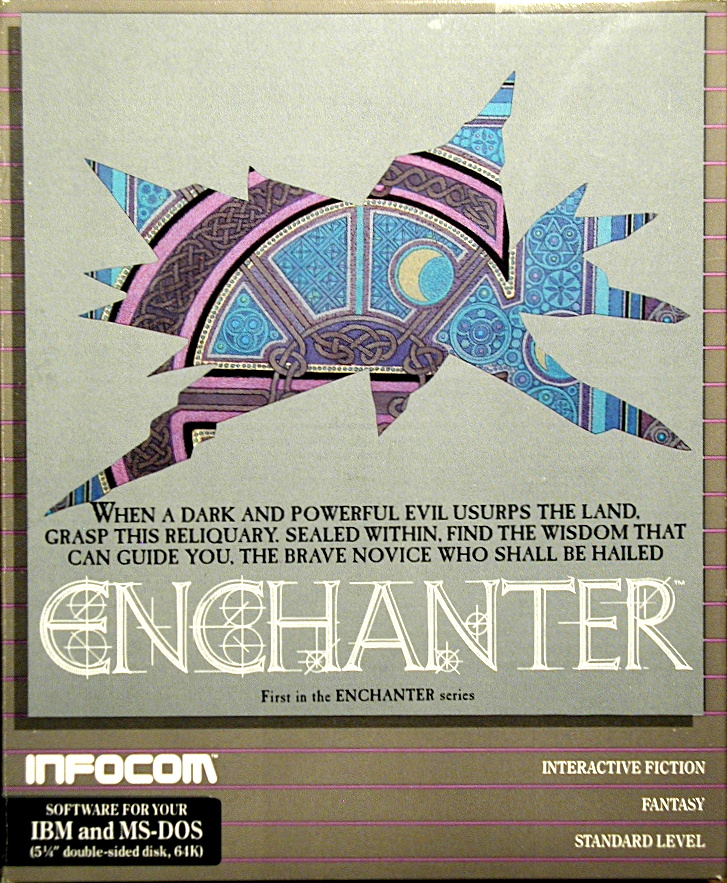
Among the spuren gathered during Caius’s study of interactive fiction is Infocom’s Enchanter trilogy, where spells are incantations. The trilogy’s magical vocabulary includes imaginary words like frotz, blorb, rezrov, nitfol, and gnusto. Performative speech acts. Verbs submitted as commands. So mote it be. By typing verb-noun combinations into a text parser, players effect changes in the gameworld. Saying makes it so.