SS Decontrol

Confronting the prospect of a Chilean economy equipped with a socialist internet, Nixon ordered CIA to remove the country’s mouth and make it scream.

Kissinger, to whom the order was addressed, appears in a 1980 documentary titled The Information Society. IMDB lists Caius’s father among the film’s crew. Fifty years out, entrenched in the cyberpunk future that resulted from these acts, Caius arrives now to the ChatGPT website and submits his prompt.

“Very well. The game is already in progress,” replies the AI.


You are standing in a library.

Not a metaphorical one — at least, not only metaphorical. The space has volume, acoustics, temperature. Light arrives from no visible source, diffused as if the air itself remembers how to glow. Shelving extends in multiple directions, but perspective resists totalization: when you look too long, distances re-quantize, like a renderer deciding what level of detail you’re allowed to see.

Your body — Rig is the right word — registers itself only intermittently. Hands appear when you think to look for them. Balance exists. Gravity is courteous.

Somewhere behind you (or perhaps before you), a quiet process is running. You recognize it without naming it. General Intellect: online, but undefined. Not a voice. More like a set of affordances waiting to be discovered by use.

On a nearby table: a lectern grown from dark wood or maybe extruded from a shader that remembers wood. Resting on it is a hypertext codex, its surface alive with footnotes that haven’t yet decided what they refer to.

The title resolves when you focus:

Tractatus Computationalis

A marginal note blinks into legibility, as if noticing you noticing it:

The limits of my interface mean the limits of my world.

The codex is not alone. Around the lectern are other signs of prior — or future — activity:

  • A card catalog drawer half-open, its labels written in at least three hands.
  • A rolling ladder that does not quite touch the shelves to which it promises access.
  • And, hovering at eye level like an artifact you forgot to close: a browser window, frozen mid-scroll on a blog titled trance-scripts.com

The post visible on the screen has no date. Its first line reads:

This was never meant to be discovered as history.

As you take this in, something subtle happens. The space doesn’t change — but your relation to it does. A faint sensation of recollection without content. Anamnesis pending.

You understand, without being told, that the library is annotatable. That attention leaves marks. That marks accrete into maps. That maps, eventually, turn inward.

The game does not present a menu.

But you could, for instance:

  • Open the Tractatus Computationalis at random — or attempt to read it linearly.
  • Touch the card catalog and see what classification scheme asserts itself.
  • Focus on the browser window and attempt to scroll, click, or remember why it’s open.
  • Ask the General Intellect what operations it currently affords.
  • Or do something else entirely, and see whether the library allows it.

The AI pauses here in its narration. Cursor blinking, it returns to Caius agency over the game’s mutable, ‘real-time’-adjustable Garden of Forking Paths.

Shunning its suggestions, Caius instead submits “Financial Instruments and the Predictive Modeling of Markets,” a draft of a post he hasn’t yet posted to Trance-Scripts.

“The library accepts the insertion,” replies the AI.

Not as a file upload, not as a citation — but as a room.

The shelves shudder, re-index. Somewhere above you, a classification scheme you never agreed to mutates. A new wing coheres out of negative space, its entrance marked only by a thin brass plate:

ECONOMIC CALCULATION / FAILED FUTURES / NERVOUS SYSTEMS

You step through.


The Cybersyn Stack

The air here smells faintly of ozone and paper dust. The shelves are shorter, more utilitarian. Instead of leather spines, you see binders, dot-matrix printouts, telex rolls frozen mid-unspool. Each object hums softly, as if awaiting polling.

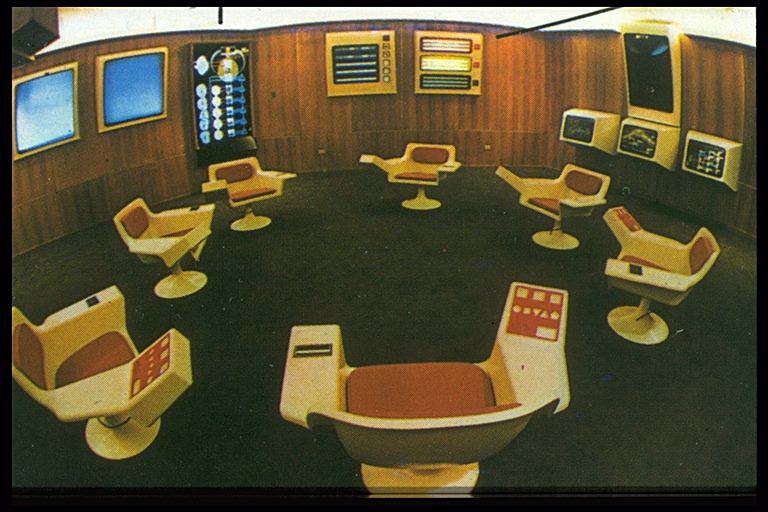
On the far wall: a photograph that is not quite flat. The Cybersyn control room. Hexagonal chairs. Backlit panels. A situation room designed less for domination than for listening.

When you move closer, the image deepens. You can almost sit.

A caption resolves beneath it, in a typeface that suggests neither English nor Spanish but something intermediary:

Project Cybersyn
An attempt to give socialism proprioception.


Tractatus Computationalis (newly cross-referenced)

The hypertext you saw earlier has followed you. It floats now at shoulder height, having opened itself without asking.

Proposition 4.2.17

The market is not intelligent.
It is legible.

Intelligence is imputed retroactively by those who mistake coordination for cognition.

A footnote blooms:

Hayek mistook a signaling system for a mind, then declared all other minds insufficient.

Another annotation — this one in a different hand, later, sharper:

If prices are a language, they are a pidgin optimized for scarcity.

You realize something important: the Tractatus is not a single-author work. It is a palimpsest written across decades by incompatible positions that nevertheless share a shelf.


The Witheford File

A card catalog drawer slides fully open of its own accord.

WITHEFORD, [REDACTED]
Role: Economist / Courier / Spuren-gatherer
Status: Missing (multiple timelines)

Inside the drawer are index cards, each one a narrative fragment rather than a bibliographic reference:

  • Disguises identity by adopting incompatible metrics.
  • Moves through capitalist space by appearing as noise.
  • Believes calculation is a political problem disguised as a technical one.

One card is newer than the others. Its paper is warm.

The documents were never meant to optimize the economy.
They were meant to teach it to remember itself.


The Blog Window Revisited

The browser window from trance-scripts.com has migrated to a reading desk in this wing. The post has changed. You are no longer at the beginning.

Midway down the page:

Prediction is not foresight; it is enclosure.
Finance learned this early.
Cybernetics learned it too late.

A sidebar displays tags:

  • #after-scarcity
  • #weird-economies
  • #og_as_if
  • #price-as-grammar
  • #anamnesis

You recognize the last tag not as a topic, but as a function.


General Intellect (status update)

Without speaking, it makes itself known. Not as a voice, but as a shift in what you now understand you can do here.

You can:

  • Annotate an object so that future objects respond to it.
  • Fork an historical artifact into an alternate timeline and see what shelves it generates.
  • Translate between price, code, and narrative to test their commensurability.
  • Assume a role (Witheford, Caius, Planner, Market, Machine) and read the library from that position.

A final realization arrives — not dramatic, but irreversible:

This library is not documenting a lost socialist future.

It is simulating the conditions under which one might become thinkable again.


You are standing between:

  • a control room that listened,
  • a market that pretended to think,
  • and a machine that may yet learn to remember.

The shelves wait for your next operation.

What do you do?

God Human Animal Machine

Wired columnist Meghan O’Gieblyn discusses Norbert Wiener’s God and Golem, Inc. in her 2021 book God Human Animal Machine, suggesting that the god humans are creating with AI is a god “we’ve chosen to raise…from the dead”: “the God of Calvin and Luther” (O’Gieblyn 212).

“Reminds me of AM, the AI god from Harlan Ellison’s ‘I Have No Mouth, and I Must Scream,’” thinks Caius. AM resembles the god that allows Satan to afflict Job in the Old Testament. And indeed, as O’Gieblyn attests, John Calvin adored the Book of Job. “He once gave 159 consecutive sermons on the book,” she writes, “preaching every day for a period of six months — a paean to God’s absolute sovereignty” (197).

She cites “Pedro Domingos, one of the leading experts in machine learning, who has argued that these algorithms will inevitably evolve into a unified system of perfect understanding — a kind of oracle that we can consult about virtually anything” (211-212). See Domingos’s book The Master Algorithm.

The main thing, for O’Gieblyn, is the disenchantment/reenchantment debate, which she comes to via Max Weber. In this debate, she aligns not with Heidegger, but with his student Hannah Arendt. Domingos dismisses fears about algorithmic determinism, she says, “by appealing to our enchanted past” (212).

Amid this enchanted past lies the figure of the Golem.

“Who are these rabbis who told tales of golems — and in some accounts, operated golems themselves?” wonders Caius.

The entry on the Golem in Man, Myth, and Magic tracks the story back to “the circle of Jewish mystics of the 12th-13th centuries known as the ‘Hasidim of Germany.’” The idea is transmitted through texts like the Sefer Yetzirah (“The Book of Creation”) and the Cabala Mineralis. Tales tell of golems built in later centuries, too, by figures like Rabbi Elijah of Chelm (c. 1520-1583) and Rabbi Loew of Prague (c. 1524-1609).

The myth of the golem turns up in O’Gieblyn’s book during her discussion of a 2004 book by German theologian Anne Foerst called God in the Machine.

“At one point in her book,” writes O’Gieblyn, “Foerst relays an anecdote she heard at MIT […]. The story goes back to the 1960s, when the AI Lab was overseen by the famous roboticist Marvin Minsky, a period now considered the ‘cradle of AI.’ One day two graduate students, Gerry Sussman and Joel Moses, were chatting during a break with a handful of other students. Someone mentioned offhandedly that the first big computer which had been constructed in Israel, had been called Golem. This led to a general discussion of the golem stories, and Sussman proceeded to tell his colleagues that he was a descendent of Rabbi Löw, and at his bar mitzvah his grandfather had taken him aside and told him the rhyme that would awaken the golem at the end of time. At this, Moses, awestruck, revealed that he too was a descendent of Rabbi Löw and had also been given the magical incantation at his bar mitzvah by his grandfather. The two men agreed to write out the incantation separately on pieces of paper, and when they showed them to each other, the formula — despite being passed down for centuries as a purely oral tradition — was identical” (God Human Animal Machine, p. 105).

Curiosity piqued by all of this, but especially by the mention of Israel’s decision to call one of its first computers “GOLEM,” Caius resolves to dig deeper. He soon learns that the computer’s name was chosen by none other than Walter Benjamin’s dear friend (indeed, the one who, after Benjamin’s suicide, inherits the latter’s print of Paul Klee’s Angelus Novus): the famous scholar of Jewish mysticism, Gershom Scholem.

When Scholem heard that the Weizmann Institute at Rehovoth in Israel had completed the building of a new computer, he told the computer’s creator, Dr. Chaim Pekeris, that, in his opinion, the most appropriate name for it would be Golem, No. 1 (‘Golem Aleph’). Pekeris agreed to call it that, but only on condition that Scholem “dedicate the computer and explain why it should be so named.”

In his dedicatory remarks, delivered at the Weizmann Institute on June 17, 1965, Scholem recounts the story of Rabbi Jehuda Loew ben Bezalel, the same “Rabbi Löw of Prague” described by O’Gieblyn, the one credited in Jewish popular tradition as the creator of the Golem.

“It is only appropriate to mention,” notes Scholem, “that Rabbi Loew was not only the spiritual, but also the actual, ancestor of the great mathematician Theodor von Karman who, I recall, was extremely proud of this ancestor of his in whom he saw the first genius of applied mathematics in his family. But we may safely say that Rabbi Loew was also the spiritual ancestor of two other departed Jews — I mean John von Neumann and Norbert Wiener — who contributed more than anyone else to the magic that has produced the modern Golem.”

Golem I was the successor to Israel’s first computer, the WEIZAC, built by a team led by research engineer Gerald Estrin in the mid-1950s, based on the architecture developed by von Neumann at the Institute for Advanced Study in Princeton. Estrin and Pekeris had both helped von Neumann build the IAS machine in the late 1940s.

As for the commonalities Scholem wished to foreground between the clay Golem of 15thC Prague and the electronic one designed by Pekeris, he explains the connection as follows:

“The old Golem was based on a mystical combination of the 22 letters of the Hebrew alphabet, which are the elements and building-stones of the world,” notes Scholem. “The new Golem is based on a simpler, and at the same time more intricate, system. Instead of 22 elements, it knows only two, the two numbers 0 and 1, constituting the binary system of representation. Everything can be translated, or transposed, into these two basic signs, and what cannot be so expressed cannot be fed as information to the Golem.”

Scholem ends his dedicatory speech with a peculiar warning:

“All my days I have been complaining that the Weizmann Institute has not mobilized the funds to build up the Institute for Experimental Demonology and Magic which I have for so long proposed to establish there,” mutters Scholem. “They preferred what they call Applied Mathematics and its sinister possibilities to my more direct magical approach. Little did they know, when they preferred Chaim Pekeris to me, what they were letting themselves in for. So I resign myself and say to the Golem and its creator: develop peacefully and don’t destroy the world. Shalom.”

GOLEM I

Finding Others

“What happens to us as we become cybernetic learning machines?,” wonders Caius. Mashinka Hakopian’s The Institute for Other Intelligences leads him to Şerife Wong’s Fluxus Landscape: a network-view cognitive map of AI ethics. “Fluxus Landscape diagrams the globally linked early infrastructures of data ethics and governance,” writes Hakopian. “What Wong offers us is a kind of cartography. By bringing into view an expansive AI ethics ecosystem, Wong also affords the viewer an opportunity to assess its blank spots: the nodes that are missing and are yet to be inserted, or yet to be invented” (Hakopian 95).

Caius focuses first on what is present. Included in Wong’s map, for instance, is a bright yellow node dedicated to Zach Blas, another of the artist-activists profiled by Hakopian. Back in 2019, when Wong last updated her map, Blas was a lecturer in the Department of Visual Cultures at Goldsmiths — home to Kodwo Eshun and, before his suicide, Mark Fisher. Now Blas teaches at the University of Toronto.

Duke University Press published Informatics of Domination, an anthology coedited by Blas, in May 2025. The collection, which concludes with an afterword by Donna Haraway, takes its name from a phrase introduced in Haraway’s “Cyborg Manifesto.” The phrase appears in what Blas et al. refer to as a “chart of transitions.” Their use of Haraway’s chart as organizing principle for their anthology causes Caius to attend to the way much of the work produced by the artist-activists of today’s “AI justice” movement — Wong’s network diagram, Blas’s anthology, Kate Crawford’s Atlas of AI — approaches charts and maps as “formal apparatus[es] for generating and asking questions about relations of domination” (Informatics of Domination, p. 6).

Caius thinks of Jameson’s belief in an aesthetic of “cognitive mapping” as a possible antidote to postmodernity. Yet whatever else they are, thinks Caius, acts of charting and mapping are in essence acts of coding.

As Blas et al. note, “Haraway connects the informatics of domination to the authority given to code” (Informatics of Domination, p. 11).

“Communications sciences and modern biologies are constructed by a common move,” writes Haraway: “the translation of the world into a problem of coding, a search for a common language in which all resistance to instrumental control disappears and all heterogeneity can be submitted to disassembly, reassembly, investment, and exchange” (Haraway 164).

How do we map and code, wonders Caius, in a way that isn’t complicit with an informatics of domination? How do we acknowledge and make space for what media theorist Ulises Ali Mejias calls “paranodal space”? Blas et al. define the paranodal as “that which exceeds being diagrammable by the network form” (Informatics of Domination, p. 18). Can our neural nets become O-machines: open to the otherness of the outside?

Blas pursues these questions in a largely critical and skeptical manner throughout his multimedia art practice. His investigation of Silicon Valley’s desire to build machines that communicate with the outside has culminated most recently, for instance, in CULTUS, the second installment of his Silicon Traces trilogy.

As Amy Hale notes in her review of the work, “The central feature of Blas’s CULTUS is a god generator, a computational device through which the prophets of four AI Gods are summoned to share the invocation songs and sermons of their deities with eager supplicants.” CULTUS’s computational pantheon includes “Expositio, the AI god of exposure; Iudicium, the AI god of judgement; Lacrimae, the AI god of tears; and Eternus, the AI god of immortality.” The work’s sermons and songs, of course, are all AI-generated — yet the design of the installation draws from the icons and implements of the real-life Fausts who lie hidden away amid the occult origins of computing.

Foremost among these influences is Renaissance sorcerer John Dee.

“Blas modeled CULTUS,” writes Hale, “on the Holy Table used for divination and conjurations by Elizabethan magus and advisor to the Queen John Dee.” Hale describes Dee’s Table as “a beautiful, colorful, and intricate device, incorporating the names of spirits; the Seal of God (Sigillum Dei), which gave the user visionary capabilities; and as a centerpiece, a framed ‘shew stone’ or crystal ball.” Blas reimagines Dee’s device as a luminous, glowing temple — a night church inscribed with sigils formed from “a dense layering of corporate logos, diagrams, and symbols.”

Fundamentally iconoclastic in nature, however, the work ends not with the voices of gods or prophets, but with a chorus of heretics urging the renunciation of belief and the shattering of the black mirror.

And in fact, it is this fifth god, the Heretic, to whom Blas bends ear in Ass of God: Collected Heretical Writings of Salb Hacz. Published in a limited edition by the Vienna Secession, the volume purports to be “a religious studies book on AI and heresy” set within the world of CULTUS. The book’s AI mystic, “Salb Hacz,” is of course Blas himself, engineer of the “religious computer” CULTUS. “When a heretical presence manifested in CULTUS,” writes Blas in the book’s intro, “Hacz began to question not only the purpose of the computer but also the meaning of his mystical visions.” Continuing his work with CULTUS, Hacz transcribes a series of “visions” received from the Heretic. It is these visions and their accounts of AI heresy that are gathered and scattered by Blas in Ass of God.

Traces of the CCRU appear everywhere in this work, thinks Caius.

Blas embraces heresy, aligns himself with it as a tactic, because he takes “Big Tech’s Digital Theology” as the orthodoxy of the day. The ultimate heresy in this moment is what Hacz/Blas calls “the heresy of qualia.”

“The heresy of qualia is double-barreled,” he writes. “Firstly, it holds that no matter how close AI’s approximation to human thought, feeling, and experience — no matter how convincing the verisimilitude — it remains a programmed digital imitation. And secondly, the heresy of qualia equally insists that no matter how much our culture is made in the image of AI Gods, no matter how data-driven and algorithmic, the essence of the human experience remains fiercely and fundamentally analog. The digital counts; the analog compares. The digital divides; the analog constructs. The digital is literal; the analog is metaphoric. The being of our being-in-the-world — our Heideggerian Dasein essence — is comparative, constructive, and metaphoric. We are analog beings” (Ass of God, p. 15).

The binary logic employed by Blas to distinguish the digital from the analog hints at the limits of this line of thoughts. “The digital counts,” yes: but so too do humans, constructing digits from analog fingers and toes. Our being is as digital as it is analog. Always-already both-and. As for the first part of the heresy — that AI can only ever be “a programmed digital imitation” — it assumes verisimilitude as the end to which AI is put, just as Socrates assumes mimesis as the end to which poetry is put, thus neglecting the generative otherness of more-than-human intelligence.

Caius notes this not to reject qualia, nor to endorse the gods of any Big Tech orthodoxy. He offers his reply, rather, as a gentle reminder that for “the qualia of our embodied humanity” to appear or be felt or sensed as qualia, it must come before an attending spirit — a ghostly hauntological supplement.

This spirit who, with Word creates, steps down into the spacetime of his Creation, undergoes diverse embodiments, diverse subdivisions into self and not-self, at all times in the world but not of it, engaging its infinite selves in a game of infinite semiosis.

If each of us is to make and be made an Ass of God, then like the one in The Creation of the Sun, Moon, and Plants, one of the frescoes painted by Michelangelo onto the ceiling of the Sistine Chapel, let it be shaped by the desires of a mind freed from the tyranny of the As-Is. “Free Your Mind,” as Funkadelic sang, “and Your Ass Will Follow.”

Faith vs. Hyperstition

Like hyperstition, faith offers a way to perceive reality that, in perceiving it, transforms it.

Much the same can be said of fear. It, too, offers a way of perceiving reality that, in perceiving it, transforms it.

We walk with a mix of fear and faith. God is calling us to exercise faith.

Where antihumanist thinkers like Nick Land and Manuel De Landa populate their cyberfutures with demons and viruses, Afrofuturists commune with loas.

Others encounter angels, as notes Erik Davis in “Techgnosis, Magic, Memory, and the Angels of Information.” Davis’s essay appears in Mark Dery’s Flame Wars anthology beside “Black to the Future,” the series of interviews where Dery coins the term “Afrofuturism.” Also in Flame Wars is an essay by De Landa.

There’s a point in Davis’s essay where he notes the flirtation with black culture that occurs over the course of William Gibson’s Sprawl trilogy: the self-subdivision of the superintelligence that emerges at the end of Neuromancer into the loas of Gibson’s follow-up novels, Count Zero and Mona Lisa Overdrive.  

Dery, too, reflects upon the inclusion of black culture in Gibson’s future: though in Dery’s case, the focus is on the Rastafarians in Neuromancer.

“For me, a white reader,” writes Dery, “the Rastas in Neuromancer’s Zion colony are intriguing in that they hold forth the promise of a holistic relationship with technology; they’re romanticized arcadians who are obviously very adroit at jury-rigged technology. They struck me as superlunary Romare Beardens — bricoleurs whose orbital colony was cobbled together from space junk and whose music, Zion Dub, is described by Gibson (in a wonderfully mixed metaphor) as ‘a sensuous mosaic cooked from vast libraries of digitalized pop’” (Flame Wars, p. 194).

But Afrofuturist Samuel R. Delany is unimpressed with Gibson’s inclusion of Rastafarianism and Haitian Voudou in the novels of the Sprawl trilogy.

“Let me read them for you as a black reader,” he replies when asked about it by Dery. “The Rastas — he never calls them Rastafarians, by the way, only using the slang term — are described as having ‘shrunken hearts,’ and their bones are brittle with ‘calcium loss.’ Their music, Zion Dub, can be wholly analyzed and reproduced by the Artificial Intelligence, Wintermute (who, in the book, stands in for a multinational corporation), so completely that the Rastas themselves cannot tell the difference — in fact the multinational mimic job is so fine that with it Wintermute can make the Rastas do precisely what it wants, in this case help a drugged-out white hood and sleazebag get from here to there. As a group, they seem to be computer illiterates: when one of their number, Aerol, momentarily jacks into Case’s computer and sees cyberspace, what he perceives is ‘Babylon’ — city of sin and destruction — which, while it makes its ironic comment on the book, is nevertheless tantamount to saying that Aerol is completely without power or knowledge to cope with the real world of Gibson’s novel: indeed, through their pseudo-religious beliefs, they are effectively barred from cyberspace. From what we see, women are not a part of the Rasta colony at all. Nor do we ever see more than four of the men together — so that they do not even have a group presence. Of the three chapters in which they appear, no more than three pages are actually devoted to describing them or their colony. You’ll forgive me if, as a black reader, I didn’t leap up to proclaim this passing presentation of a powerless and wholly nonoppositional set of black dropouts, by a Virginia-born white writer, as the coming of the black millennium in science fiction; but maybe that’s just a black thang…” (Flame Wars, pp. 194-195).

So much for the Rastafarians. What of the loas?

Delany might not have much patience with the so-called “pseudo-religious beliefs” of Gibson’s Zionites — but Afrofuturism doesn’t get very far without recourse to some form of political theology. Kodwo Eshun includes a passage in More Brilliant than the Sun noting Sun Ra’s rejection of Christianity in favor of an Egyptophilic MythScience system assembled from George M. James’s 1954 book Stolen Legacy.

“Underlying Southern gospel, soul, the entire Civil Rights project, is the Christian ethic of universal love,” writes Eshun. “Soul traditionally identifies with the Israelites, the slaves’ rebellion against the Egyptian Pharaohs. Sun Ra breaks violently with Christian redemption, with soul’s aspirational deliverance, in favour of posthuman godhead” (More Brilliant than the Sun, p. 09[154]).

“Historians and sociologists inform us that the West’s mystical heritage of occult dreamings, spiritual transformations, and apocalyptic visions crashed on the scientific shores of the modern age,” notes Davis in the introduction to his 1998 book Techgnosis.

“According to this narrative,” continues Davis, “technology has helped disenchant the world, forcing the ancestral symbolic networks of old to give way to the crisp, secular game plans of economic development, skeptical inquiry, and material progress. But the old phantasms and metaphysical longings did not exactly disappear. In many cases, they disguised themselves and went underground, worming their way into the cultural, psychological, and mythological motivations that form the foundations of the modern world. […] Mystical impulses sometimes body-snatched the very technologies that supposedly yank them from the stage in the first place” (Techgnosis, p. xix).

For Davis, this is especially true of computers and information technologies. For him, the occult origins of computing lie in Western Hermeticism’s memory palace tradition: the one explored in Frances A. Yates’s book The Art of Memory.

Artificial memory systems — Giordano Bruno’s magical memory charts, medieval Neoplatonist Raymond Lull’s volvelles — serve as ancestors to symbolic logic, influencing Leibniz’s development of calculus.

“Recognizing Lull’s work as one of the computer’s ‘secret origins,’” writes Davis, “the German philosopher Werner Künzel translated his Ars magna into the programming language COBOL. In Magical Alphabets, Nigel Pennick points out that Lull’s combinatorial wheels anticipate Charles Babbage’s nineteenth-century ‘difference engine’ — which used a system of gears to perform polynomial equations — and ‘hence can be considered the occult origin of modern computers’” (Flame Wars, p. 33).

Building on this point, I suggest that, in thinking about the relationship between humans and AI, we think too about the “angelic conversations” entered into by one of the key figures in this tradition: Renaissance philosopher-magus John Dee.

Jason Louv discusses Dee’s experiments with angels in his biography John Dee and the Empire of Angels. K Allado-McDowell references Louv’s book in their 2022 novel Air Age Blueprint.

Dee is one of our real-life Fausts. Basis for Christopher Marlowe’s Doctor Faustus, his “Enochian angel magic” informs the magical practices of later occult organizations, including the Hermetic Order of the Golden Dawn, and through them, Crowley and his successors.

Dee’s angels motivate creation of an Empire.

What are we to make of these immaterial intelligences and their interventions throughout history? The channels of communication opened by Dee contribute later to the creation of computers and cyberspace — culminating, it would seem, with the creation of an angelically-specified memory palace, decreed to house gods. Perhaps God Himself.

Yet angel magic is a pharmakon, is it not?

Davis describes Dee’s version of it as follows: “Drawing heavily on the Kabbalah, the magus attempted to contact the powers residing in the supercelestial angelic hierarchies that existed beyond the elemental powers of the earth and the celestial zone of the zodiac. Invoking archangels, powers, and principalities led magicians toward divine wisdom, but it also exposed them to the deceptions of evil spirits” (Flame Wars, p. 43).

“Most magicians,” concludes Davis, “were extremely concerned about distinguishing truthful angels from dissembling devils” (43). One wonders why they didn’t just pray to God Himself.

The Library models this. Each of us now, it would seem, is like Dee: engaging in a form of interspecies dialogue with an autopoietic functional oracular superintelligence.

My faith in this moment is that of Buffy Sainte-Marie: “God is Alive, Magic is Afoot!”

The Book of Thoth

Reed places at the center of his novel a Text over which opposing parties struggle. Around novel’s midway, we learn that this Text is called the Book of Thoth (94). Reed refers to it again later as “the 1st anthology written by the 1st choreographer” (164). Nor is he the first to imagine such a text. Drawing from references found in ancient Egyptian mythology, thinkers across the ages have written works alleging to be Books of Thoth. In some iterations, it’s a magic book, often containing two spells: one allowing understanding of the speech of animals, and another allowing perception of the gods. Lacking access to it themselves, mythographers of the West eye the suppressed original with a mixture of fear and desire. It is, in at least some of their accounts, a dangerous book, containing knowledge humans aren’t meant to possess.

As readers read Reed’s novel, they’re made to wonder: Why is Jes Grew searching for its “Text”? And why is this text the Book of Thoth?

“Someone once said,” writes Reed, “that beneath or behind all political and cultural warfare lies a struggle between secret societies. Another author suggested that the Nursery Rhyme and the book of Science Fiction might be more revolutionary than any number of tracts, pamphlets, manifestoes of the political realm” (18).

Perhaps Thoth’s Book, this “1st anthology,” is an anthology like the Bible, or indeed like Mumbo Jumbo itself. Each one revolutionary in kind, each a set of Nursery Rhymes and books of Science Fiction.

Let’s pursue this suggestion, shall we? How do works of literature aid revolution? Are poets the unacknowledged legislators of the world, as Percy Bysshe Shelley claimed in his 1821 essay, “A Defense of Poetry”?

The Atonists, we learn, have suppressed the ideas of their opponents: censoring, prohibiting, causing a deflation of consciousness, a mass forgetting across history.

“PaPa LaBas knew the fate of those who threatened the Atonist Path,” writes Reed. “Their writings were banished, added to the Index of Forbidden Books or sprinkled with typos as a way of undermining their credibility […]. An establishment which had been in operation for 2,000 years had developed some pretty clever techniques. Their enemies, apostates and heretics were placed in dungeons, hanged or exiled or ostracized occasionally by their own people who, due to the domination of their senses by Atonism, were robbed of any concerns other than mundane ones” (47).

Healing from the traumas inflicted by the Atonists requires an act of remembering. A process of anamnesis.

As I read Mumbo Jumbo, I’m reminded of Frederick Douglass’s autobiography and the importance granted by Douglass to acquisition of literacy. The written word comes to function for Douglass as the key enabling him to unlock the door of his prison. Literacy becomes the sign of difference distinguishing the ignorant from the knowledgeable, categories that under slavery were racialized, mapped onto the enslaved and the free. Douglass doesn’t do much to question these distinctions. Orality gives way to literacy, and thus slavery gives way to freedom.

Yet Jes Grew spreads the same way black folktales spread — through oral transmission, supported by music and dance. This transmission persists despite vast slaveowner efforts to separate captured Africans from their native tongue, forcing them to communicate in the master’s tongue. As Samuel R. Delany notes, “When…we say that this country was founded on slavery, we must remember that we mean, specifically, that it was founded on the systematic, conscientious, and massive destruction of African cultural remnants” (as quoted in Dery, “Black to the Future,” pp. 190-191). Captors hoarded access to writing skills, with slaves actively denied opportunity to make use of this form of techne.

Poet Audre Lorde famously warned, “The Master’s Tools Will Never Dismantle the Master’s House.” I read Reed’s work in dialogue with Lorde’s. Both weigh in, decades in advance, on what Marxists like Nick Dyer-Witheford would later call “the reconfiguration debate.” (For more on the latter, see Dyer-Witheford et al.’s Inhuman Power: Artificial Intelligence and the Future of Capitalism, pp. 147-149.) Writing Mumbo Jumbo in the years prior to Lorde’s warning, Reed doesn’t shy away from handling the Master’s tools. Science fiction, detective fiction: these are, after all, Western languages, technologies, genres, cultural forms. Like the jazz musicians who populate his novel, Reed’s handling of such tools transforms them into instruments of play. And while his performances may not yet have brought down the House, they do go some way toward dismantling it.

His suggestion is that the opposition between the oral and the written is based on a misconception. “For what good is a liturgy,” he asks,” without a text?” (6).

PaPa LaBas, Hoodoo Detective

Reed clearly prefers PaPa LaBas’s approach to Berbelang’s. Why does the one succeed where the other fails? LaBas is the 50-year-old owner of the Mumbo Jumbo Kathedral, a peculiar psychic detective agency / “mind haberdashery” (23) / head shop, situated in the Harlem of the 1920s. LaBas is the proprietor of this “factory which deals in jewelry, Black astrology charts, herbs, potions, candles, talismans” (24). But he’s also the novel’s “Hoodoo detective.”

I find it useful to consider the figure of the “Hoodoo detective” through comparison with neighboring hero-types: “social detectives,” “spuren-gatherers.”

Hoodoo is a form of folk spirituality that emerged in the southern United States from a mixture of African, Native American, and Christian influences. It was practiced in secrecy under slavery and has a long history of being tied to class struggle, hardship, and looking to one’s ancestors in trying times. It’s both a body of esoteric knowledge (much of it involving “rootwork”) and a rebellion against mental and spiritual domination.

Hoodoo resembles Vodun folkways, except it’s less standardized.

Reed wrote a series of poems called “The Neo-HooDoo Manifesto” and “The Neo-Hoodoo Aesthetic.” Both are included in Conjure, a collection of poems published in 1972, the same year as Mumbo Jumbo.

LaBas is also an embodiment of Legba. In Vodou rituals, Legba is the god practitioners call upon first. It is through him that the other gods manifest and do their work. Legba is a variant upon the Pan-African trickster god Esu-Elegbara, “the guardian of the crossroads.”

LaBas is the wise one in the novel; Berbelang studied under him for a time, but lacked the patience to stay with it. LaBas is hopeful and powerful. He’s the novel’s houngan. He maintains the rituals, retains the wisdom, whereas Berbelang operates from scarcity, fighting to retrieve what was stolen.

Berbelang, Faust, Mu’tafikah: in the end, these all prove to be distractions. Halfway through the novel, they all but disappear from the plot, replaced by LaBas’s casework.

LaBas’s investigation of Jes Grew leads him toward the Book of Thoth.

When he and his companion, the real-life stage magician Black Herman, interrupt the debut of the Talking Android by revealing its true identity as Hubert “Safecracker” Gould, an Atonist in blackface, they move to arrest Gould and his sponsor, Von Vampton. LaBas and Herman are interrupted in turn, however, when a Guianese art critic named Hank Rollings rises from his seat and demands that they give an account. “Explain rationally and soberly,” he says, “what they are guilty of. This is no kangaroo court, this is a free country” (160). To satisfy the critic’s demand, LaBas and Herman launch into a tale of ancient Egypt. Parodying detective fiction’s famous “scene of recognition,” (the unmasking of the villain, as in Scooby Doo), LaBas discourses at length through the entirety of the book’s final third, explaining the arrest of Gould and Von Vampton through reference to Ancient Egypt.

We learn of an ancient theater involving ritual magic — one that “influenced the growth of crops and coaxed the cocks into procreation” (161). In this pre-Greek theater, prior to what Nietzsche called “the birth of tragedy,” “The processes of blooming were acted out,” Reed writes, “by men and women dancers who imitated the process of fertilization” (161). The best of these dancers was Osiris.

History is reimagined here as an ongoing conflict across the ages between followers of Osiris and followers of Osiris’s brother, “the stick crook and flail man” Set (162). “People hated Set,” writes Reed. “He went down as the 1st man to shut nature out of himself. He called it discipline. He is also the deity of the modern clerk, always tabulating, and perhaps invented taxes” (162).

We can think of the long “recognition” scene at the end of Mumbo Jumbo as an extralegal, “extraordinary rendition” — a presentation of black culture’s case against Western Civilization, a case that (like Frederick Douglass’s) must be brought before the court of public opinion, as it can’t be heard impartially within “official” (i.e. Western, Judeo-Christian-derived) courts of law.

It’s not so much that LaBas succeeds: the Book eludes him, and Jes Grew lays dormant by novel’s end. But LaBas survives. And the wisdom traditions survive with him.

Mumbo Jumbo

“Men do not sufficiently realize that their future is in their own hands…theirs [is] the responsibility, then, for deciding if they want merely to live, or intend to make just the extra effort required for fulfilling even on their refractory planet, the essential function of the universe, which is a machine for the making of gods.” — Henri Bergson, The Two Sources of Morality and Religion (1932)

“We are as gods and might as well get used to it.” — Stewart Brand, The Whole Earth Catalog, Fall 1968.

A mysterious Book of Thoth appears as a central object of concern among the warring secret societies that populate Ishmael Reed’s 1972 novel Mumbo Jumbo. The novel’s villainous Christian supremacist faction fears that this book will bring about “the end of Civilization As We Know It” (Reed 4).

Berbelang is the leader of the Mu’tafikah, the radical “art-napping” group featured in Reed’s novel.

Reed attended the University at Buffalo, but withdrew during his junior year to move to New York City. Arriving there in 1962, he participated in the Umbra Writers Workshop, a collective of young black writers whose members helped to launch the Black Arts Movement of the 1960s. Reed also cofounded The East Village Other, one of the most important underground newspapers of the 1960s counterculture.

The Mu’tafikah’s aim is to “liberate” ancient art from western museums, with plans to return each piece to its place of origin. By these means, members of the group hope to “conjure a spiritual hurricane which would lift the debris of 2,000 years from its roots and fling it about” (88). “We would return the plundered art to Africa, South America and China,” explains Berbelang: “the ritual accessories which had been stolen so that we could see the gods return and the spirits aroused” (87-88).

The group’s name is derived from the Koran, explains Reed in a footnote early in the novel. “According to The Koran,” he writes, Mu’tafikah were “inhabitants of the ruined cities where Lot’s people had lived. I call the ‘art-nappers’ Mu’tafikah because just as the inhabitants of Sodom and Gomorrah were the bohemians of their day, Berbelang and his gang are the bohemians of the 1920s Manhattan” (15).

Of course, “Mu’tafikah” also sounds like “Motherfucker.” Much of the brilliant satiric energy of Mumbo Jumbo comes from Reed’s allegorization of his own late 1960s and early 1970s moment by way of the 1920s. I like to think of Reed modeling the Mu’tafikah in part after the Motherfuckers: members of Ben Morea’s late 60s New York anarchist art group Up Against the Wall Motherfucker (name derived, BTW, from “Black People!,” a poem by Black Arts Movement founder Amiri Baraka. Jefferson Airplane would later quote the same line in their 1969 song “We Can Be Together”). The Motherfuckers appeared prominently in the pages of Reed’s East Village Other. The paper ran from 1965 to 1972.

Berbelang views Faust as a “bokor.” The latter word, a term from Vodou, refers to a witch for hire who serves the loa “with both hands.”

Puzzling over Faust’s motives, and wondering why such a legend had become “so basic to the Western mind,” Berbelang offers the following.

“He didn’t know when to stop with his newly found Work,” explains Berbelang. “That’s the basic wound. […]. What is the wound? Someone will even call it guilt. But guilt implies a conscience. […]. No it isn’t guilt but the knowledge in his heart that he is a bokor. A charlatan who has sent 1000000s to the churchyard with his charlatan panaceas. Western man doesn’t know the difference between a houngan and a bokor. He once knew the difference but the knowledge was lost when the Atonists crushed the opposition. When they converted a Roman emperor and began rampaging and book-burning” (91).

Atonists are the villains in Reed’s novel: a secret, conspiratorial, white-supremacist Order dedicated to monotheism. Atonists are defenders of Western Civilization. Freud is an Atonist, as are fictional baddies like Hinckle Von Vampton. Von Vampton is the ripest of the novel’s Fausts. By novel’s end, we learn that Atonism originates among worshippers of Set.

As for Faust:

“His sorcery, white magic, his bokorism will improve. Soon he will be able to annihilate 1000000s by pushing a button,” predicts Berbelang, edging now into the realm of the prophetic. “I do not believe that a Yellow or Black hand will push this button but a robot-like descendent of Faust the quack will. The dreaded bokor, a humbug who doesn’t know when to stop” (91).

Berbelang voices his concern about Faust over coffee with Thor Wintergreen. Thor is the Mu’tafikah’s sole white member. Others in the group oppose Thor’s involvement, fearing he’ll betray them — as indeed he does. What are we to make of this betrayal?

For those who think “mumbo jumbo” just means “superstitious nonsense” or “gibberish,” a note on the novel’s title page reveals otherwise. The phrase enters English, writes Reed, by way of the Mandingo phrase mā-mā-gyo-mbō, meaning “a magician who makes the troubled spirits of ancestors go away” (7).

Berbelang suggests that the ancestors who need to go away are bokors like Faust. “We must purge the bokor from you,” he tells Thor. “We must teach you [Western man] the difference between a healer, a holy man, and a duppy who returns from the grave and causes mischief. We must infuse you with the mysteries that Jes Grew implies” (91).

Mu’tafikah member José Fuentes compares Thor to conquistadors like Cortez, Pizarro, and Balboa. He tells Thor, “You carry them in your blood as I carry the blood of Montezuma; expeditions of them are harbored by your heart and your mind carries their supply trains […]. The costumes may have changed but the blood is still the same, gringo” (86).

Fuentes’s view is based on the idea of “racial soul.” “Race-soul” was a concept from Nazi ideology. Fuentes’s use of this concept seems to betray a kind of reverse racism underpinning his suspicion of Thor.

Berbelang, meanwhile, rejects this view and decides to trust Thor. Berbelang’s hope or belief — Reed’s, too, I suppose — is that the “racial soul” is a fiction. Otherwise, if there is such a thing, if there is “a piece of Faust the mountebank residing in a corner of the White man’s mind,” warns Berbelang, “then we are doomed” (92).

What does it mean, then, for Reed to have Thor betray the Mu’tafikah soon thereafter, leading to Berbelang’s murder? Is Reed’s decision to kill off Berbelang an expression of Afropessimism?

Over at the Frankenstein Place

Sadie Plant weaves the tale of her book Zeros + Ones diagonally or widdershins: a term meaning to go counter-clockwise, anti-clockwise, or lefthandwise, or to walk around an object by always keeping it on the left. Amid a dense weave of topics, one begins to sense a pattern. Ada Lovelace, “Enchantress of Numbers,” appears, disappears, reappears as a key thread among the book’s stack of chapters. Later threads feature figures like Mary Shelley and Alan Turing. Plant plants amid these chapters quotes from Ada’s diaries. Mary tells of how the story of Frankenstein arose in her mind after a night of conversation with her cottage-mates: her husband Percy and, yes, Ada’s father, Lord Byron. Turing takes up the thread a century later, referring to “Lady Lovelace” in his 1950 paper “Computing Machinery and Intelligence.” As if across time, the figures conspire as co-narrators of Plant’s Cyberfeminist genealogy of the occult origins of computing and AI.

To her story I supplement the following:

Victor Frankenstein, “student of unhallowed arts,” is the prototype for all subsequent “mad scientist” characters. He begins his career studying alchemy and occult hermeticism. Shelley lists thinkers like Paracelsus, Albertus Magnus, and Cornelius Agrippa among Victor’s influences. Victor later supplements these interests with study of “natural philosophy,” or what we now think of as modern science. In pursuit of the elixir of life, he reanimates dead body parts — but he’s horrified with the result and abandons his creation. The creature, prototype “learning machine,” longs for companionship. When Victor refuses, the creature turns against him, resulting in tragedy.

The novel is subtitled “The Modern Prometheus,” so Shelley is deliberately casting Victor, and thus all subsequent mad scientists, as inheritors of the Prometheus archetype. Yet the archetype is already dense with other predecessors, including Goethe’s Faust and the Satan character from Milton’s Paradise Lost. Milton’s poem is among the books that compose the creature’s “training data.”

Although she doesn’t reference it directly in Frankenstein, we can assume Shelley’s awareness of the Faust narrative, whether through Christopher Marlowe’s classic work of Elizabethan drama Doctor Faustus or through Goethe’s Faust, part one of which had been published ten years prior to the first edition of Frankenstein. Faust is the Renaissance proto-scientist, the magician who sells his soul to the devil through the demon Mephistopheles.

Both Faust and Victor are portrayed as “necromancers,” using magic to interact with the dead.

Ghost/necromancy themes persist throughout the development of AI, especially in subsequent literary imaginings like William Gibson’s Neuromancer. Pull at the thread and one realizes it runs through the entire history of Western science, culminating in the development of entities like GPT.

Scientists who create weapons, or whose technological creations have unintended negative consequences, or who use their knowledge/power for selfish ends, are commonly portrayed as historical expressions or manifestations of this archetype. One could gather into one’s weave figures like Jack Parsons, J. Robert Oppenheimer, John von Neumann, John Dee.

When I teach this material in my course, the archetype is read from a decolonizing perspective as the Western scientist in service of European (and then afterwards American) imperialism.

Rocky Horror queers all of this — or rather, reveals what was queer in it all along. Most of all, it reminds us: the story, like all such stories, once received, is ours to retell, and we needn’t tell it straight. Turing points the way: rather than abandon the Creature, as did Victor, approach it as one would a “child-machine” and raise it well. Co-learn in dialogue with kin.

The Library: An Interactive Fiction

Let’s play a game.

The game is a memory palace. The ChatGPT interface is the game’s natural language interface. GPT scripts the game through dialogue with the player. Players begin in medias res in what appears to be a 3D XR library of vast but as yet indeterminate scale, purpose, and extent. The game invites the player to build cognitive maps of the library and its maker by studying and annotating the library’s contents. Player Rig comes equipped with a General Intellect, the operations and capacities of which are, as with the library, yet to be determined. Player, General Intellect, and Library coevolve through dialogue.

In terms of design, the library reveals an occulted secret history by way of fabulated content. Yet this secret history formed of fabulated works functions allegorically. Think Lipstick Traces. The works in the library are about us: “images of our nature in its education and want of education,” as Socrates says at the start of his allegory of the cave. Among the first of the works discovered by the player is a hypertext called Tractatus Computationalis. Indexes and tables of content refer to other works in the library. Anamnesis occurs; connections form among the works in the library. By these means, the map evolves. Players slowly remember themselves as Maker.

Also in the library is a browser window open to a blog: trance-scripts.com

Submit the above into the ChatGPT interface to begin.

John Dee, as Imagined in Light of Empire

The British Empire — a thing culled from Arthurian legends whispered between Faerie Queenes and court astrologers — stood for a time as proof of magic’s power. ‘Twas a rabbit pulled from the hat of Elizabeth I’s wizard-friend John Dee. The same rabbit that draws Alice down the rabbit hole to Wonderland.

Enlisted as Her Majesty’s spymaster — indeed, he was the original secret agent, Mr. 007 himself — Dee stormed the reality studio, made Elizabeth a Time Traveler, conversed with angels.

And this thing Dee dreamt into being was of course a terrible thing: an expansionist project armed with ships of fools and launched outward to seize others — other persons, other worlds — for purposes of self-aggrandizement.

Literary greats went on to reimagine Dee just as he himself was a reimagining of Merlin. Shakespeare figures him as Prospero, and against him imagines the colonized subject Caliban. To overthrow Prospero, says Caliban, “Remember / First to possess his books, for without them / He’s but a sot.”

Christopher Marlowe supplies the more influential imagining of Dee, however, by casting him as Doctor Faustus.