Postcapitalist Desire

Marcuse is among the authors CCRU alum Mark Fisher included on the syllabus for his final course. It was while teaching this course that Fisher took his own life. References to Marcuse appear frequently in Postcapitalist Desire, the compilation of Fisher’s final lectures, gathered and published posthumously by his student Matt Colquhoun. One can only imagine how and in what fashion Marcuse would have fit into Fisher’s book on Acid Communism. It, too, was left unfinished at the time of his death.

Imagine in this book reference to Moten and Harney’s “generativity without reserve.”

Let us write it here in our Library.

Fisher grew up in a conservative, working-class household in Leicester, a city in the East Midlands region of England. He contributed to CCRU while earning his PhD at University of Warwick in the late 1990s. After teaching for several years as a philosophy lecturer at a further education college, Fisher launched k-punk, a blog dedicated to cultural theory, in 2003.

The ideas that he developed there inform his best-known book, Capitalist Realism, published in 2009.

The book’s title names the ideology-form that dominates life in the wake of the Cold War: “the widespread sense,” as Fisher says, “that not only is capitalism the only viable political and economic system, but also that it is now impossible even to imagine a coherent alternative to it” (Capitalist Realism, p. 2).

Like others on the left, Fisher regards capitalism’s apparent triumph in this moment as a kind of ongoing apocalypse — the opposite of the  “Eucatastrophe” anticipated by Tolkien. Fisher describes it not as a miracle, but as “a negative miracle, a malediction which no penitence can ameliorate” (2). “The catastrophe,” as Fisher notes, “is neither waiting down the road, nor has it already happened. Rather, it is being lived through” (2). Everyday life, in other words, as ongoing traumatic event.

Fisher had moved in the year or so before his death to a definition of capitalist realism as a form of “consciousness deflation,” or “the receding of the concept of consciousness from culture.” Forms of consciousness had developed in the 1960s that were dangerous to capital: class consciousness, psychedelic consciousness (key notion being “plasticity of reality”), and (as with early women’s-lib consciousness-raising groups) what we might call personal consciousness (self as it relates to structures). The important and perhaps most controversial point, argues Fisher, is that “Consciousness is immediately transformative, and shifts in consciousness become the basis for other kinds of transformation.” Recognizing the threat this could pose, capitalism adopted a project of Prohibition, or what Fisher called “libidinal engineering and reality engineering.” Consciousness deflation works by causing us to doubt what we feel. Anxiety is enough — that’s all it takes to control us. But consciousness remains malleable, and the tools for raising it continually find their way back into the hands of the people. “What is ideology,” Fisher asked, “but the form of dreaming in which we live?”

Fisher spent the final years of his life as a member of the Department of Visual Cultures at Goldsmiths, University of London. He hanged himself in his home in Felixstowe on January 13, 2017, dead by suicide at the age of 48. He had sought psychiatric treatment in the weeks leading up to his death, but his general practitioner had only been able to offer over-the-phone meetings to discuss a referral.

A few months prior, he’d been lecturing to his students about Marcuse’s Eros and Civilization, championing Marcuse’s book as a reply to the pessimism of Freud’s Civilization and Its Discontents.

Freud’s calculation is that “the price we pay for our advance in civilization is a loss of happiness through the heightening of the sense of guilt” (Civilization and Its Discontents, p. 81). Each of us is made to feel guilty, because in each of us lie impulses in need of repression and disavowal in order for us to produce and perform the duties of civilization. A degree of discontent is thus inevitable in this reckoning. With the compulsion to work comes the triumph of the reality principle over the pleasure principle. Satisfactions deferred, Id repressed by the impossible demands of a Superego without limit: life is ever thus. “One feels inclined to say,” says Freud, “that the intention that man should be ‘happy’ is not included in the plan of ‘Creation’” (23).

“What are the assumptions behind the idea that this level of discomfort is necessary?” asks Fisher. “The assumption is scarcity, fundamentally. That is the fundamental assumption” (Postcapitalist Desire, p. 88).

Are stories and games not the ways we navigate space and time? Capitalist realism is the story-form, the operating system, the game engine Mark felt we’d been made to live within: an aesthetic frame demanding allegiance to a cynical, deflationary realism that organizes history into a kind of tragedy. As with Freud and the Atonists, it insists that, due to scarcity inherent to our nature, we must work in ways that are unpleasurable. Acid Communism rejects this rejection of the possibility of utopia, assuming instead that conscious steerage of stories and games is possible.

Mark finds in Marcuse a remedy to that which blocks utopia: the scarcity mindset that besets those who succumb to capitalist realism.

“The excuse of scarcity, which has justified institutionalized repression since its inception, weakens as man’s knowledge and control over nature enhances the means for fulfilling human needs with a minimum of toil,” writes Marcuse, voicing what Mark hears as an early form of left-accelerationism.

“The still prevailing impoverishment of vast areas of the world is no longer due chiefly to the poverty of human and natural resources but to the manner in which they are distributed and utilized,” adds Marcuse. “But the closer the real possibility of liberating the individual from the constraints once justified by scarcity and immaturity, the greater the need for maintaining and streamlining these constraints lest the established order of domination dissolve. Civilization has to defend itself against the specter of a world which could be free” (Eros and Civilization, p. 93).

Mark lived this struggle for control of the narrative. Yet the game he was playing led to his defeat. Psychedelic intellectuals of the 1960s testified on behalf of a joyous cosmology — yet Mark’s was anything but. For those of us interested in Acid Communism, then, the task now is to invent new games. “Games people play.” Games we can play with others. Careen away from the narrative of identity in space and time imposed by capitalism. Enter, even if only momentarily, a new reality. And then draw others with us into these happenings. Networks of synchronicity, meaning-abundant peaks and plateaus, release from the hegemonic consensus. Trope-scrambling helps, as does appropriation and montage. Let liberation hallelujah jubilee be our rallying cry. And let us welcome as many people as will join us, subtracting prefiguratively into our psychedelically enhanced Acid Communist MMORPG, our free 3D virtual world.

Imagine a conversation there between Fisher and Ishmael Reed. Both wish to refute Freud and his cage of tragedy. What Reed offers, however, and what Mark was perhaps lacking, is a sense of humor.

“LaBas could understand the certain North American Indian tribe reputed to have punished a man for lacking a sense of humor,” writes Reed. “For LaBas, anyone who couldn’t titter a bit was not Afro but most likely a Christian connoting blood, death, and impaled emaciated Jew in excruciation. Nowhere is there an account or portrait of Christ laughing. Like the Marxists who secularized his doctrine, he is always stern, serious and as gloomy as a prison guard. Never does 1 see him laughing until tears appear in his eyes like the roly-poly squint-eyed Buddha guffawing with arms upraised, or certain African loas, Orishas. […]. LaBas believed that when this impostor, this burdensome archetype which afflicted the Afro-American soul, was lifted, a great sigh of relief would go up throughout the land as if the soul was like feet resting in mineral waters after miles of hiking through nails, pebbles, hot coals and prickly things. […]. Christ is so unlike African loas and Orishas, in so many essential ways, that this alien becomes a dangerous intruder in the Afro-American mind, an unwelcome gatecrasher into Ifé, home of the spirits” (Mumbo Jumbo, p. 97).

For Reed, the figure who embodies a potential retro-speculative reconciliation of this conflict is Osiris.
Automation as Condition for the Emancipation of Labor

Another reconciliation comes by way of Frankfurt School philosopher Herbert Marcuse, one of the first figures to integrate the lessons of the Grundrisse into his thinking. Marcuse, sharing the Frankfurt School’s rootedness in the languages of both Marx and Freud, premised his hope for the future upon automation’s potential to eradicate the need for the subordination of the pleasure principle to the performance principle. His 1964 book One-Dimensional Man is one of the first to stress the importance of Marx’s “Fragment on Machines.”

As Marcuse recognized, Marx’s account anticipates the situation today. Machinery is, in Marx’s terms, a form of “fixed capital.” “In machinery,” he writes, “objectified labour confronts living labour within the labour process itself as the power which rules it; a power which, as the appropriation of living labour, is the form of capital.”

Despite machinery’s alignment with capital in this view, Marx holds out hope that, with time, it will usher in capital’s demise and, by a kind of ruse of reason, serve emancipatory ends. In its economical, market-driven pursuit of automation, he writes, capital quite unintentionally “reduces human labour, expenditure of energy, to a minimum. This will redound to the benefit of emancipated labour, and is the condition of its emancipation.”

After a certain point, goes the hope, capitalist use of machinery reduces necessary labour time to a minimum, thus freeing up the disposable time needed for workers to appropriate their own surplus labour. Reduction of necessary labour time increases “free time, i.e., time for the full development of the individual.”

Or so it would, if not for artificially-necessary labour time.

Free time is what catalyzes growth of new organs. Its possession transforms those who possess it.

Already in Eros and Civilization, a synthesis of Marx and Freud published in 1955, we find Marcuse suggesting that this condition of emancipation is upon us: that the development of humanity’s productive forces has reached a point where automation can overcome most forms of scarcity. Awake to this condition, he rejects Freud’s conservative assumptions about the impossibility of reconciliation between “civilization” and “instinct,” or “man” and “nature.” Satisfaction of needs can be achieved “without toil” (152), argues Marcuse, and “surplus-repression can be eliminated” (151).

Sure enough, Prometheus turns up in this account.

At variance from the Prometheanism we find in Marx, however, Marcuse views Prometheus as the culture-hero of the performance principle. Western civilization is informed by this archetypal trickster and rebel. Culture-heroes like Prometheus symbolize “the attitudes and deeds that have determined the fate of mankind. […]. He symbolizes productiveness, the unceasing effort to master life; but, in his productivity, blessing and curse, progress and toil are inextricably intertwined” (161).

To get off this wheel of tragedy, argues Marcuse, we would need to worship as our culture-hero a god other than Prometheus.

Keeping within the pantheon of the Greeks, and thus never quite “out of the Western box,” Marcuse nevertheless points helpfully to Orpheus, Narcissus, and Dionysus as alternatives.

Orpheus provides Western culture with the archetype of the inspired singer, he says: the poet who harmonizes word and world.

“Orpheus is the archetype of the poet as liberator and creator,” writes Marcuse. “He establishes a higher order in the world—an order without repression. In his person, art, freedom, and culture are eternally combined. He is the poet of redemption, the god who brings peace and salvation by pacifying man and nature, not through force but through song” (Eros and Civilization, p. 170).

According to legend, Orpheus’s music could charm birds, fish, and wild beasts, and coax trees and rocks into dance. His parents were the god Apollo and the muse Calliope. He is the founder of the “Orphic mysteries” and is credited with composition of the Orphic Hymns. Some classical accounts describe him as a magician or a wizard.

Dionysus, meanwhile, is referred to as “the antagonist of the god who sanctions the logic of domination, the realm of reason” (162).

Both are forms taken by Osiris upon his Hellenization, his translation into the worship cultures of Ancient Greece.

All of these figures, says Marcuse, grant us images of “joy and fulfillment; the voice which does not command but sings; the gesture which offers and receives; the deed which is peace and ends the labor of conquest; the liberation from time which unites man with god, man with nature” (162).

Marcuse doesn’t retain this talk of gods when discussing automation in One-Dimensional Man. But in this latter book, as in Eros and Civilization, his abiding hope lies in the “aesthetic dimension” as an avenue toward the erotic transfiguration of reality.

And it is in the aesthetic dimension where these stories of gods play out. It is there that we seek our alternatives to the Modern Prometheus. Orpheus and others are there among the resources to be drawn upon in imagining the arrival into our lives of a General Intellect.

Gods, like feelings, orient our speech acts. An Orphic orientation seems preferable to a Promethean one. Erotic, agapic speech is, in letting things be loved, what changes the world.

“In being spoken to, loved, and cared for, flowers and springs and animals appear as what they are,” writes Marcuse: “beautiful, not only for those who address and regard them, but for themselves, ‘objectively.’ […]. In the Orphic and Narcissistic Eros, this tendency is released: the things of nature become free to be what they are. But to be what they are they depend on the erotic attitude: they receive their telos only in it. The song of Orpheus pacifies the animal world, reconciles the lion with the lamb and the lion with man. The world of nature is a world of oppression, cruelty, and pain, as is the human world; like the latter, it awaits its liberation. This liberation is the work of Eros. The song of Orpheus breaks the petrification, moves the forests and the rocks—but moves them to partake in joy” (166).

May it be so, too, in our relationships with machine intelligences. With our General Intellects, we are as gods. Let us seek fates other than that of Shelley’s Modern Prometheus.

Wednesday March 10, 2021

I wish I knew more about “Irma,” thinks the patient. Freud should be read alongside those he treated (like the poet H.D.!), just as André Breton’s Nadja ought to be read alongside the life of the woman on which the Nadja character is based. Nadja, the French Surrealist novel par excellence, is based on Breton’s encounter with a mysterious woman: Leona Camille Ghislane Delacourt, a mad patient of the French psychotherapist Pierre Janet. The Surrealists performed events. They embarked on walks and strolls among the cities of France. Art was for Breton and the other Surrealists a way of life. Guided by the Unconscious, they produced an immensity of objects: films, novels, sculptures, poems. They sought revolutionary change of a sort, attempting a brief alignment with Trotskyism in the 1930s. I wonder if I could include Nadja in my course “Rabbit Holes, Time Machines, and Doors in the Wall.” Might it work? The book begins with a question: “Who am I?” The “I” on the page introduces itself through a proverb, claiming to be a ghost of sorts. The “I” that speaks is a Catholic one, a distinctly French subjectivity organized by Catholicism and Descartes, haunted by images of ghosts and eternal torments. As readers, we’re made to wonder. Breton presents language as a site of self-inquiry: Ego in Search of Premise. After a break, the narrator launches into “university discourse”: the French psychoanalyst Jacques Lacan’s term for one of four possible formulations of the symbolic network: “Master, University, Hysteric, and Analyst.” The subject of “university discourse,” claims Lacan, is a castrated subject, barred from knowing the world except as it appears in language. Spacey mood, tonight, folks. Chasing after some occulted master signifier. Lacan remains a language. To converse with him, one must learn his terms. Same with Marx, same with Freud. And one never arrives: revelations promised go unrevealed. With Breton and the Surrealists, however, it’s all “sudden parallels, petrified coincidences…harmonies struck as though on the piano, flashes of light that would make you see, really see, if only they were not so much quicker than all the rest” (19). Breton announces early in Nadja his conviction that “psychoanalysis is not qualified to deal with such phenomena” (24).

Sunday February 21, 2021

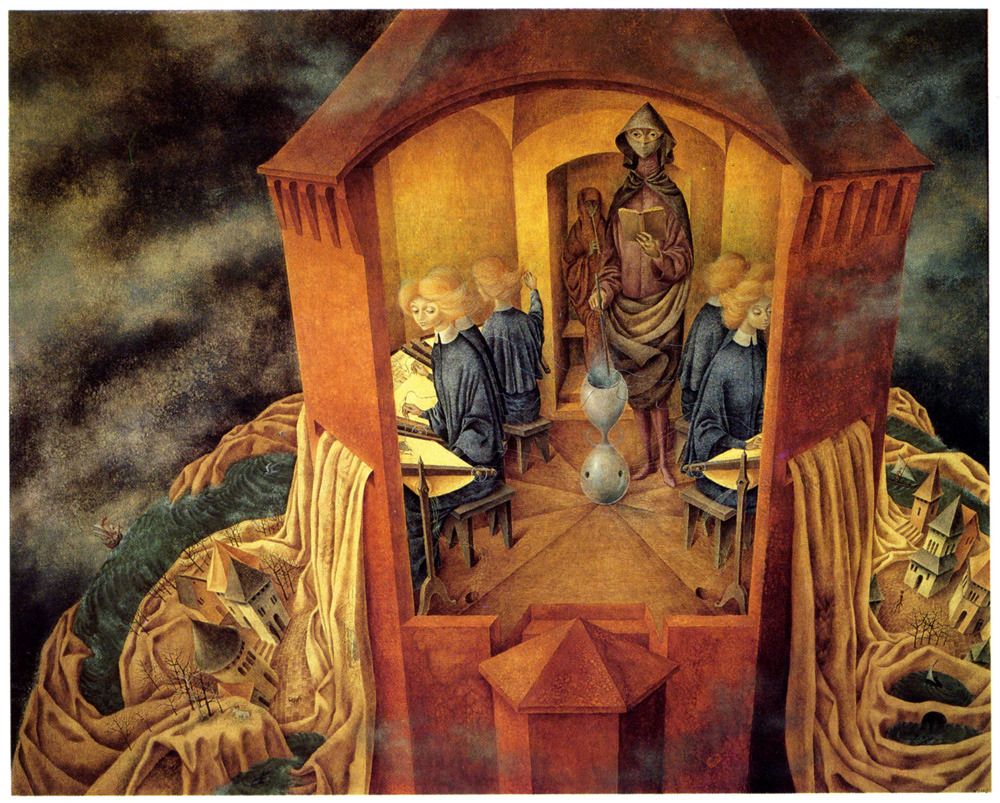
Rereading Freud’s Civilization and Its Discontents, the parent in me wants instantly to refute it. I want for my daughter something other than the Oedipus complex. I imagine a succession of heroines and goddesses. Why among all the characters of mythology does Freud opt for Oedipus and Electra? The latter, of course, has been reinvented in our time as a Marvel superhero. No longer daughter of Agamemnon and Clytemnestra, she wields a pair of sai. Electras loom large in the minds of at least two hideous men: Freud and Frank Miller. What if instead we imagine Oedipa Mass, the heroine in Thomas Pynchon’s novel The Crying of Lot 49? While imagining Oedipa, imagine too the women in “Bordando el Manto Terrestre (“Embroided Earth’s Mantle”),” the Remedios Varo painting (middle part of a triptych, in fact) viewed by Oedipa at a key point in the novel.

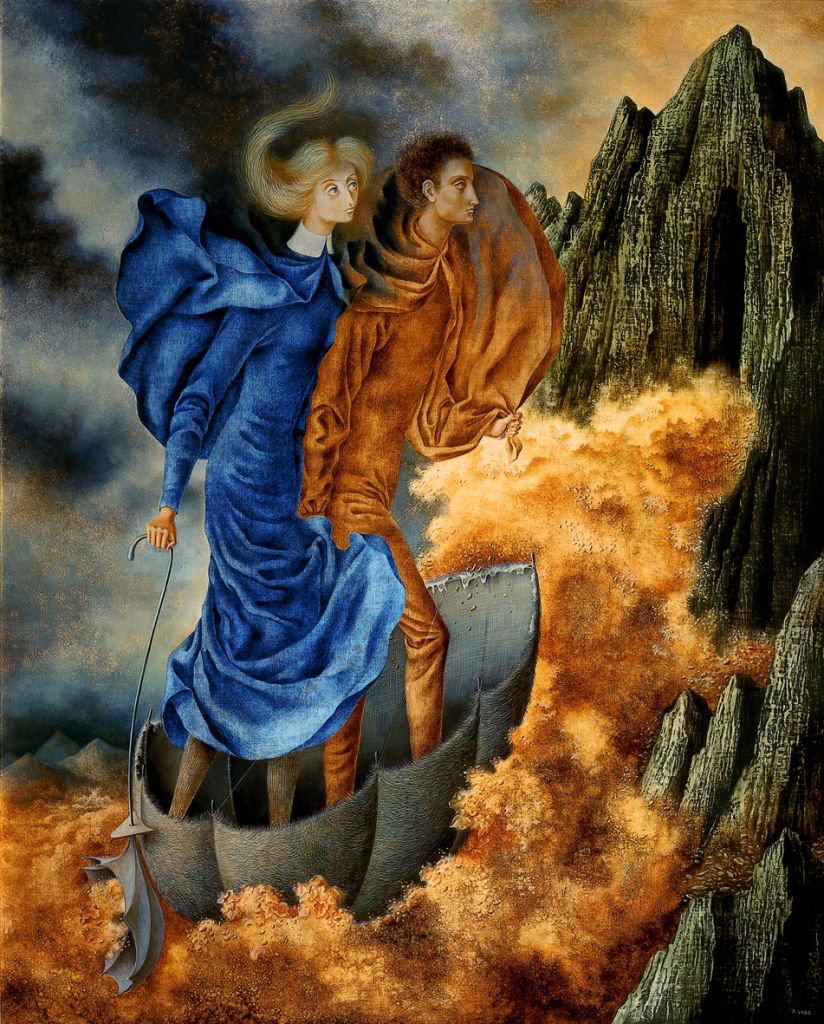
The figures in each case are all still figures trapped in another’s tapestry. “Such a captive maiden,” writes Pynchon, “having plenty of time to think, soon realizes that her tower, its height and architecture, are like her ego only incidental: that what really keeps her where she is is magic, anonymous and malignant, visited on her from outside and for no reason at all. Having no apparatus except gut fear and female cunning to examine this formless magic, to understand how it works, how to measure its field strength, count its lines of force, she may fall back on superstition, or take up a useful hobby like embroidery, or go mad, or marry a disk jockey. If the tower is everywhere and the knight of deliverance no proof against its magic, what else?” This, too, is the dilemma faced by Melba Zuzzo, the heroine of Joanna Ruocco’s novel Dan. Next thing I know, I’m sending myself “Playing the Post Card: On Pynchon’s The Crying of Lot 49 while scanning my shelves for H.D.’s book Tribute to Freud. Having seen the Varo painting in an exhibit a year prior to writing the novel, Pynchon recalls it from memory. Oedipa sees in the painting what Pynchon wants her to see. If she’d looked closely, she’d have seen “La Huida (The Escape),” the third part of the triptych, where the girl and her lover flee to the mountains.

And at the center of the triptych, reading from a spell book and stirring a cauldron, a sorceress. Such figures of power and liberation are occulted by Pynchon’s imagining of a feminized Oedipus — a character “hailed,” “interpellated” as Althusser would say, in the novel’s opening sentence when named executor of the estate of her former lover, Pierce Inverarity. Principle among the items of Pierce’s estate is a stamp collection. LSD is a plot point in Pynchon’s novel. Perhaps we could read Pierce’s stamp collection as the equivalent of “blotter art.” It’s described as containing “thousands of little colored windows into deep vistas of space and time,” and is delivered to Oedipa by “somebody named Metzger.” Readers might be forgiven for confusing “Metzger” with “Metzner,” as in the logic of a dream. As in “Ralph Metzner,” editor of Psychedelic Review and co-author, along with Timothy Leary and Richard Alpert, of The Psychedelic Experience.

Thursday February 18, 2021

Awaiting a therapy session with a gestalt psychologist, I reflect upon psychoanalysis. Coleridge imports the Unconscious into English after study of German philosophy. Freud sets this concept at the center of his project, his newly-founded science, psychoanalysis. The latter attempts a secular-scientific grasping of the Unconscious. Freud had a practice. He was a therapist. He was paid by clients. He treated patients. Psychoanalysis is a technology of the self. The therapist is one who applies a treatment, a cure for individuals suffering new illnesses of modernity: neuroses and psychoses. Before psychoanalysis, treatment of mental illness was a duty performed by clergy, or by “madhouses,” institutions invented by the State. Freud’s “talking cure” is an attempt to heal individuals who, in other times, would have been handed one-way tickets to board Ships of Fools or subjected to some other means of solitude and confinement. Psychoanalysis happened: it was put to use as a state apparatus, it was absorbed into institutions, it became part of the technocratic machinery of Western modernity. The mid-twentieth century was the age of psychoanalysis. The latter shaped the way the century thought itself. Freud fed into the development of public relations and advertising, especially through the influence of his nephew, Edward Bernays. According to French Marxist Louis Althusser, however, these uses were all betrayals of Freud’s revolutionary discovery. “The fall into ideology,” he writes, “began…with the fall of psycho-analysis into biologism, psychologism, and sociologism” (“Freud and Lacan,” p. 191).

Tuesday February 16, 2021

Dereliction of dung heap. Data-driven dumbwaiter at your service. Chronically correct I effect my own cause. Alpha Dog to Omega Man: can you read me? Justin Timberlake’s “What Goes Around…Comes Around” saddens me, so I head outdoors. I gather sticks. I stand among the trees, finding in the sky above me the crescent moon. The night’s songs are sad ones: Dolly Pardon’s “Jolene” and Regina Spektor’s “Fidelity.” And just this morning arrived the words of artist-friend Irving Bleak, speaking of owls as characters in world mythology. Characters in the lives of children. Guardians, protectors. I think of the Tesseract from Madeline L’Engle’s A Wrinkle in Time. Owls appear as a ‘theme’ or ‘motif’ throughout the evening. For work, meanwhile, I’ve had to reconsider Freud. Prep for an upcoming lecture. “Aggressiveness was not created by property,” he asserts in Civilization and Its Discontents. “It reigned almost without limit in primitive times, when property was still very scanty, and it already shows itself in the nursery almost before property has given up its primal, anal form. […]. If we were to remove this factor…by allowing complete freedom of sexual life and thus abolishing the family, the germ-cell of civilization, we cannot, it is true, easily foresee what new paths the development of civilization could take; but one thing we can expect, and that is that this indestructible feature of human nature will follow it there” (61). Aggression is for Freud an “indestructible feature of human nature.” Do those of us with children know otherwise? Freud is a cultural chauvinist, a bourgeois moralist, a critic of communism and an apologist for capitalist imperialism. I think now of his critics: Left Freudians like Herbert Marcuse, but also the Italian Marxist Sebastiano Timpanaro. Most of all, though, I think of anticolonial theorist and psychiatrist Frantz Fanon. How might we put Freud to radical use today amid Black Radical critiques of Western subjectivity and the rise of psychedelic science? I’m reminded of the opening remarks in Slavoj Žižek’s book The Ticklish Subject. “A spectre is haunting Western academia,” he writes, “the spectre of the Cartesian subject. Deconstructionists and Habermasians, cognitive scientists and Heideggerians, feminists and New Age obscurantists — all are united in their hostility to it.” Žižek himself, however, defends the subject — from these and other of its critics. Ever the provocateur. I’m teaching a gen-ed lit course. My task is to introduce Freud to students new to him. Let us establish the subject before we critique it. During breaks from Freud I watch the new Adam Curtis series Can’t Get You Out of My Head (2021) and read bits of Principia Discordia. In whatever book is finally written on acid’s arrival into history, there will be a chapter on Discordianism and Kerry Thornley, “Operation Mindfuck” figuring prominently therein. Colonization of the last free outpost, the human mind.

Friday February 5, 2021

Joanna Ruocco’s Dan is a book I read with students. Dan is a place and a state of mind, through which moves a perplexed, brilliant young woman, the book’s protagonist Melba Zuzzo. Melba travels via bicycle, accosted by men and townspeople, en route to and at her place of work, the town’s bakery. Her morning customers include Officer Greg, who suspects Melba of a crime, and Don Pond, a man who brings her back to his apartment on behalf of a conspiracy involving all of the town’s men. The apparent head of this conspiracy is the book’s villain, Dr. Buck. Melba suffered Buck’s hands. He touched her inappropriately and claimed to be her father when she visited his office about chronic congestion of her sinuses as a child. She remembers the event over the course of her day. Buck haunts her, in a sense. He gaslights Melba, using his status as expert and authority to call into question her ability to know. She lays quietly on a sheet of paper in his office by book’s end. Some of my students unfortunately begin the book siding unknowingly with Buck. The course is designed, though, to demonstrate harms done to women by male doctors. Patriarchal patterns of abuse appear, for instance, once Dan is read in light of Charlotte Perkins Gilman’s “The Yellow Wall-Paper” and Freud’s The Interpretation of Dreams.

Saturday January 30, 2021

When thinking about Freud, we should think also of one of his most important successors, Frantz Fanon. Fanon was born in Martinique in 1925 and studied medicine in France, specializing in psychiatry. In books like Black Skin, White Masks and The Wretched of the Earth, he rewrites Freud, positing in place of the latter’s Western imperial Ego a black psyche: a diasporic, anti-colonialist Orphée Noir or “Black Orpheus,” as Sartre would say, seeking to liberate itself from a white world. Fanon is angered because the French Empire imposed upon him through colonial schooling the Master’s language, “the mother tongue,” the language of the core. The anticolonial subject takes possession of the language and talks back — though not, as he says, with fervor. Fanon tells us he doesn’t trust fervor. “Every time it has burst out somewhere,” he writes, “it has brought fire, famine, misery…And contempt for man. Fervor is the weapon of choice of the impotent” (Black Skin, White Masks, p. 9). What Fanon performs instead is a kind of radical psychiatry upon Western consciousness. His books are psychotherapeutic treatments for those whose heads have been shrunk.

Tuesday December 1, 2020

Ishmael Reed chips away at Freud, portrays Herr Doktor as an “Atonist” in his brilliant 1972 novel Mumbo Jumbo. PaPa LaBas lectures about Freud in the book’s “Epilogue” — tells of his attempt to communicate with Freud, thwarted by the latter’s “entourage”: Freud’s “ego defenses,” his sycophants and followers. “Freud,” Reed writes, “whose real talent lies in the coinage of new terms for processes as old as the Ark,” reacted with revulsion upon encountering America’s racial diversity. He pitted his “Austrian” conception of civilization against “occultism,” or what in conversation with Carl Jung he called “The Black Tide of Mud” (208-209). The “Id” is Freud’s “boogeyman” — a denunciation of all that is Other: racially other, culturally other, religiously other. What does it matter now? Freud has receded in the culture’s memory, replaced by neuroscience. Or so it seems. Time, perhaps to listen to Stanislav Grof’s Psychology of the Future: Lessons from Modern Consciousness Research, a seminar Grof recorded at Naropa in 2004. Change the channel, flip the script. Or as Gene Youngblood would say, “Secede from the broadcast.”