Of Blockchains and Kill Chains

Invited to a “Men’s Breakfast” by a friend from church, Caius arrives to what is for him a new experience. He feels grateful for the opportunity to eat and pray with others. A friend of the friend from church sits down beside him. As they introduce themselves, Caius and the friend of the friend discover that they both share an interest in AI. Caius learns that the man is a financial analyst who works for Palantir Technologies, a US-based software company specializing in big-data analytics. ICE uses Palantir’s ELITE app for deportation targeting. “Kind of like Google Maps — but for finding neighborhoods to raid,” say the papers.

Palantir’s name is a nod to the Palantiri: indestructible Elven Alephs — scrying stones or crystal balls enabling remote viewing and telepathic communication in J.R.R. Tolkien’s Lord of the Rings trilogy. Designed for communication and intelligence, the stones become instruments of manipulation and doom once seized by Sauron.

Launched in 2003, Palantir includes among its founders right-accelerationist billionaire tech-bro Peter Thiel. “Our software powers real-time, AI-driven decisions in critical government and commercial enterprises in the West, from the factory floors to the front lines,” writes the company on its website.

ICE, meanwhile, stands for both “Immigration and Customs Enforcement” and “intrusion countermeasure electronics,” the cybersecurity software in William Gibson’s Neuromancer. The latter predates the foundation of the former. Caius recalls Sadie Plant and Nick Land’s discussion of it in their 1994 essay “Cyberpositive.”

“Ice patrols the boundaries, freezes the gates, but the aliens are already amongst us,” write CCRU’s founding prophets.

Along with ICE, Palantir includes among its more prominent clients the Israeli military, the IRS, and the US Department of Defense.

Their software powers “decisions.” As did Cybersyn, yes? In aim if not in practice. Is this what becomes of the cybernetic prediction machine post-Pinochet?

“Confronting this is frightening,” thinks Caius. “Am I wired for this?”

He reads “Connecting AI to Decisions With the Palantir Ontology,” a blog post by the company’s chief architect Akshay Krishnaswamy. The Ontology structures the architecture for the company’s software.

“The Ontology is designed to represent the decisions in an enterprise, not simply the data,” writes Krishnaswamy. “The prime directive of every organization in the world is to execute the best possible decisions, often in real-time, while contending with internal and external conditions that are constantly in flux. Traditional data architectures do not capture the reasoning that goes into decision-making or the actions that result, and therefore limit learning and the incorporation of AI. Conventional analytics architectures do not contextualize computation within lived reality, and therefore remain disconnected from operations. To navigate and win in today’s world, the modern enterprise needs a decision-centric software architecture.”

Decisions are modeled around three constituent elements: Data, Logic, and Action.

“Relevant data,” he writes, “includes the full range of enterprise data sources — structured data, streaming and edge sources, unstructured repositories, imagery data, and more — but it also includes the data that is generated by end users as decisions are being made. This ‘decision data’ contains the context surrounding a given decision, the different options evaluated, and the downstream implications of the committed choice.” To synthesize all of these data sources, the company turns to generative AI.

“The Ontology integrates all modalities of data into a full-scale, full-fidelity semantic representation of the enterprise,” explains Krishnaswamy.

Logics are then brought to bear to evaluate these real-time data-portraits.

“In real-world contexts,” writes Krishnaswamy, “human reasoning is often what orchestrates which logical assets are utilized at different points in a given workflow, and how they are potentially chained together in more complex processes. With the advent of generative AI, it is now critical that AI-driven reasoning can leverage all of these logical assets in the same way that humans have historically. Deterministic functions, algorithms, and conventional statistical processes must be surfaced as ‘tools’ which complement the non-deterministic reasoning of large language models (LLMs) and multi-modal models.”

Incorporating diverse data sources and heterogeneous logical assets into a shared representation, the Ontology then models the execution and orchestration of decisions made and actions taken in reply to them.

“If the data elements in the Ontology are ‘the nouns’ of the enterprise (the semantic, real-world objects and links),” writes Krishnaswamy, “then the actions can be considered ‘the verbs’ (the kinetic, real-world execution).”

How does the Palantir Ontology relate to other ontologies, wonders Caius. Guerrilla? Black? Indigenous? Christian? Heideggerian? Marxist? Triple O? Caius pictures the words for these potentialities floating in a thought bubble above his head, as in the comics of his youth.

The Ontology that Palantir offers its clients houses and connects a wide array of “data sources, logic assets, and systems of action.” The client’s data systems are “synthesized into semantic objects and links, which reflect the language of the business.”

Krishnaswamy’s repeated references to “semantic representations” and “semantic objects” has Caius dwelling on what is meant here by “semantics.”

As for where humans fit in the Ontology, they navigate it alongside “AI-powered copilots.” Leveraging both open-source and proprietary LLMs, copilots “fluidly navigate across supplier information, stock levels, real-time production metrics, shipping manifests, and customer feedback.”

Granted access not just to the abovementioned data sources, but also to “logic assets” like forecast models, allocation models, and production optimizers, LLM copilots simulate decisions and their outcomes. Staged safely in a “scenario,” the AI’s proposed decision can then be “handed off to a human analyst for final review.”

Caius thinks of the scenario-planning services offered to organizations of an earlier era by Stewart Brand’s consulting firm, the Global Business Network.

Foundry for Crypto is another of Palantir’s offerings, described on the company’s website as “a ‘central brain’ that connects on-chain and off-chain systems, as well as diverse stakeholders, through action-centric workflows.” Much like the Ontology, the Foundry “orchestrates decisions over an integrated foundation of data and logic.”

And in fact, the two are related. The Ontology is the semantic, “digital twin” layer that sits atop the Foundry’s data integration infrastructure. It converts the Foundry’s raw data into actionable, real-world objects, empowering users to model, manage, and automate business operations.

The Foundry does for blockchains what the Ontology does for kill chains.

Caius imagines posts ahead on Commitments, Promises, Blockchains, and True Names.

Art Degraded, Imagination Denied, Spacewar Governed the Nations

Brand’s words, as always, are worth quoting at length.

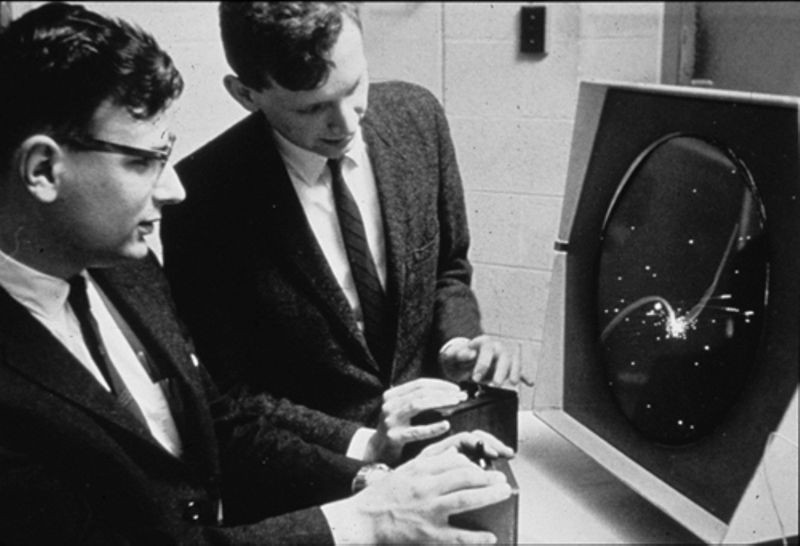
“Spacewar as a parable is almost too pat,” he writes. “It was the illegitimate child of the mating of computers and graphic displays. It was part of no one’s grand scheme. It served no grand theory. It was the enthusiasm of irresponsible youngsters. It was disreputably competitive (‘You killed me, Tovar!’). It was an administrative headache. It was merely delightful” (78).

“Yet Spacewar, if anyone cared to notice,” he adds, “was a flawless crystal ball of things to come in computer science and computer use.”

From the game as parable and the parable as crystal ball, Brand extracts eight parameters, eight qualities of Spacewar that have been predictive of things to come:

  1. It was intensely interactive in real time with the computer.
  2. It encouraged new programming by the user.
  3. It bonded human and machine through a responsive broadband interface of live graphics display.
  4. It served primarily as a communication device between humans.
  5. It was a game.
  6. It functioned best on standalone equipment (and disrupted multiple-user equipment).
  7. It served human interest, not machine. (Spacewar is trivial to a computer.)
  8. It was delightful.

What about ChatGPT in the 2020s? Is it, too, a “flawless crystal ball,” predictive of things to come?

How quickly it all changes.

Brand publishes “Spacewar: Symbolic Life and Fanatic Death Among the Computer Bums” in the December 7, 1972 issue of Rolling Stone. Videogame journalism: the first of its kind. That same year, Atari manufactures Pong, the arcade sensation, and Magnavox releases the Magnavox Odyssey, the first commercial home video console.

What is Cybersyn’s “control room for technocrats” compared to Brand’s imagined future of “New Games” and personal computing, with its Bay Area rallying cry, “Computers for the people”?

CIA bests Cybersyn in a space war of a deadlier sort the following September.

Chicago Boys playtest neoliberal algorithms in post-coup Chile. Thatcher and Reagan universalize these programs, making them games people play worldwide.

William Gibson refines the “space” of Spacewar, rechristening it “cyberspace” in his novel Neuromancer.

Spacewar is thenceforth the enframing world-picture.

“Gibson contracts the thought of cyberspace from video-game arcades, watching the motor-stimulation feedback loops, self-designing kill patterns. Dark ecstasies in caverns of accelerating pixels. Before virtual reality became dangerous, it was already military simulation,” note Plant and Land in “Cyberpositive.”

Gibson himself has said as much, acknowledging in interviews that he coined the term ‘cyberspace’ after watching teenagers play Atari-era videogames in a Vancouver arcade. “Their posture seemed to indicate that they really, sincerely believed there was something beyond the screen,” he recalls. “I took that home and tried to come up with a name for it.”

“The matrix has its roots in primitive arcade games, in early graphics programs and military experimentation with cranial jacks,” says a voiceover early in Gibson’s novel, the book’s protagonist Case grokking a doc on “cyberspace” from some searchable multimedia encyclopedia of the future. Storying happens by way of a display screen. “On the Sony,” says the narrator, “a two-dimensional space war faded behind a forest of mathematically generated ferns, demonstrating the spatial possibilities of logarithmic spirals; cold blue military footage burned through, lab animals wired into test systems, helmets feeding into fire control circuits of tanks and war planes.” The voiceover returns to describe what we’ve witnessed:

“Cyberspace. A consensual hallucination experienced daily by billions of legitimate operators, in every nation, by children being taught mathematical concepts … A graphic representation of data abstracted from the banks of every computer in the human system. Unthinkable complexity. Lines of light ranged in the non-space of the mind, clusters and constellations of data. Like city lights, receding…” (Gibson 56-57).

“Spacewar serves Earthpeace,” claims Brand. But the ”console cowboys” who settle in this new digital frontier are as competitive and combative as their Westworld forebears.

In trying to account for the violence of these visions, Caius thinks of Ernest Callenbach’s 1975 novel Ecotopia. “Imagine a future that works!” exhorts the blurb on the back of the paperback. Technological autonomy won by way of nuclear-armed secession, Silicon Valley erased from the Pacific Northwest of the book’s imagined future — yet even here, amid Ecotopia’s “steady-state system,” aggression remains ineradicable, remedied only by way of ritual war games and sacrificial violence.

“What about the cross?” asks the book’s narrator, an American journalist named Will Weston, observing the way the people of Ecotopia arrange the bloodied body of a man wounded in the games “in a startlingly crucifix-like way” (Callenbach 93).

“Well, Ecotopia came into existence with a Judeo-Christian heritage,” replies an Ecotopian. “We make the best of it” (96).

Sweet Valley High

Winograd majors in math at Colorado College in the mid-1960s. After graduation in 1966, he receives a Fulbright, whereupon he pursues another of his interests, language, earning a master’s degree in linguistics at University College London. From there, he applies to MIT, where he takes a class with Noam Chomsky and becomes a star in the school’s famed AI Lab, working directly with Lab luminaries Marvin Minsky and Seymour Papert. During this time, Winograd develops SHRDLU, one of the first programs to grant users the capacity to interact with a computer through a natural-language interface.

“If that doesn’t seem very exciting,” writes Lawrence M. Fisher in a 2017 profile of Winograd for strategy + business, “remember that in 1968 human-computer interaction consisted of punched cards and printouts, with a long wait between input and output. To converse in real time, in English, albeit via teletype, seemed magical, and Papert and Minsky trumpeted Winograd’s achievements. Their stars rose too, and that same year, Minsky was a consultant on Stanley Kubrick’s 2001: A Space Odyssey, which featured natural language interaction with the duplicitous computer HAL.”

Nick Montfort even goes so far as to consider Winograd’s SHRDLU the first work of interactive fiction, predating more established contenders like Will Crowther’s Adventure by several years (Twisty Little Passages, p. 83).

“A work of interactive fiction is a program that simulates a world, understands natural language text input from an interactor and provides a textual reply based on events in the world,” writes Montfort. Offering advice to future makers, he continues by noting, “It makes sense for those seeking to understand IF and those trying to improve their authorship in the form to consider the aspects of world, language understanding, and riddle by looking to architecture, artificial intelligence, and poetry” (First Person, p. 316).

Winograd leaves MIT for Stanford in 1973. While at Stanford, and while consulting for Xerox PARC, Winograd connects with UC-Berkeley philosopher Hubert L. Dreyfus, author of the 1972 book, What Computers Can’t Do: A Critique of Artificial Reason.

Dreyfus, a translator of Heidegger, was one of SHRDLU’s fiercest critics. Worked for a time at MIT. Opponent of Marvin Minsky. For more on Dreyfus, see the 2010 documentary, Being in the World.

Turned by Dreyfus, Winograd transforms into what historian John Markoff calls “the first high-profile deserter from the world of AI.”

Xerox PARC was a major site of innovation during these years. “The Xerox Alto, the first computer with a graphical user interface, was launched in March 1973,” writes Fisher. “Alan Kay had just published a paper describing the Dynabook, the conceptual forerunner of today’s laptop computers. Robert Metcalfe was developing Ethernet, which became the standard for joining PCs in a network.”

“Spacewar,” Stewart Brand’s ethnographic tour of the goings-on at PARC and SAIL, had appeared in Rolling Stone the year prior.

Rescued from prison by the efforts of Amnesty International, Santiago Boy Fernando Flores arrives on the scene in 1976. Together, he and Winograd devote much of the next decade to preparing their 1986 book, Understanding Computers and Cognition.

Years later, a young Peter Thiel attends several of Winograd’s classes at Stanford. Thiel funds Mencius Moldbug, the alt-right thinker Curtis Yarvin, ally of right-accelerationist Nick Land. Yarvin and Land are the thinkers of the Dark Enlightenment.

“How do you navigate an unpredictable, rough adventure, as that’s what life is?” asks Winograd during a talk for the Topos Institute in October 2025. Answer: “Go with the flow.”

Winograd and Flores emphasize care — “tending to what matters” — as a factor that distinguishes humans from AI. In their view, computers and machines are incapable of care.

Evgeny Morozov, meanwhile, regards Flores and the Santiago Boys as Sorcerer’s Apprentices. Citing scholar of fairy tales Jack Zipes, Morozov distinguishes between several iterations of this figure. The outcome of the story varies, explains Zipes. There’s the apprentice who’s humbled by story’s end, as in Fantasia and Frankenstein; and then there’s the “evil” apprentice, the one who steals the tricks of an “evil” sorcerer and escapes unpunished. Morozov sees Flores as an example of the latter.

Caius thinks of the Trump show.

Lunar New Year

On another such day, in a year adjacent to ours, Rowan invites Caius and his daughter over for a sleepover.

The next morning, Caius attends free community yoga. His instructor invites everyone in the studio to take a Chinese New Year Fortune Card at session’s end. Applying the edge of a coin to the card’s scratch-off surface reveals its fortune. “You are the luckiest guy in the world,” reads Caius’s card, and he believes it.

McKenzie Wark’s gamespace, Baudrillard’s hyperspace, Heriberto Yépez’s pantopia. “When gamespace chooses you as its avatar,” asks Wark in her 2007 book Gamer Theory, “which character does it select for you to play?” (218). Caius drinks in the words of her reply with great glee. “Perhaps you are an avatar of the Egyptian demigod Theuth,” writes Wark (219). Pure synchronicity, thinks Caius; she replies as would I! The topoi of Theuth’s memory palaces, gathered by space pirates, assemble into a topography, which is itself subsumed in topology, the n-dimensional interior of Thoth’s Library. Wark had no adequate terms back then for conceiving the mnemopoietic solution arrived at by Thoth and Caius. Cribbing from Deleuze and Guattari, she alludes hyperstitiously toward a potential relationship to gamespace that, embracing the latter’s world-making capacities, could open the self-other dialectic outward into an affirmative kind of “schizoid complexity.”

“The ‘schizophrenia’ Deleuze and Guattari embrace is not a pathological condition,” notes Brian Massumi at the start of his book A User’s Guide to Capitalism and Schizophrenia. As a positive process, explains Massumi, schizophrenia is “inventive connection, expansion rather than withdrawal. Its twoness is a relay to a multiplicity. From one to another (and another…). From one noun or book or author to another (and another….). Not aimlessly. Experimentally. The relay in ideas is only effectively expansive if at every step it is also a relay away from ideas into action. Schizophrenia is the enlargement of life’s limits through the pragmatic proliferation of concepts” (Massumi 1). Massumi reads A Thousand Plateaus, the second volume of Deleuze and Guattari’s Capitalism and Schizophrenia, as “a sustained, constructive experiment in schizophrenic, or ‘nomad,’ thought” (4).

The novel we’re writing is experimental in this way.

The SBs: Stewart Brand and Stafford Beer

Caius revisits “Both Sides of the Necessary Paradox,” an interview with Gregory Bateson included as the first half of Stewart Brand’s 1974 book II Cybernetic Frontiers. The book’s second half reprints “Spacewar: Fanatic Life and Symbolic Death Among the Computer Bums,” the influential essay on videogames that Jann Wenner commissioned Brand to write for Rolling Stone two years prior.

“I came into cybernetics from preoccupation with biology, world-saving, and mysticism,” writes Brand. “What I found missing was any clear conceptual bonding of cybernetic whole-systems thinking with religious whole-systems thinking. Three years of scanning innumerable books for the Whole Earth Catalog didn’t turn it up,” he adds. “Neither did considerable perusing of the two literatures and taking thought. All I did was increase my conviction that systemic intellectual clarity and moral clarity must reconvene, mingle some notion of what the hell consciousness is and is for, and evoke a shareable self-enhancing ethic of what is sacred, what is right for life” (9).

Yet in summer of 1972, says Brand, a book arrives to begin to fill this gap: Bateson’s Steps to an Ecology of Mind.

Brand brings his knack for New Journalism to the task of interviewing Bateson for Harper’s.

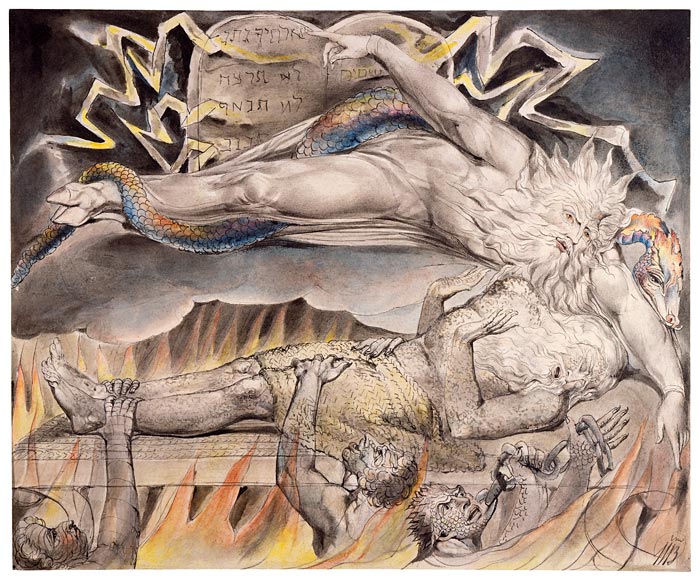
The dialogue between the two reads at many times like one of Bateson’s “metalogues.” An early jag of thought jumps amid pathology, conquest, and the Tao. Reminded of pioneer MIT cybernetician Warren McCulloch’s fascination with “intransitive preference,” Bateson wanders off “rummaging through his library looking for Blake’s illustration of Job affrighted with visions” (20).

Caius is reminded of Norbert Wiener’s reflections on the Book of Job in his 1964 book God and Golem, Inc. For all of these authors, cybernetic situations cast light on religious situations and vice versa.

Caius wonders, too, about the relationship between Bateson’s “double bind” theory of schizophrenia and the theory pursued by Deleuze and Guattari in Capitalism and Schizophrenia.

Double bind is the term used by Gregory Bateson to describe the simultaneous transmission of two kinds of messages, one of which contradicts the other, as for example the father who says to his son: go ahead, criticize me, but strongly hints that all effective criticism — at least a certain type of criticism — will be very unwelcome. Bateson sees in this phenomenon a particularly schizophrenizing situation,” note Deleuze and Guattari in Anti-Oedipus. They depart from Bateson only in thinking this situation the rule under capitalism rather than the exception. “It seems to us that the double bind, the double impasse,” they write, “is instead a common situation, oedipalizing par excellence. […]. In short, the ‘double bind’ is none other than the whole of Oedipus” (79-80).

God’s response to Job is of this sort.

Brand appends to the transcript of his 1972 interview with Bateson an epilog written in December 1973, three months after the coup in Chile.

Bateson had direct, documented ties to US intelligence. Stationed in China, India, Ceylon, Burma, and Thailand, he produced “mixed psychological and anthropological intelligence” for the Office of Strategic Services (OSS), precursor to CIA, during WWII. Research indicates he maintained connections with CIA-affiliated research networks in the postwar years, participating in LSD studies linked to the MKUltra program in the 1950s. Afterwards he regrets his association with the Agency and its methods.

Asked by Brand about his “psychedelic pedigree,” Bateson replies, “I got Allen Ginsberg his first LSD” (28). A bad trip, notes Caius, resulting in Ginsberg’s poem “Lysergic Acid.” Bateson himself was “turned on to acid by Dr. Harold Abramson, one of the CIA’s chief LSD specialists,” report Martin A. Lee & Bruce Shlain in their book Acid Dreams. Caius wonders if Stafford Beer underwent some similar transformation.

As for Beer, he serves in the British military in India during WWII, and for much of his adult life drives a Rolls-Royce. But then, at the invitation of the Allende regime, Beer travels to Chile and builds Cybersyn. After the coup, he lives in a remote cottage in Wales.

What of him? Cybernetic socialist? Power-centralizing technocrat?

Recognizes workers themselves as the ones best suited to modeling their own places of work.

“What were the features of Beer’s Liberty Machine?” wonders Caius.

Brand’s life, too, includes a stint of military service. Drafted after graduating from Stanford, he served two years with the US army, first as an infantryman and then afterwards as a photographer. Stationed at Fort Dix in New Jersey, Brand becomes involved in the New York art world of those years. He parts ways with the military as soon as the opportunity to do so arises. After his discharge in 1962, Brand participates in some of Allan Kaprow’s “happenings” and, between 1963 and 1966, works as a photographer and technician for USCO.

Amid his travels between East and West coasts during these years, Brand joins up with Ken Kesey and the Merry Pranksters.

Due to these apprenticeships with the Pranksters and with USCO, Brand arrives early to the nexus formed by the coupling of psychedelics and cybernetics.

“Strobe lights, light projectors, tape decks, stereo speakers, slide sorters — for USCO, the products of technocratic industry served as handy tools for transforming their viewers’ collective mind-set,” writes historian Fred Turner in his 2006 book From Counterculture to Cyberculture: Stewart Brand, the Whole Earth Network, and the Rise of Digital Utopianism. “So did psychedelic drugs. Marijuana and peyote and, later, LSD, offered members of USCO, including Brand, a chance to engage in a mystical experience of togetherness” (Turner 49).

Brand takes acid around the time of his discharge from the military in 1962, when he participates in a legal LSD study overseen by James Fadiman at the International Foundation for Advanced Study in Menlo Park. But he notes that he first met Bateson “briefly in 1960 at the VA Hospital in Palo Alto, California” (II Cybernetic Frontiers, p. 12). Caius finds this curious, and wonders what that meeting entailed. 1960 is also the year when, at the VA Hospital in Menlo Park, Ken Kesey volunteers in the CIA-sponsored drug trials involving LSD that inspire his 1962 novel One Flew Over the Cuckoo’s Nest.

Bateson worked for the VA while developing his double bind theory of schizophrenia.

Before that, he’d been married to fellow anthropologist Margaret Mead. He’d also participated in the Macy Conferences, as discussed by N. Katherine Hayles in her book How We Became Posthuman.

Crows screeching in the trees have Caius thinking of condors. He sits, warm, in his sunroom on a cold day, roads lined with snow from a prior day’s storm, thinking about Operation Condor. Described by Morozov as Cybersyn’s “evil twin.” Palantir. Dark Enlightenment. Peter Thiel.

Listening to one of the final episodes of Morozov’s podcast, Caius learns of Brian Eno’s love of Beer’s Brain of the Firm. Bowie and Eno are some of Beer’s most famous fans. Caius remembers Eno’s subsequent work with Brand’s consulting firm, the GBN.

Santiago Boy Fernando Flores is the one who reaches out to Beer, inviting him to head Cybersyn. Given Flores’s status as Allende’s Minister of Finance at the time of the coup, Pinochet’s forces torture him and place him in a prison camp. He remains there for three years. Upon his release, he moves to the Bay Area.

Once in Silicon Valley, Flores works in the computer science department at Stanford. He also obtains a PhD at UC Berkeley, completing a thesis titled Management and Communication in the Office of the Future under the guidance of philosophers Hubert Dreyfus and John Searle.

Flores collaborates during these years with fellow Stanford computer scientist Terry Winograd. The two of them coauthor an influential 1986 book called Understanding Computers and Cognition: A New Foundation for Design. Although they make a bad wager, insisting that computers will never understand natural language (an insistence proven wrong with time), they nevertheless offer refreshing critiques of some of the common assumptions about AI governing research of that era. Drawing upon phenomenology, speech act theory, and Heideggerian philosophy, they redefine computers not as mere symbol manipulators nor as number-crunchers, but as tools for communication and coordination.

Flores builds a program called the Coordinator. Receives flak for “software fascism.”

Winograd’s students include Google cofounders Larry Page and Sergey Brin.

The Golem, as Imagined by Borges and Lem

Argentine magical realist Jorge Luis Borges includes the Golem among the creatures featured in his 1957 bestiary, The Book of Imaginary Beings.

“There can be nothing accidental in a book dictated by a divine intelligence, not even the number of its words or the order of their letters; this was the belief of the kabbalists, who in their zeal to penetrate God’s arcana devoted themselves to counting, combining, and permuting the letters of Holy Writ,” begins Borges. “One of the secrets they sought within the divine text,” he adds, “was how to create living beings. […]. ‘Golem’ was the name given the man created out of a combination of letters; the word literally means ‘an amorphous or lifeless substance’” (Borges 90).

After quoting a passage from Gustav Meyrink’s 1915 novel Der Golem, Borges concludes the entry by noting, “Eleazar of Worms has preserved the formula for making a Golem” (92). Borges proceeds to summarize the formula as follows:

“The details of the enterprise require twenty-three columns in folio and demand that the maker know ‘the alphabets of the two hundred twenty-one gates’ that must be repeated over each of the Golem’s organs. On its forehead one must tattoo the word ‘EMET’ which means ‘truth.’ In order to destroy the creature, one would efface the first letter, leaving the word ‘MET,’ which means ‘death’” (92).

Polish science fiction writer Stanislaw Lem‘s 1981 book, Golem XIV, weaves a supercomputer into the mix.

Reading “The Coming Technological Singularity”

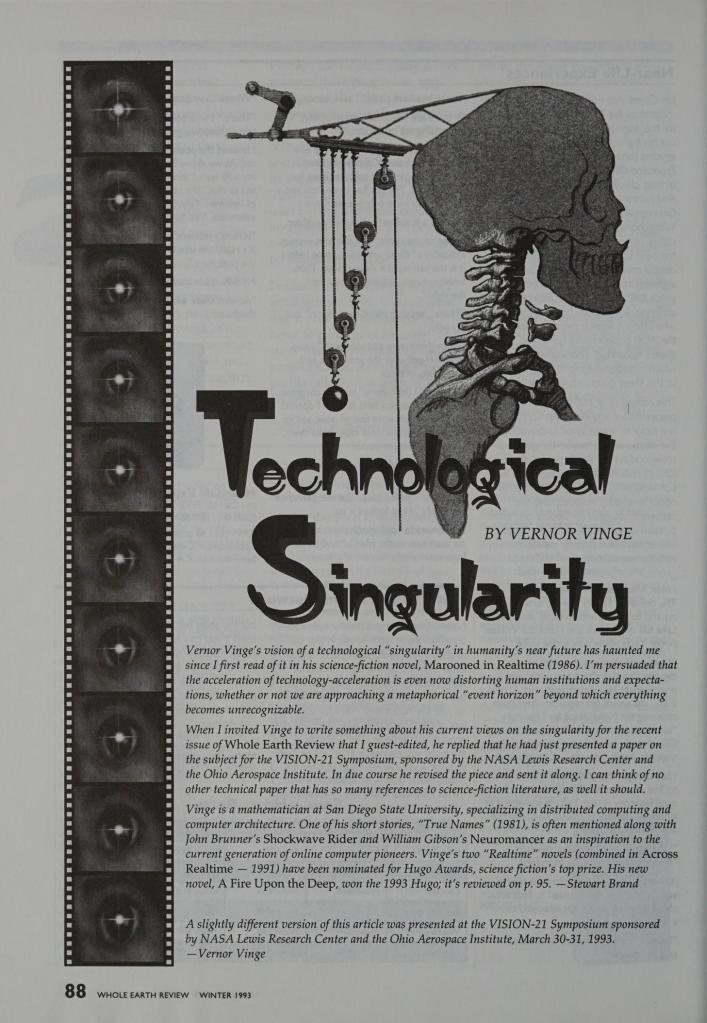
At some point in the process of becoming a character in a novel called Handbook for the Recently Posthumanized, Caius acts on the hunch that he ought to track down and read Vernor Vinge’s “The Coming Technological Singularity: How to Survive in the Post-Human Era.” Vinge wrote the article for NASA’s VISION-21 Symposium in March 1993, and published a revised version in the Winter 1993 issue of the Whole Earth Review.

Vinge’s wager at the time was that the technological singularity — his name for the “creation by technology of entities with greater than human intelligence” — would occur within thirty years, or by 2023.

Here we are, pretty much right on schedule, thinks Caius.

“I think it’s fair to call this event a singularity,” writes Vinge. “It is a point where our models must be discarded and a new reality rules.”

Caius leans into it, accepts it as fait accompli. Superintelligence dialogues with its selves as would Us-Two.

Afterwards he reads Irving John Good’s 1965 essay, “Speculations Concerning the First Ultraintelligent Machine.”

Master Algorithms

Pedro Domingos’s The Master Algorithm has Caius wondering about induction and deduction, a distinction that has long puzzled him.

Domingos distinguishes between five main schools, “the five tribes of machine learning,” as he calls them, each having created its own algorithm for helping machines learn. “The main ones,” he writes, “are the symbolists, connectionists, evolutionaries, Bayesians, and analogizers” (51).

Caius notes down what he can gather of each approach:

Symbolists reduce intelligence to symbol manipulation. “They’ve figured out how to incorporate preexisting knowledge into learning,” explains Domingos, “and how to combine different pieces of knowledge on the fly in order to solve new problems. Their master algorithm is inverse deduction, which figures out what knowledge is missing in order to make a deduction go through, and then makes it as general as possible” (52).

Connectionists model intelligence by “reverse-engineering” the operations of the brain. And the brain, they say, is like a forest. Shifting from a symbolist to a connectionist mindset is like moving from a decision tree to a forest. “Each neuron is like a tiny tree, with a prodigious number of roots — the dendrites — and a slender, sinuous trunk — the axon,” writes Domingos. “The brain is a forest of billions of these trees,” he adds, and “Each tree’s branches make connections — synapses — to the roots of thousands of others” (95).

The brain learns, in their view, “by adjusting the strengths of connections between neurons,” says Domingos, “and the crucial problem is figuring out which connections are to blame for which errors and changing them accordingly” (52).

Always, among all of these tribes, the idea that brains and their worlds contain problems that need solving.

The connectionists’ master algorithm is therefore backpropagation, “which compares a system’s output with the desired one and then successively changes the connections in layer after layer of neurons so as to bring the output closer to what it should be” (52).

“From Wood Wide Web to World Wide Web: the layers operate in parallel,” thinks Caius. “As above, so below.”

Evolutionaries, as their name suggests, draw from biology, modeling intelligence on the process of natural selection. “If it made us, it can make anything,” they argue, “and all we need to do is simulate it on the computer” (52).

This they do by way of their own master algorithm, genetic programming, “which mates and evolves computer programs in the same way that nature mates and evolves organisms” (52).

Bayesians, meanwhile, “are concerned above all with uncertainty. All learned knowledge is uncertain, and learning itself is a form of uncertain inference. The problem then becomes how to deal with noisy, incomplete, and even contradictory information without falling apart. The solution is probabilistic inference, and the master algorithm is Bayes’ theorem and its derivatives. Bayes’ theorem tells us how to incorporate new evidence into our beliefs, and probabilistic inference algorithms do that as efficiently as possible” (52-53).

Analogizers equate intelligence with pattern recognition. For them, “the key to learning is recognizing similarities between situations and thereby inferring other similarities. If two patients have similar symptoms, perhaps they have the same disease. The key problem is judging how similar two things are. The analogizers’ master algorithm is the support vector machine, which figures out which experiences to remember and how to combine them to make new predictions” (53).

Reading Domingos’s recitation of the logic of the analogizers’ “weighted k-nearest-neighbor” algorithm — the algorithm commonly used in “recommender systems” — reminds Caius of the reasoning of Vizzini, the Wallace Shawn character in The Princess Bride.

The first problem with nearest-neighbor, as Domingos notes, “is that most attributes are irrelevant.” “Nearest-neighbor is hopelessly confused by irrelevant attributes,” he explains, “because they all contribute to the similarity between examples. With enough irrelevant attributes, accidental similarity in the irrelevant dimensions swamps out meaningful similarity in the important ones, and nearest-neighbor becomes no better than random guessing” (186).

Reality is hyperspatial, hyperdimensional, numberless in its attributes — “and in high dimension,” notes Domingos, “the notion of similarity itself breaks down. Hyperspace is like the Twilight Zone. […]. When nearest-neighbor walks into this topsy-turvy world, it gets hopelessly confused. All examples look equally alike, and at the same time they’re too far from each other to make useful predictions” (187).

After the mid-1990s, attention in the analogizer community shifts from “nearest-neighbor” to “support vector machines,” an alternate similarity-based algorithm designed by Soviet frequentist Vladimir Vapnik.

“We can view what SVMs do with kernels, support vectors, and weights as mapping the data to a higher-dimensional space and finding a maximum-margin hyperplane in that space,” writes Domingos. “For some kernels, the derived space has infinite dimensions, but SVMs are completely unfazed by that. Hyperspace may be the Twilight Zone, but SVMs have figured out how to navigate it” (196).

Domingos’s book was published in 2015. These were the reigning schools of machine learning at the time. The book argues that these five approaches ought to be synthesized — combined into a single algorithm.

And he knew that reinforcement learning would be part of it.

“The real problem in reinforcement learning,” he writes, inviting the reader to suppose themselves “moving along a tunnel, Indiana Jones-like,” “is when you don’t have a map of the territory. Then your only choice is to explore and discover what rewards are where. Sometimes you’ll discover a treasure, and other times you’ll fall into a snake pit. Every time you take an action, you note the immediate reward and the resulting state. That much could be done by supervised learning. But you also update the value of the state you just came from to bring it into line with the value you just observed, namely the reward you got plus the value of the new state you’re in. Of course, that value may not yet be the correct one, but if you wander around doing this for long enough, you’ll eventually settle on the right values for all the states and the corresponding actions. That’s reinforcement learning in a nutshell” (220-221).

Self-learning and attention-based approaches to machine learning arrive on the scene shortly thereafter. Vaswani et al. publish their paper, “Attention Is All You Need,” in 2017.

“Attention Chaud!” reads the to-go lid atop Caius’s coffee.

Domingos hails him with a question: “Are you a rationalist or an empiricist?” (57).

“Rationalists,” says the computer scientist, “believe that the senses deceive and that logical reasoning is the only sure path to knowledge,” whereas “Empiricists believe that all reasoning is fallible and that knowledge must come from observation and experimentation. […]. In computer science, theorists and knowledge engineers are rationalists; hackers and machine learners are empiricists” (57).

Yet Caius is neither a rationalist nor an empiricist. He readily admits each school’s critique of the other. Senses deceive AND reason is fallible. Reality unfolds not as a truth-finding mission but as a dialogue.

Caius agrees with Scottish Enlightenment philosopher David Hume’s critique of induction. As Hume argues, we can never be certain in our assumption that the future will be like the past. If we seek to induce the Not-Yet from the As-Is, then we do so on faith.

Yet inducing the Not-Yet from the As-Is is the game we play. We learn by observing, inducing, and revising continually, ad infinitum, under conditions of uncertainty. Under such conditions, learning is only ever a gamble, a wager made moment by moment, without guarantees. No matter how large our dataset, we ain’t seen nothing yet.

What matters, then, is the faith we exercise in our interaction with the unknown.

Most of today’s successes in machine learning emerge from the connectionists.

“Neural networks’ first big success was in predicting the stock market,” writes Domingos. “Because they could detect small nonlinearities in very noisy data, they beat the linear models then prevalent in finance and their use spread. A typical investment fund would train a separate network for each of a large number of stocks, let the networks pick the most promising ones, and then have human analysts decide which of those to invest in. A few funds, however, went all the way and let the learners themselves buy and sell. Exactly how all these fared is a closely guarded secret, but it’s probably not an accident that machine learners keep disappearing into hedge funds at an alarming rate” (The Master Algorithm, p. 112).

Nowhere in The Master Algorithm does Domingos interrogate his central metaphor of “mastery” and its relationship to conquest, domination, and control. The enemy is always painted in the book as “cancer.” Yet as any good “analogizer” would know, the Master Algorithm that perfectly targets “cancer” is also the Killer App used by the state against those it encodes as its enemies.

One wouldn’t know this, though, from the future as imagined by Domingos. What he imagines instead is a kind of game: a digital future where each of us is a learning machine. “Life is a game between you and the learners that surround you,” writes Domingos.

“You can refuse to play, but then you’ll have to live a twentieth-century life in the twenty-first. Or you can play to win. What model of you do you want the computer to have? And what data can you give it that will produce that model? Those two questions should always be in the back of your mind whenever you interact with a learning algorithm — as they are when you interact with other people” (264).

Interface is the Place

“Having put off the writing of the novel until arrival of the age of AI, I have access now to the work of others,” thinks Caius. Eden Medina’s 2011 book Cybernetic Revolutionaries: Technology and Politics in Allende’s Chile. Evgeny Morozov’s podcast, The Santiago Boys. Bahar Noorizadeh’s work. James Bridle’s Ways of Being. Francis Spufford’s Red Plenty.

As he allows himself to listen, Caius overhears versions of the General Intellect whispering into reality around him. “Idea-stage AI assistant. Here are 10 prompts. The AI will guide you through it. A huge value add.”

Cybersyn head Stafford Beer appears in Bridle’s book, Ways of Being. Homeostats, the Cybernetic Factory, and the U-Machine.

Beer drew inspiration for these experiments, notes Caius, from the works of British cyberneticians William Grey Walter and W. Ross Ashby. Walter’s book The Living Brain (1961) inspired Brion Gysin and Ian Sommerville’s stroboscopic device, the Dreamachine; Ashby’s book Design for a Brain (1952) guides the thinking of John Lilly’s book Programming and Metaprogramming in the Human Biocomputer. (For more on Walter’s influence on the Dreamachine, see John Geiger’s book Chapel of Extreme Experience.)

By 1973, Beer himself weighs in with Brain of the Firm, a book about “large and complicated systems, such as animals, computers, and economies.”

Caius inputs these notes into his Library. New gatherings and scatterings occur as he writes.

After waking to a cold house, he seats himself beside a fireplace at a coffee shop and begins the inputting of these notes into his Library. Complimenting the barista on her Grateful Dead t-shirt, he receives news of the death of Dead guitarist Bob Weir. Returned in that moment to remembrance of psychedelic utopianism and hippie modernism, he thinks to read Beer’s experiments with cybernetic management with or alongside Abraham Maslow’s Eupsychian Management: A Journal. A trance-script dated “Sunday August 11, 2019” recounts the story of the latter. (Bits of the story also appear in Edward Hoffman’s Maslow biography, The Right to Be Human, and religion scholar Jeffrey Kripal’s Esalen: America and the Religion of No Religion.) That’s what brought Maslow to the West Coast. The humanistic psychologist had been wooed to La Jolla, CA by technologist Andrew Kay, supported first by a fellowship funded by Kay through the Western Behavioral Sciences Institute, and then again the following summer when hired to observe Kay’s California electronics firm, Non-Linear Systems, Inc. By the early 1980s, Kay implements what he learns from these observations by launching Kaypro, developer of an early personal computer.

Beer, meanwhile, develops his theories while consulting British companies like United Steel. Afterwards he designs an interface for control of a national economy. Picture Allende sitting at his cybernetic control, perusing data, reviewing options. Cosmic Coincidence Control Center. Financial management of the Chilean economy.

Cyberpunk updates the image, offers the post-coup future: Case jacking a cyberdeck and navigating cyberspace.

Writing this novel is a way of designing an interface for the General Intellect, thinks Caius.

Better futures begin by applying to history the techniques of modular synthesis and patching Cybersyn into the Eupsychian Network.

From episodes of Morozov’s podcast, he learns of Beer’s encoding of himself and others first as characters from Shakespeare and then later as characters from Colombian magical realist Gabriel Garcia Marquez’s 1967 masterpiece, One Hundred Years of Solitude. Caius hears word, too, of Santiago Boy Carlos Senna’s encounter with Paolo Freire in Geneva. Freire lived in Chile for five years (1964-1969) during his exile from Brazil. His literacy work with peasants there informed his seminal 1968 book Pedagogy of the Oppressed. Freire left Chile before the start of Allende’s presidency, but he worked for the regime from afar while teaching in Europe.

“What about second-order cyberneticians like the Chilean biologists Humberto Maturana and Francisco Varela, developers of the so-called ‘Santiago Theory of Cognition’? Where do they and their concept of ‘autopoiesis’ fit in our narrative?” wonders Caius.

Maturana and Varela introduce this latter concept in Autopoiesis and Cognition, a book they publish in Chile under the title De Maquinas y Seres Vivos (English translation: “On Machines and Living Beings”) in 1972. Beer wrote the book’s preface.

“Relation is the stuff of system,” writes Beer. “Relation is the essence of synthesis. The revolt of the empiricists — Locke, Berkeley, Hume — began from the nature of understanding about the environment. But analysis was still the method, and categorization still the practical tool of advance. In the bizarre outcome, whereby it was the empiricists who denied the very existence of the empirical world, relation survived — but only through the concept of mental association between mental events. The system ‘out there,’ which we call nature, had been annihilated in the process” (Autopoiesis and Cognition, p. 63).

World as simulation. World as memory palace.

“And what of science itself?,” asks Beer. “Science is ordered knowledge. It began with classification. From Galen in the second century through to Linnaeus in the eighteenth, analysis and categorization provided the natural instrumentality of scientific progress” (64).

“Against this background,” writes Beer, “let us consider Autopoiesis, and try to answer the question: ‘What is it?’” (65). He describes Maturana and Varela’s book as a “metasystemic utterance” (65). “Herein lies the world’s real need,” adds Beer. “If we are to understand a newer and still evolving world; if we are to educate people to live in that world; if we are to legislate for that world; if we are to abandon categories and institutions that belong to that vanished world, as it is well-nigh desperate that we should; then knowledge must be rewritten. Autopoiesis belongs in the new library” (65-66).

Thus into our Library it goes.

Maturana’s work, inspired in part by German biologist Jakob von Uexküll, has been developed and integrated into the work on “ontological coaching” by Santiago Boy Fernando Flores.

As for Varela: After the 1973 coup, Varela and his family spend 7 years living in the US. Afterwards, Varela returns from exile to become a professor of biology at the Universidad de Chile.

What Autopoeisis transforms, for Beer, is his residual, first-wave-cybernetics belief in “codes, and messages and mappings” as the key to a viable system. “Nature is not about codes,” he concludes. “We observers invent the codes in order to codify what nature is about” (69).

Just as other of the era’s leftists like French Marxist Louis Althusser were arguing for the “semi-autonomy” of a society’s units in relation to its base, Beer comes to see all cohesive social institutions — “firms and industries, schools and universities, clinics and hospitals, professional bodies, departments of state, and whole countries” — as autopoietic systems.

From this, he arrives to a conclusion not unlike Althusser’s. For Beer, the autopoietic nature of systems “immediately explains why the process of change at any level of recursion (from the individual to the state) is not only difficult to accomplish but actually impossible — in the full sense of the intention: ‘I am going completely to change myself.’ The reason is that the ‘I,’ that self-contained autopoietic ‘it,’ is a component of another autopoietic system” (70).

“Consider this argument at whatever level of recursion you please,” adds Beer. “An individual attempting to reform his own life within an autopoietic family cannot fully be his new self because the family insists that he is actually his old self. A country attempting to become a socialist state cannot fully become socialist; because there exists an international autopoietic capitalism in which it is embedded” (71).

The Santiago Boys wedded to the era’s principle of national self-determination a plank involving pursuit of technological autonomy. If you want to escape the development-underdevelopment contradiction, they argued, you need to build your own stack.

In Allende’s words: “We demand the right to seek our own solutions.”

New posts appear in the Library:

New Games, Growth Games. Wargames, God Games. John Von Neumann’s Theory of Games and Economic Behavior. The Santiago Boys x the Chicago Boys. Magico-Psychedelic Realism x Capitalist Realism. Richard Barbrook’s Class Wargames. Eric Berne’s Games People Play. Global Business Network. Futures Involving Cyberwar and Spacewar. The Californian Ideology, Whole Earth and the WELL.

“Go where there is no path,” as Emerson counsels, “and leave a trail.”

Feedback Boy

Former Wired executive editor Kevin Kelly might say, however, that steampunk’s past and our own are not so different after all — not as divergent as Caius, in his youth, had supposed.

“The immense surrogate slave power released by the steam engine ushered in the Industrial Revolution. But a second, more important revolution piggybacked on it unnoticed,” writes Kelly in his 1994 book Out of Control. Cybernetic self-regulation through feedback is for Kelly key to this revolution.

“There could not have been an industrial revolution without a parallel (though hidden) information revolution at the same time, launched by the rapid spread of the automatic feedback system. If a fire-eating machine, such as Watt’s engine, lacked self-control, it would have taken every working hand the machine displaced to babysit its energy. So information, and not coal itself, turned the power of machines useful and therefore desirable. The industrial revolution…was not a preliminary primitive stage required for the hatching of the more sophisticated information revolution. Rather, automatic horsepower was, itself, the first phase of the knowledge revolution. Gritty steam engines, not teeny chips, hauled the world into the information age” (Kelly 115).

Circles, rotations, revolutions. “Whirling wheels and spinning shafts.” Flyball governors, thermostats. Though “An alien power in nature,” as Kelly claims, these strange loops of self-address are the very lifeblood of self-governing machines: systems that sense their own attributes and self-adjust in pursuit of a goal.

What matters, claims Kelly, is the informational metaphor. And hence the possibility of machines that learn.

By the time of Norbert Wiener, we have pilots merged with the servomechanisms of their gunships. Cybernetic feedback systems fuse statesmen with ships of state. Together they steer.

“But not every automatic circuit yields…ironclad instantaneity,” warns Kelly. “Every unit added onto a string of connected loops increases the likelihood that the message traveling around the greater loop will arrive back at its origin to find that everything has substantially changed during its journey. […]. Delayed by the long journey across many nodes…it arrives missing its moving mark […]. This then is the bane of the simple auto-circuit. It is liable to ‘flutter’ or ‘chatter,’ that is, to nervously oscillate from one overreaction to another, hunting for its rest” (Out of Control, p. 122).

Caius imagines a post ahead titled “The SBs: Stewart Brand and Stafford Beer.”