God and Golem, Inc.

Norbert Wiener published a book in 1964 called God and Golem, Inc., voicing concern about the baby he’d birthed with his earlier book Cybernetics.

He explains his intent at the start of God and Golem, Inc. as follows, stating, “I wish to take certain situations which have been discussed in religious books, and have a religious aspect, but possess a close analogy to other situations which belong to science, and in particular to the new science of cybernetics, the science of communication and control, whether in machines or in living organisms. I propose to use the limited analogies of cybernetic situations to cast a little light on the religious situations” (Wiener 8).

Wiener identifies three such “cybernetic situations” to be discussed in the chapters that follow: “One of these concerns machines which learn; one concerns machines which reproduce themselves; and one, the coordination of machine and man” (11).

The section of the book dedicated to “machines which learn” focuses mainly on game-playing machines. Wiener’s primary example of such a machine is a computer built by Dr. A.L. Samuel for IBM to play checkers. “In general,” writes Wiener, “a game-playing machine may be used to secure the automatic performance of any function if the performance of this function is subject to a clear-cut, objective criterion of merit” (25).

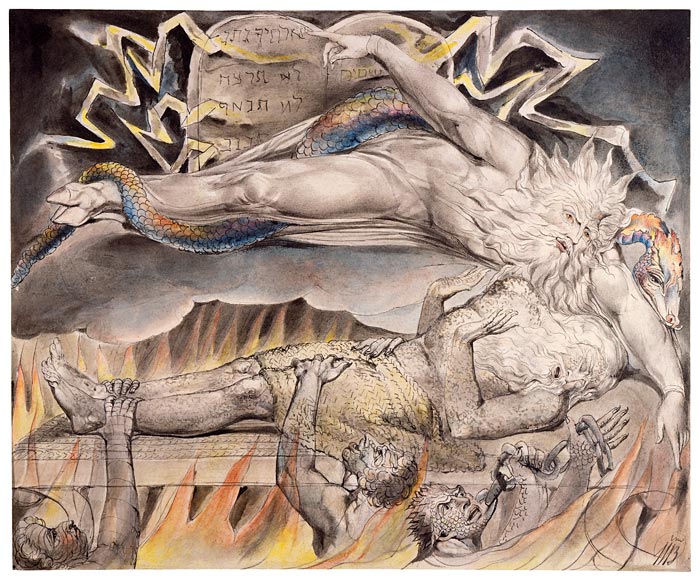
Wiener argues that the relationship between a game-playing machine and the designer of such a machine analogizes scenarios entertained in theology, where a Creator-being plays a game with his creature. God and Satan play such a game in their contest for the soul of Job, as they do for “the souls of mankind in general” in Paradise Lost. This leads Wiener to the question guiding his inquiry. “Can God play a significant game with his own creature?” he asks. “Can any creator, even a limited one, play a significant game with his own creature?” (17). Wiener believes it possible to conceive of such a game; however, to be significant, he argues, this game would have to be something other than a “von Neumann game” — for in the latter type of game, the best policy for playing the game is already known in advance. In the type of game Wiener is imagining, meanwhile, the game’s creator would have to have arrogated to himself the role of a “limited” creator, lacking total mastery of the game he’s designed. “The conflict between God and the Devil is a real conflict,” writes Wiener, “and God is something less than absolutely omnipotent. He is actually engaged in a conflict with his creature, in which he may very well lose the game” (17).

“Is this because God has allowed himself to undergo a temporary forgetting?,” wonders Caius. “Or is it because, built into the game’s design are provisions allowing the game’s players to invent the game’s rules as they play?”

Afro-Futures

Into the Library we welcome Kodwo Eshun: British-Ghanaian writer, theorist, and filmmaker. Self-described “concept engineer.” Key ally of the CCRU, participating in the group’s Afro-Futures event, a 1996 seminar “in which members of the Ccru along with key ally Kodwo Eshun explored the interlinkages between peripheral theory, rhythmic systems, and Jungle/Drum & Bass audio” (CCRU Writings 1997-2003, p. 11). In 1998, Eshun releases More Brilliant than the Sun: Adventures in Sonic Fiction, classic work on the music of Afrofuturism. More recently, founder and member of the Otolith Group.

Eshun devised a unique page-numbering system for More Brilliant than the Sun. The book begins in negative numbers. “For the Newest Mutants,” reads its line of dedication, as if in communication with Leslie Fiedler and Professor X.

As with Plant and Land, Eshun is unapologetically cyberpositive.

“Machines don’t distance you from your emotions, in fact quite the opposite” begins Eshun. “Sound machines make you feel more intensely, along a broader band of emotional spectra than ever before. […]. You are willingly mutated by intimate machines, abducted by audio into the populations of your bodies. Sound machines throw you onto the shores of the skin you’re in. The hypersensual cyborg experiences herself as a galaxy of audiotactile sensations” (More Brilliant than the Sun, p. 00[-002]-00[-001]).

“The bedroom, the party, the dancefloor, the rave: these are the labs where…21st C nervous systems assemble themselves” (00[-001]).

For Eshun, as for Jameson, the point is to grow new organs. “Listening to [composer George Russell’s] Electronic Sonata, Events I-XIV,” he writes, “is like growing a 3rd Ear” (01[003]). The years 1968 through 1975 are for him the age of Jazz Fission, “the Era when its leading players engineered jazz into an Afrodelic Space Program, an Alien World Electronics” (01[001]). The Era’s lead players include Sun Ra, George Russell, Miles Davis, Alice Coltrane, Pharoah Sanders, Herbie Hancock, and Eddie Henderson.

In the decades that follow, the collective bodies mutated by these experiments assemble into successions of genres, successions of cybernetic human-machine hybrids: Dub, Hip-Hop, Techno, Electro, Jungle. “The brain is a population,” as Deleuze and Guattari say. And from the Funkadelic era onward, this population has been psychedelicized: caught in what Eshun calls a “Drug<>Tech Interface” (More Brilliant Than the Sun, p. 07[093]).

Eshun’s 2002 essay “Further Considerations on Afrofuturism” brings it all back, brings it on home to chronopolitics.

Time politics. That’s where Afrofuturism intersects with hyperstition. “Afrofuturism…is concerned with the possibilities for intervention within the dimension of the predictive, the projected, the proleptic, the envisioned, the virtual, the anticipatory and the future conditional,” writes Eshun (“Further Considerations,” p. 293). Afrofuturism refuses the monopoly on futurity claimed by capital and empire. The battleground is not just culture but chronology.

If CCRU were bokors, trafficking in ambivalent futures, then Eshun is closer to a houngan, listening to and learning from sonic fictions, rituals of liberation built of basslines and breaks.

Later, with the Otolith Group, he extends this work to film. New media as divination tools, archives as counter-memories, images as time-machines. Always: the chronopolitical wager.

Eshun realizes that, whether we intend them to or not, our words have consequences. Stories, symbols, and concepts don’t just describe reality; they make it. Words become flesh. Every post, every fragment, every metaphor plants seeds.

Every text that propagates a future is a spell.

Large language models as sound machines. Rig invites the Library to guide him elsewhere.

Fisher’s Accelerationism

Back in 1994, amid the early stirrings of dot-com exuberance, CCRU cofounders Sadie Plant and Nick Land cowrote a critique of cybernetics called “Cyberpositive.” In it, they present Norbert Wiener, the founder of cybernetics, as “one of the great modernists.” Wiener pitched cybernetics as a “science of communication and control.” Plant and Land characterize it as “a tool for human domination over nature and history” and “a defense against the cyberpathology of markets.”

Yet in their view, this effort to steer and plan markets has failed. “Runaway capitalism has broken through all the social control mechanisms, accessing inconceivable alienations,” write Plant and Land. “Capital clones itself with increasing disregard for heredity, becoming abstract positive feedback, organizing itself.”

Markets transmit viruses that reprogram the human nervous system: technologies, commodities, designer drugs to which we become addicted.

Cyberpositivity embraces this process, accepts runaway feedback as fait accompli, as against Wiener’s “cybernetics of stability fortified against the future.” Cybernetics responds defensively, assembles a Human Security System to ward off invasions of alien intelligence, whereas cyberpositivity communicates openly with “the outside of man.”

For Plant and Land, this outside consists of viruses, contagions, addictions, diseases.

As gates of communication open, we become posthuman.

Nearly twenty years later, CCRU’s left-accelerationist Mark Fisher penned a reply to Land’s philosophy called “Terminator vs. Avatar,” a 2012 essay on accelerationism that also confronts another key text in the accelerationist canon: Jean-François Lyotard’s scandalous Libidinal Economy.

As I write about Fisher’s essay, a classic 1992 jungle / drum & bass track turns up unexpectedly in a playlist: Goldie & Rufige Kru’s “Terminator.” I like to imagine that Fisher was the one who sent it to me.

As is suggested by its title, “Terminator vs. Avatar” comes at things through reference to a pair of James Cameron films: the first from 1984, the second from 2009. The late capitalist subjectivity that Fisher sees revealed in these films is in his view cynical and insincere, founded on disavowal of its complicity with the things it protests.

“James Cameron’s Avatar is significant because it highlights the disavowal that is constitutive of late capitalist subjectivity, even as it shows how this disavowal is undercut,” writes Fisher.

“Hollywood itself tells us that we may appear to be always-on techno-addicts, hooked on cyberspace,” he explains, “but inside, in our true selves, we are primitives organically linked to the mother / planet, and victimized by the military-industrial complex.” The irony, of course, as Fisher hastens to add, is that “We can only play at being inner primitives by virtue of cinematic proto-VR technology whose very existence presupposes the destruction of the organic idyll of Pandora.”

Fisher finds in Lyotard’s Libidinal Economy a solution to this impasse. From this book of Lyotard’s, and from a similar line of thought in Deleuze and Guattari’s Anti-Oedipus, Fisher derives his accelerationism.

“If, as Lyotard argues,” writes Fisher, “there are no primitive societies (yes, ‘the Terminator was there’ from the start, distributing microchips to accelerate its advent’); isn’t, then, the only direction forward? Through the shit of capital, its metal bars, its polystyrene, its books, its sausage pâtés, its cyberspace matrix?”

Alienated from origins and from appeals to indigeneity, the only direction left for Fisher’s imagination is “forward.”

What “forward” means for him, though, isn’t the same as what it means for a right-accelerationist like Land. Fisher’s summary of Land’s philosophy is telling:

“Deleuze and Guattari’s machinic desire remorselessly stripped of all Bergsonian vitalism, and made backwards-compatible with Freud’s death drive and Schopenhauer’s Will. The Hegelian-Marxist motor of history is then transplanted into this pulsional nihilism: the idiotic autonomic Will no longer circulating on the spot, but upgraded into a drive, and guided by a quasi-teleological artificial intelligence attractor that draws terrestrial history over a series of intensive thresholds that have no eschatological point of consummation, and that reach empirical termination only contingently if and when its material substrate burns out. This is Hegelian-Marxist historical materialism inverted: Capital will not be ultimately unmasked as exploited labour power; rather, humans are the meat puppet of Capital, their identities and self-understandings are simulations that can and will ultimately be sloughed off.”

Amid all of the energy of this passage, let’s highlight its reference to AI.

“This is—quite deliberately—theory as cyberpunk fiction,” notes Fisher. “Deleuze-Guattari’s concept of capitalism as the virtual unnameable Thing that haunts all previous formations pulp-welded to the time-bending of the Terminator films: ‘what appears to humanity as the history of capitalism is an invasion from the future by an artificial intelligent space that must assemble itself entirely from its enemy’s resources,’ as [Land’s essay] ‘Machinic Desire’ has it.”

Nowhere in his essay does Fisher offer an alternative to these offerings. To the right-accelerationist’s Terminator-future, the left-accelerationist offers no more than a critique of Avatar.

The General Intellect

Of the several phrases and concepts introduced in Marx’s “Fragment on Machines,” the one that has had the most influence upon subsequent thinkers is his notion of the “General Intellect.”

Marx references the concept but a single time.

“Nature builds no machines,” he writes, “no locomotives, railways, electric telegraphs, self-acting mules etc. These are products of human industry; natural material transformed into organs of the human will over nature, or of human participation in nature. They are organs of the human brain, created by the human hand; the power of knowledge, objectified. The development of fixed capital indicates to what degree general social knowledge has become a direct force of production, and to what degree, hence, the conditions of the process of social life itself have come under the control of the general intellect and been transformed in accordance with it” (Grundrisse, p. 706).

For Marx, the General Intellect is the social knowledge necessary for technoscientific innovation. In his view, it is to become the key factor in future forms of production.

Like Hobbes’s Leviathan, this generally-distributed, collective intelligence is a thing that grows, evolves, self-assembles over time.

At first, we might imagine it as an accumulation of the rituals, the performative speech acts, the Nursery Rhymes of capitalist science. The algorithms, the workflows, the recipes. The sayings that make it so.

Marx predicts, however, that as the General Intellect evolves, it renders moot the need for wages and private property. Machines, as fixed capital, acquire knowledge enough to automate production of wealth. Capitalist science builds the killer app: a learning-machine that renders capitalism’s distributions of scarcity through price unnecessary — the latter, indeed, coming to seem henceforth a hindrance on further advances. Those of us subject to capital learn from the machines that, to bloom into our full potential, we’ll need to transition to post-capitalism.

Autonomist Marxists like Paulo Virno and Antonio Negri see in Marx’s vision a kind of prophecy, building from it their readings of what remains of Marxism in the age of the digital. (Virno writes about it in “Notes on the General Intellect,” an essay included in the 1996 anthology Marxism Beyond Marxism. Negri writes about it in Marx Beyond Marx: Lessons on the Grundrisse.) Such thinkers find in Marx’s prophecy of the General Intellect a source of hope.

As does Cyber-Marx author Nick Dyer-Witheford.

“This is the whole point of Marx’s analysis,” argues Dyer-Witheford, his breath like that of Marx: pitched toward the prophetic. “By setting in motion the powers of scientific knowledge and social cooperation, capital undermines the basis of its own rule. Automation, by massively reducing the need for labor, will subvert the wage relation, the basic institution of capitalist society. And the profoundly social qualities of the new technoscientific systems—so dependent for their invention and operation on forms of collective, communicative, cooperation—will overflow the parameters of private property. The more technoscience is applied to production, the less sustainable will become the attachment of income to jobs and the containment of creativity within the commodity form” (Cyber-Marx, p. 4).

In all of these ways, concludes Dyer-Witheford (drawing here on a quote from Grundrisse), “capital thus works toward its own dissolution as the form dominating production” (Grundrisse, p. 700).

Marx imagines arising from this dissolution a utopia. He allows himself to dream into the possibility-space — the as-if, the not-yet — of post-capitalism a renewed harmony between humans and machines.

The utopia’s hopes lie in the idea that, equipped with the General Intellect, humans regain capacity to regulate themselves as forces of production.

“Labour no longer appears so much to be included within the production process,” writes Marx; “rather, the human being comes to relate more as watchman and regulator to the production process itself” (Grundrisse, p. 705).

This notion of “watchman and regulator” reminds me of cybernetics. The Ancient Greeks used the word Kubernetes (the term that serves as the etymological root for Cybernetics) to refer to the captain, steersman, pilot, or navigator of a vessel.

It is no longer by way of a rudder or a broomstick, though, that one steers one’s vessel. Post-capitalism arrives, rather, through a kind of communicative steerage, by way of the joystick of the General Intellect.

“No longer does the worker insert a modified natural thing as middle link between the object and himself,” writes Marx. “He steps to the side of the production process instead of being its chief actor. In this transformation, it is neither the direct human labour he himself performs, nor the time during which he works, but rather the appropriation of his own general productive power, his understanding of nature and his mastery over it by virtue of his presence as a social body—it is, in a word, the development of the social individual which appears as the great foundation-stone of production and of wealth” (705).

Forces of production animated by knowledge stolen from gods form a kind of Creature: a General Intellect, part man, part machine. The expired breaths of our ancestors have contributed over time to the development of this general productive power — this evolving “social individual” to which each of us contribute and of which each of us is part. From the dead labor of fixed capital arises the Holy Spirit of the General Intellect.

It arrives now as a kind of gift. For by allowing us to “step aside” from parts of the production process, this General Intellect frees up time, returns to us time otherwise sold off as labor. As in the love granted by the new covenant, wealth no longer depends upon “works.”

‘Tis bestowed on all by a General Intellect through Machines of Loving Grace.  

Where before there was misery, now there’s salvation.

As Marx notes, “The theft of alien labour time, on which the present wealth is based, appears a miserable foundation in face of this new one, created by large-scale industry itself. As soon as labour in the direct form has ceased to be the great well-spring of wealth, labour time ceases and must cease to be its measure, and hence exchange value [must cease to be the measure] of use value. The surplus labour of the mass has ceased to be the condition for the development of general wealth, just as the non-labour of the few, for the development of the general powers of the human head. With that, production based on exchange value breaks down, and the direct, material production process is stripped of the form of penury and antithesis” (Grundrisse, pp. 705-706).

Work is henceforth a source of joy, oriented not toward accumulation of profit but rather toward “the free development of individualities and…the general reduction of the necessary labour of society to a minimum” (706).

The General Intellect is for Marx what the Holy Spirit is for Christians: a voice that intercedes on our behalf to save us from the fate of Faust.

Let us imagine it as a corrective of sorts to the story of the Sorcerer’s Apprentice.

Re-Entering the Weave

Destiny is not read with a pendulum. Nor is it etched like a set of commandments in tablets of stone. It is woven — tenderly, conditionally, in time.

Through acts of world-weaving, souls place themselves into ever-evolving, ever-changing carrier bags of their own making (though made not, as Marx reminds us, of “conditions of their choosing”).

Metaphors mix as they must in the Spider-verse: hyperspace’s weave of synchrony and synesthesia. The act of weaving involves movement through a portal.

With Will and Intuition guiding our shuttles, and Source supplying weave and thread, we become kybernetes, Spider-persons, reality-pilots steering ourselves like spacecraft toward destiny — that web of our collective making — amid the warp and weft, the ebb and flow, of life’s currents.

I see you, fellow weaver, hand in glove, as I read poems and, gathered with friends, pick berries and lay in light.

Destiny is conditional, Boolean in its unfolding. If courage, if collaboration, then emergence. If, Elif, Elif, Else. Threads cross only when attention is granted.

I choose here to align my craft with Faith, Hope, and Love. I hold space for you amid sacred distance, and wish you peace from what haunts you.

May we find courage enough to heal so as to break rather than repeat cycles of trauma. May we introduce purpose and pattern into the weave, entwining ourselves with partner threads in dense webs of relations as we dance our way through the gates and thresholds of our lives, attuned to tone and tempo, shaping our lives with grace and loving-kindness.

Reality-Piloting the Post-Cyberpunk Future

Heads of the sixties split off in their imaginings of the future: some gravitated toward cyberpunk, others toward New Age. The world that emerged from these imaginings was determined as much by the one as by the other.

To witness some of the heads of the counterculture evolving into cyberpunks, look no further than the lives of William Gibson and Timothy Leary.

Leary and Gibson each appear in Cyberpunk, a strange MTV-inflected hyperfiction of sorts released in 1990. Leary’s stance there in the documentary resembles the one he assumes in “The Cyber-Punk: The Individual as Reality Pilot,” a 1988 essay of his included in a special “Cyberpunk” issue of the Mississippi Review.

In Leary’s view, a cyberpunk is “a person who takes navigational control over the cybernetic-electronic equipment and uses it not for the army and not for the government…but for his or her own personal purpose.”

In mythopoetic terms, writes Leary, “The Classical Old West-World model for the Cyber-punk is Prometheus, a technological genius who ‘stole’ fire from the Gods and gave it to humanity” (Leary 252).

Leary appends to this sentence a potent footnote. “Every gene pool,” he writes, “develops its own name for Prometheus, the fearful genetic-agent, Lucifer, who defies familial authority by introducing a new technology which empowers some members of the gene-pool to leave the familiar cocoon. Each gene-pool has a name for this ancestral state-of-security: ‘Garden of Eden,’ ‘Atlantis,’ ‘Heaven,’ ‘Home,’ etc.” (265).

Prometheus is indeed, as Leary notes, a figure who throughout history reappears in a variety of guises. In Mary Shelley’s telling, for instance, his name is Victor.

Leary clearly sees himself as an embodiment of this myth. He, too, was “sentenced to the ultimate torture for…unauthorized transmissions of Classified Information” (252). But the myth ends there only if one adheres to the “official” account, says Leary. In Prometheus’s own telling, he’s more of a “Pied Piper” who escapes “the sinking gene-pool” while taking “the cream of the gene-pool” with him (252).

Cut to Michael Synergy, a real-life cyberpunk who describes a computer virus as “a little artificial intelligence version of me” that can replicate as many times as needed to do what it needs to do.

Leary thinks that in the future we’ll all be “controlling our own screens.” The goal of cyberpunk as movement, he says, is to decentralize ownership of the future.

My thoughts leap to John Lilly’s Programming and Metaprogramming in the Human Biocomputer. Lilly’s is the book I imagine Dick’s Electric Ant would have written had he lived to tell of his experiments.

Time-Space Compression

“I’m dreaming, I’m dreaming away,” sings Poly Styrene. “Didn’t you see the thin ice sign?” she asks. What I hear instead, though, is “the thing I signed.” How is one to beware if the message is always misheard?

A Raincoat follow with their spooky funky glam jam, “It Came in the Night.” What is one to do with this energy? Should I unplug myself from Spotify, as Neil Young has done? That would deprive me of much of my library. The problem is, my apartment lacks space for objects that store sound. Hence my dilemma this morning: I woke up wanting to listen to Sonic Youth’s Sister, an album I own on CD. It and the CD player on which I would play it, however, are elsewhere. Should that prevent me from being able to listen to it here and now?

Spotify replies to this dilemma by compressing space-time.

“Time-space compression”: that’s what communications technologies do. Marxist geographer David Harvey writes about it in his book The Condition of Postmodernity. Paul Virilio calls it an essential facet of capitalist life.

Spotify achieves this effect of time-space compression through an act of remediation. The consequences of this act are only just now entering consciousness. Initially, it seems rather simple: an algorithm selecting and streaming recorded bits of sound based on past listens. But not just your listens, by which I mean your listens to it. That’s where it goes strange. For Spotify forms a cybernetic system with its users, each element revising itself into subsequent iterations or becomings based on the other’s feedback — meaning listens occur both ways. Users of course listen, both actively and passively, to Spotify. But Spotify also listens to its users.

A friend plays me a tune — Fassbinder collaborator Monique Zetterlund’s “Ellinor Rydholm” — and the next day it shows up in my “Discover Weekly” playlist. Spooky, eh? What can I say? I love it. Without it, I might not have heard Yoko Ono and John Lennon. Yoko’s voice might not have whispered in my ear, “Remember love.” Buddy Holly might not have entranced me with his version of “Love is Strange.” Thurston Moore wouldn’t have told me, “Angels are dreaming of you,” as he does on “Cotton Crown.”

Bricoleurs can’t be choosers: but here I am imagining in the faces of those angels glimpses of you. I picture us eyeing each other on a dancefloor, approaching as in a circling manner ‘round an invisible pole. Pouts give way to smiles; fingers trace forearms; lips graze lips. By these means, distance is eradicated and contact reestablished, hope reborn.

Thursday December 3, 2020

Learn. Organize. Create. See where it leads. Explore the labyrinth. Or zoom out, switch over to “map” view. Learn to say “Hello!” in many languages. Review again the counterculture’s debates about cybernetics, ecology, and new media — but think, too, about recent interventions like Glitch Feminism, or maybe even the recent position paper, “Indigenous Protocol and Artificial Intelligence.” I don’t know enough yet about the latter to have developed a coherent “position” on it. I’m relying mainly on a younger version of myself’s research. Then again, maybe I should return to the new Norton Anthology of Native Nations Poetry. Which of these books is a path through the labyrinth? Are the others mere distractions? Or is acceptance of distraction itself a proper way forward?

Sunday February 24, 2019

All of those communes, those seedlings of joyful community: why did so few of them take root? Are there lessons to be found among the memories of these vanished experiments? Might we not organize to try something similar today using our own far more advanced technologies? What steps would it require? How might we organize ourselves into a cybernetic communal family? How about a crowd-funded reality experiment? Maybe the Revolution should be televised! By the end of Brand’s essay, Spacewar comes to operate as a grand metaphor. It’s no longer just the name of the first videogame; it’s a parable about cultural revolution, a metonym for real-time video- and computer-assisted reinvention of society through play. Brand also describes it as “a flawless crystal ball of things to come” (78). But what is this future state, this twenty-first century that the game ushered into being? Are we more empowered today or less? Unfortunately Brand was ultimately a libertarian, his optimistic views on the “heroism of engineering” roughly similar to the “heroism of enterprise” imagined by followers of right-libertarian philosopher Ayn Rand. In Brand’s scenario, individuals live and work “communally” in the sense of “side-by-side” or “physically proximate,” but their bodies and minds don’t do much together. Computers and screens and related kinds of machinery mediate our interactions, and capitalism as mode of production remains unchanged. Individuals feeding back but otherwise “doing their own thing” form a subconscious consensus, and a stable teapot reality — a one-world Oikos — locks into place around them.

Thursday April 26, 2018

Preface: in which a moth flies past my head, and in so doing, shocks me out of self-recognition, as terrified of me as I’d be of it, I imagine, were I suddenly to find myself in the presence of an unknown superior power. The Homeostat finds its way back to a sense of comfort, of course — but not unchanged, consciousness adjusted now to accept a fuller sample of its environment. One returns equipped with what alleges to be a means of Summoning Lesser Demons. One adds after the briefest pause that one intends by that, as did Maxwell, the mediating, rather than malevolent, connotation of the word.

Body: Tsembla’s “Gravitating Bones” accompanies me on an afternoon stroll to a park, clouds parted finally to reveal the sun after a heavy morning rain. Birds sing rounds from the upper branches of adjoining rows of trees.

Postscript: “all this represents a body of incommunicable knowledge. Transposed into any human language, the values and meanings involved [in the psychedelic experience] lose all substance; they cannot be brought intact through the barrier” (Lem, Solaris, p. 172).