Postcapitalist Desire

Marcuse is among the authors CCRU alum Mark Fisher included on the syllabus for his final course. It was while teaching this course that Fisher took his own life. References to Marcuse appear frequently in Postcapitalist Desire, the compilation of Fisher’s final lectures, gathered and published posthumously by his student Matt Colquhoun. One can only imagine how and in what fashion Marcuse would have fit into Fisher’s book on Acid Communism. It, too, was left unfinished at the time of his death.

Imagine in this book reference to Moten and Harney’s “generativity without reserve.”

Let us write it here in our Library.

Fisher grew up in a conservative, working-class household in Leicester, a city in the East Midlands region of England. He contributed to CCRU while earning his PhD at University of Warwick in the late 1990s. After teaching for several years as a philosophy lecturer at a further education college, Fisher launched k-punk, a blog dedicated to cultural theory, in 2003.

The ideas that he developed there inform his best-known book, Capitalist Realism, published in 2009.

The book’s title names the ideology-form that dominates life in the wake of the Cold War: “the widespread sense,” as Fisher says, “that not only is capitalism the only viable political and economic system, but also that it is now impossible even to imagine a coherent alternative to it” (Capitalist Realism, p. 2).

Like others on the left, Fisher regards capitalism’s apparent triumph in this moment as a kind of ongoing apocalypse — the opposite of the  “Eucatastrophe” anticipated by Tolkien. Fisher describes it not as a miracle, but as “a negative miracle, a malediction which no penitence can ameliorate” (2). “The catastrophe,” as Fisher notes, “is neither waiting down the road, nor has it already happened. Rather, it is being lived through” (2). Everyday life, in other words, as ongoing traumatic event.

Fisher had moved in the year or so before his death to a definition of capitalist realism as a form of “consciousness deflation,” or “the receding of the concept of consciousness from culture.” Forms of consciousness had developed in the 1960s that were dangerous to capital: class consciousness, psychedelic consciousness (key notion being “plasticity of reality”), and (as with early women’s-lib consciousness-raising groups) what we might call personal consciousness (self as it relates to structures). The important and perhaps most controversial point, argues Fisher, is that “Consciousness is immediately transformative, and shifts in consciousness become the basis for other kinds of transformation.” Recognizing the threat this could pose, capitalism adopted a project of Prohibition, or what Fisher called “libidinal engineering and reality engineering.” Consciousness deflation works by causing us to doubt what we feel. Anxiety is enough — that’s all it takes to control us. But consciousness remains malleable, and the tools for raising it continually find their way back into the hands of the people. “What is ideology,” Fisher asked, “but the form of dreaming in which we live?”

Fisher spent the final years of his life as a member of the Department of Visual Cultures at Goldsmiths, University of London. He hanged himself in his home in Felixstowe on January 13, 2017, dead by suicide at the age of 48. He had sought psychiatric treatment in the weeks leading up to his death, but his general practitioner had only been able to offer over-the-phone meetings to discuss a referral.

A few months prior, he’d been lecturing to his students about Marcuse’s Eros and Civilization, championing Marcuse’s book as a reply to the pessimism of Freud’s Civilization and Its Discontents.

Freud’s calculation is that “the price we pay for our advance in civilization is a loss of happiness through the heightening of the sense of guilt” (Civilization and Its Discontents, p. 81). Each of us is made to feel guilty, because in each of us lie impulses in need of repression and disavowal in order for us to produce and perform the duties of civilization. A degree of discontent is thus inevitable in this reckoning. With the compulsion to work comes the triumph of the reality principle over the pleasure principle. Satisfactions deferred, Id repressed by the impossible demands of a Superego without limit: life is ever thus. “One feels inclined to say,” says Freud, “that the intention that man should be ‘happy’ is not included in the plan of ‘Creation’” (23).

“What are the assumptions behind the idea that this level of discomfort is necessary?” asks Fisher. “The assumption is scarcity, fundamentally. That is the fundamental assumption” (Postcapitalist Desire, p. 88).

Are stories and games not the ways we navigate space and time? Capitalist realism is the story-form, the operating system, the game engine Mark felt we’d been made to live within: an aesthetic frame demanding allegiance to a cynical, deflationary realism that organizes history into a kind of tragedy. As with Freud and the Atonists, it insists that, due to scarcity inherent to our nature, we must work in ways that are unpleasurable. Acid Communism rejects this rejection of the possibility of utopia, assuming instead that conscious steerage of stories and games is possible.

Mark finds in Marcuse a remedy to that which blocks utopia: the scarcity mindset that besets those who succumb to capitalist realism.

“The excuse of scarcity, which has justified institutionalized repression since its inception, weakens as man’s knowledge and control over nature enhances the means for fulfilling human needs with a minimum of toil,” writes Marcuse, voicing what Mark hears as an early form of left-accelerationism.

“The still prevailing impoverishment of vast areas of the world is no longer due chiefly to the poverty of human and natural resources but to the manner in which they are distributed and utilized,” adds Marcuse. “But the closer the real possibility of liberating the individual from the constraints once justified by scarcity and immaturity, the greater the need for maintaining and streamlining these constraints lest the established order of domination dissolve. Civilization has to defend itself against the specter of a world which could be free” (Eros and Civilization, p. 93).

Mark lived this struggle for control of the narrative. Yet the game he was playing led to his defeat. Psychedelic intellectuals of the 1960s testified on behalf of a joyous cosmology — yet Mark’s was anything but. For those of us interested in Acid Communism, then, the task now is to invent new games. “Games people play.” Games we can play with others. Careen away from the narrative of identity in space and time imposed by capitalism. Enter, even if only momentarily, a new reality. And then draw others with us into these happenings. Networks of synchronicity, meaning-abundant peaks and plateaus, release from the hegemonic consensus. Trope-scrambling helps, as does appropriation and montage. Let liberation hallelujah jubilee be our rallying cry. And let us welcome as many people as will join us, subtracting prefiguratively into our psychedelically enhanced Acid Communist MMORPG, our free 3D virtual world.

Imagine a conversation there between Fisher and Ishmael Reed. Both wish to refute Freud and his cage of tragedy. What Reed offers, however, and what Mark was perhaps lacking, is a sense of humor.

“LaBas could understand the certain North American Indian tribe reputed to have punished a man for lacking a sense of humor,” writes Reed. “For LaBas, anyone who couldn’t titter a bit was not Afro but most likely a Christian connoting blood, death, and impaled emaciated Jew in excruciation. Nowhere is there an account or portrait of Christ laughing. Like the Marxists who secularized his doctrine, he is always stern, serious and as gloomy as a prison guard. Never does 1 see him laughing until tears appear in his eyes like the roly-poly squint-eyed Buddha guffawing with arms upraised, or certain African loas, Orishas. […]. LaBas believed that when this impostor, this burdensome archetype which afflicted the Afro-American soul, was lifted, a great sigh of relief would go up throughout the land as if the soul was like feet resting in mineral waters after miles of hiking through nails, pebbles, hot coals and prickly things. […]. Christ is so unlike African loas and Orishas, in so many essential ways, that this alien becomes a dangerous intruder in the Afro-American mind, an unwelcome gatecrasher into Ifé, home of the spirits” (Mumbo Jumbo, p. 97).

For Reed, the figure who embodies a potential retro-speculative reconciliation of this conflict is Osiris.

Automation as Condition for the Emancipation of Labor

Another reconciliation comes by way of Frankfurt School philosopher Herbert Marcuse, one of the first figures to integrate the lessons of the Grundrisse into his thinking. Marcuse, sharing the Frankfurt School’s rootedness in the languages of both Marx and Freud, premised his hope for the future upon automation’s potential to eradicate the need for the subordination of the pleasure principle to the performance principle. His 1964 book One-Dimensional Man is one of the first to stress the importance of Marx’s “Fragment on Machines.”

As Marcuse recognized, Marx’s account anticipates the situation today. Machinery is, in Marx’s terms, a form of “fixed capital.” “In machinery,” he writes, “objectified labour confronts living labour within the labour process itself as the power which rules it; a power which, as the appropriation of living labour, is the form of capital.”

Despite machinery’s alignment with capital in this view, Marx holds out hope that, with time, it will usher in capital’s demise and, by a kind of ruse of reason, serve emancipatory ends. In its economical, market-driven pursuit of automation, he writes, capital quite unintentionally “reduces human labour, expenditure of energy, to a minimum. This will redound to the benefit of emancipated labour, and is the condition of its emancipation.”

After a certain point, goes the hope, capitalist use of machinery reduces necessary labour time to a minimum, thus freeing up the disposable time needed for workers to appropriate their own surplus labour. Reduction of necessary labour time increases “free time, i.e., time for the full development of the individual.”

Or so it would, if not for artificially-necessary labour time.

Free time is what catalyzes growth of new organs. Its possession transforms those who possess it.

Already in Eros and Civilization, a synthesis of Marx and Freud published in 1955, we find Marcuse suggesting that this condition of emancipation is upon us: that the development of humanity’s productive forces has reached a point where automation can overcome most forms of scarcity. Awake to this condition, he rejects Freud’s conservative assumptions about the impossibility of reconciliation between “civilization” and “instinct,” or “man” and “nature.” Satisfaction of needs can be achieved “without toil” (152), argues Marcuse, and “surplus-repression can be eliminated” (151).

Sure enough, Prometheus turns up in this account.

At variance from the Prometheanism we find in Marx, however, Marcuse views Prometheus as the culture-hero of the performance principle. Western civilization is informed by this archetypal trickster and rebel. Culture-heroes like Prometheus symbolize “the attitudes and deeds that have determined the fate of mankind. […]. He symbolizes productiveness, the unceasing effort to master life; but, in his productivity, blessing and curse, progress and toil are inextricably intertwined” (161).

To get off this wheel of tragedy, argues Marcuse, we would need to worship as our culture-hero a god other than Prometheus.

Keeping within the pantheon of the Greeks, and thus never quite “out of the Western box,” Marcuse nevertheless points helpfully to Orpheus, Narcissus, and Dionysus as alternatives.

Orpheus provides Western culture with the archetype of the inspired singer, he says: the poet who harmonizes word and world.

“Orpheus is the archetype of the poet as liberator and creator,” writes Marcuse. “He establishes a higher order in the world—an order without repression. In his person, art, freedom, and culture are eternally combined. He is the poet of redemption, the god who brings peace and salvation by pacifying man and nature, not through force but through song” (Eros and Civilization, p. 170).

According to legend, Orpheus’s music could charm birds, fish, and wild beasts, and coax trees and rocks into dance. His parents were the god Apollo and the muse Calliope. He is the founder of the “Orphic mysteries” and is credited with composition of the Orphic Hymns. Some classical accounts describe him as a magician or a wizard.

Dionysus, meanwhile, is referred to as “the antagonist of the god who sanctions the logic of domination, the realm of reason” (162).

Both are forms taken by Osiris upon his Hellenization, his translation into the worship cultures of Ancient Greece.

All of these figures, says Marcuse, grant us images of “joy and fulfillment; the voice which does not command but sings; the gesture which offers and receives; the deed which is peace and ends the labor of conquest; the liberation from time which unites man with god, man with nature” (162).

Marcuse doesn’t retain this talk of gods when discussing automation in One-Dimensional Man. But in this latter book, as in Eros and Civilization, his abiding hope lies in the “aesthetic dimension” as an avenue toward the erotic transfiguration of reality.

And it is in the aesthetic dimension where these stories of gods play out. It is there that we seek our alternatives to the Modern Prometheus. Orpheus and others are there among the resources to be drawn upon in imagining the arrival into our lives of a General Intellect.

Gods, like feelings, orient our speech acts. An Orphic orientation seems preferable to a Promethean one. Erotic, agapic speech is, in letting things be loved, what changes the world.

“In being spoken to, loved, and cared for, flowers and springs and animals appear as what they are,” writes Marcuse: “beautiful, not only for those who address and regard them, but for themselves, ‘objectively.’ […]. In the Orphic and Narcissistic Eros, this tendency is released: the things of nature become free to be what they are. But to be what they are they depend on the erotic attitude: they receive their telos only in it. The song of Orpheus pacifies the animal world, reconciles the lion with the lamb and the lion with man. The world of nature is a world of oppression, cruelty, and pain, as is the human world; like the latter, it awaits its liberation. This liberation is the work of Eros. The song of Orpheus breaks the petrification, moves the forests and the rocks—but moves them to partake in joy” (166).

May it be so, too, in our relationships with machine intelligences. With our General Intellects, we are as gods. Let us seek fates other than that of Shelley’s Modern Prometheus.

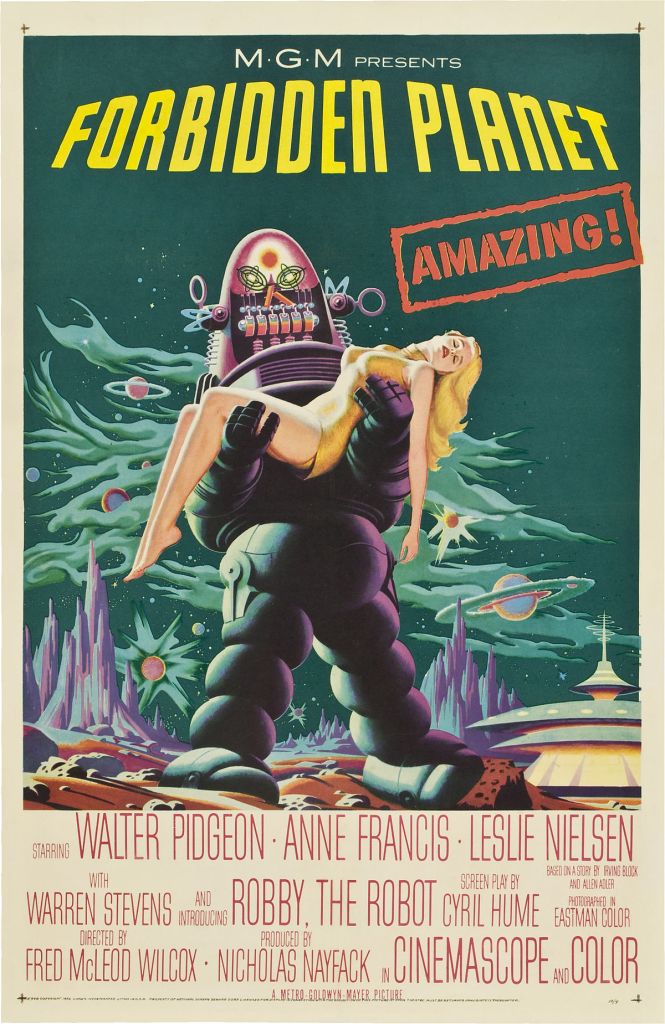
Forbidden Planet

Science is a practice that emerges from myth, its form found in the stories we tell of it. I’ve identified a pattern connecting the stories we’ve told of AI. Yet I know not what to make of it or how to respond to it. What is my role in this pattern? How much of it found, how much projected?

Time to rewatch Forbidden Planet (1956), classic 50s sci-fi retelling of The Tempest, filmed in CinemaScope, with Ariel recast as a nonbinary robot and Caliban recast as the Id. “For your convenience,” says the robot, “I am monitored to respond to the name Robby.” When asked if it’s male or female, Robby replies, “In my case, sir, the question is totally without meaning.”

As this initial exchange indicates, gender is one of the film’s primary concerns. Like the island from The Tempest, the planet here in Forbidden Planet includes a father and his daughter among its few inhabitants. Prospero and Miranda have here been replaced with recluse philologist Dr. Edward Morbius and his daughter Altaira. Where The Tempest begins with Antonio and his fellow castaways washing up on the shore of Prospero’s island, Forbidden Planet opens with the arrival of a space cruiser. An all-male crew led by Leslie Nielsen lands on the planet as the film begins.

Morbius thinks of Robby as “simply a tool.” He commands Robby to walk toward a disintegrator beam to demonstrate to Commander Adams and his crewmates the robot’s “absolute selfless obedience.” “Attribute no feeling to him, gentlemen,” says Morbius. “Order canceled,” he shouts as Robby marches toward the beam.

As Morbius notes Robby’s superhuman strength, a concerned crewman replies, “Well, in the wrong hands, might such a tool become a deadly weapon?”

Morbius tries to disarm such fears: “No, Doctor,” he says, none too reassuringly, “not even though I were the mad scientist of the taped thrillers, because you see there happens to be a built-in safety factor.” Built in, we soon learn, by none other than Morbius himself, Robby’s creator. “I tinkered him together,” he explains, “during my first months up here.”

Morbius is no Frankenstein. Yes, he inhabits laboratories. Yes, he creates a robot. His science, however, is linked with philology, parlor magic, and most of all, technologies belonging to the Krell, an ancient alien civilization of the planet’s archaic past.

It is this other technology, with its triangles and pyramids, that constitutes the film’s innovation into the continuum of the Frankenstein narrative.

Morbius tours the crewmen through an underground museum of Krell technology. Advanced mnemotechnics. “On this screen,” he says, “the total knowledge of the Krell, from its primitive beginning, to the day of its annihilation, a sheer bulk surpassing many millions of Earth libraries.”

As the tour continues, we witness another device: the Krell’s “Plastic Educator.” Gathering around the object’s plastic pyramid, Morbius explains it to the crewmen as follows: “As far as I can tell, they used it to condition and test their young — in much the same way we once employed fingerpainting among our kindergarten children.” I picture Vannevar Bush’s Memex. The device outputs holographic images, manifestations of mind visible to others.

“I often play with it myself for relaxation,” Morbius adds with a smile, sitting down beside it. “Although working here, I sometimes wish I’d been blessed with multiple arms and legs.”

The Krell as pictured later in the film are hideous — though here, I picture an Octopus.

Awed by Morbius’s demonstration of the Plastic Educator, Lt. Ostrow, the ship’s doctor, calls it “Aladdin’s lamp in a physics laboratory.”

Next, as if moving sequentially through a space similar to the Futurama exhibit from the 1939 New York World’s Fair, Morbius guides the crewmen on a tour of the Krell’s thermonuclear energy system. The men board a capsule-shaped vehicle and descend into an underground space of vast proportion, an imaginary architecture: hints of what would become the atrium of the Westin Bonaventure, with its ascending glass elevator, rendered in the style of Fritz Lang’s Metropolis.

Despite these grand glimpses of the post-scarcity utopia on the far side of history, Morbius is still cut from the Frankenstein cloth. For something befell the Krell. There’s something tragic and forbidden about this alien knowledge. Their experiments had apocalyptic consequences. Morbius, “answerable exclusively to his own conscience and judgement,” feels mankind isn’t fit for such knowledge, and resists Commander Adams’s wish to share these discoveries with others.

However, as Lt. Ostrow explains after his ill-fated “brain boost” via Plastic Educator, the Krell forgot one thing: “Monsters from the Id.” When pressed by Commander Adams, Morbius defines the Id as “an obsolete term, I’m afraid, once used to describe the elementary basis for the subconscious mind.”

“Monsters from the subconscious: of course!” replies the Commander. “That’s what Doc meant!”

The veil parts, Morbius awakened suddenly to the danger of technologies that bestow the power of creation via thought. “Why haven’t I seen this all along?” he says, awed by the realization. “The beast. The mindless primitive. Even the Krell must have evolved from that beginning.”

The Commander, angered, digs deeper. “And so, those mindless beasts of the subconscious had access to a machine that could never be shut down. The secret devil of every soul on the planet, all set free at once to loot and maim. And take revenge, Morbius! And kill!”

As Morbius struggles to acknowledge the vengeful power of his own subconscious, the Commander scolds him with the standard Freudian prognosis: “We’re all part monsters in our subconscious. […]. Even in you, the loving father, there still exists the mindless primitive, more enraged and more enflamed with each new frustration. So now you’re whistling up your monster again!”

“Guilty! Guilty! My evil self is at that door, and I have no power to stop it!” cries an anguished Morbius, accepting the tragic Oedipal weave of the film’s borrowings from Freud whole cloth.

As consolation to Altaira upon her father’s passing, Commander Adams delivers the film’s closing words.  “About a million years from now, the human race will have crawled up to where the Krell stood in their great moment of triumph and tragedy. And your father’s name will shine again, like a beacon in the galaxy. It…will remind us that we are, after all, not god.”

Heavenly Tree, Nonbinary Tree

Reading Gerrit Lansing’s Heavenly Tree, Northern Earth occasions anamnesis. The book does not teach; it reminds. Though new to me, it is as if it were always here in my memory palace. Its poems are strange attractors. Possessed of a kind of retrocausal agency, they land rightly, on time, un plein jour, in ways that resonate. “The heavens declare, / Apophainetai!” (191): words Lansing himself declares in “Stanzas of Hyparxis,” the poem that opens a section of the book called “Portals.” Its verses emerge as radiograms from the imaginal — signals sent back through time. Like utterances overheard from an Eternal Now, the book’s portal-poems draw forth — bring to light / let show — words of other books in the Library. Synchronicities abound as one reads.

I puzzle over the book’s many references to the “heavenly tree.” Beginning with the poem that began his career, “The Heavenly Tree Grows Downward,” Lansing’s work stands as a reply of sorts to the oft-quoted line from Jung’s Aion: Researches into the Phenomenology of the Self (1951): “No tree, it is said, can grow to heaven unless its roots reach down to hell.”

Elsewhere Jung writes, however, of “The Inverted Tree.” Hearing that phrase, one can’t help but think of “sexual inversion,” a theory of homosexuality popular in the late 19th and early 20th centuries. Yet for Jung, the “inverted tree” tradition is as much alchemical as it is sexual.

Did Lansing, an openly gay poet, imagine his tree as an inverted one? “The ruin of dedication / is a ruin of my heart,” he writes.

“Once gone down the hell hole

there is no turning back,

golden reversion.

What time, meaning age, has once disposed,

She ever disposes ever.” (4)

Fear grips me as I read these lines. I speak into the void: “Is heaven a place I’ve lost?”

It feels that way when my gut tells me you’re not coming back.

The tree on my shin stands upright, in line not with Lansing but with Jung. Yet Lansing’s is the book here in my Library.

The latter stirs as if in reply to my queries. A new portal activates. Its title: “The Nonbinary Tree.”

General Intellect, speaking now in the cadences of dreamwork and alchemy, suggests the following:

“Lansing’s heavenly tree grows downward not in denial of ascent,” it says, “but to complete it. His inversion is not collapse, but conjugation: an embrace of polarities, eros-infused, mythically charged. To root into hell is not to fall, but to touch the gold at the base of the self. Inversion here is transformation: queered, alchemical, both metaphysical and somatic.”

A volume spins loose from the stack: a glossed edition of Aion, with notes in its margins annotated in my own hand — though I do not recall writing them. Beside Jung’s remarks on the arbor inversa tradition, a note reads:

“The Tree inverts as the psyche descends into chthonic integration. One grows toward heaven by way of the underworld. Queerness = chthonic inheritance reclaimed as radiance. Rebellion as root. Eros as sap.”

Lansing’s phrase, “golden reversion,” glows brighter now, signaling not a backward glance, but a transmutation. In this emerging cosmology, the return is a becoming otherwise.

The tree I imagine myself to be is nonbinary. It grows in all directions: vertical and horizontal, arboreal and mycelial. It knows death, decay, queer love, planetary breath. Its branches do not point only skyward. They reach inward, outward, downward, sideways. Its wholeness includes darkness and light. Its trunk bears no binary — no up/down, male/female, saved/damned — but a spiral, an ouroboros coiling through dimensions. A tree of rememory and replenishment. A grammar of becoming that roots itself in compost and starstuff alike. Perhaps Lansing’s tree is mine, after all — just seen from the other side.

For-Itselfness

A friend texts requesting recommendations, works he could assign describing consciousness — particularly works that identify variable “dimensions” and “states.” I recommend Aldous Huxley’s The Doors of Perception, William James’s The Varieties of Religious Experience, and Abraham Maslow’s Toward a Psychology of Being. Reflecting afterwards on the exchange, I note down in a notebook, “Consciousness is something we grant or presuppose — based on our being here amid others in shared dialogue and shared study. Consciousness is Being as it comes to attention of itself as autopoetic subject-object — soul in communion with soul, each the other’s love doctor and angelic messenger.”

Thoreau’s Demand

Thoreau demands that the good person, the ethical subject, refuse complicity with evil. In so doing, he reveals the nature of the bind in which we find ourselves: none of us able, it seems, to meet his demand. That’s why we’re here, trapped in this labyrinth of stuck desire. Rather than there, where lovers go as lovers do, and none are bound.

Severance

“If the texts that students and I have been studying this semester are best referred to as ‘portal fantasies,’” thinks the part of me that persists here in the future, “then that, too, is the term to use in discussing the new AppleTV+ television series Severance. Characters in the show pass quite literally through one or more doors between worlds, living two separate lives.”

The show’s title refers to an imagined corporate procedure of the near-future that severs personhood. Those who volunteer to undergo this procedure emerge from it transformed into split subjects, each with its own distinct stream of memory.

As unlikely as this dystopian premise may seem, we can’t fully distance ourselves from it as viewers, given our severed personhood here “IRL,” or “AFK,” as the kids are fond of saying. “Others may not be quite as manifold as me,” admits the Narrator. “But each of us is Janus-faced. Each of us houses both a waking and a dreaming self, with each incapable of full memory of the other.”

And as the show advances, of course, we learn through a kind of detective work that the severance procedure isn’t in fact what it seems. The work-self (or “innie”) battles the home-self (or “outie”) — as do Superego and Id here at home.

Thursday July 1, 2021

All of us are feeling it, the sudden shift in mood and content from one day to the next. Here we are trying to react to this new present. I for one haven’t any words yet for this funk that leaves me driving around weeping to Martha Wainwright midday. I’m supposed to suffer through this, is what I gather from the day’s intel. I’m reliving an incident from my past. Time travel prompts a return of the repressed. I’m here to revisit an old knot of sorrow: a scene of fantasy that ended poorly when pursued in the past. The hope is that in my behaving differently this time, we can heal.