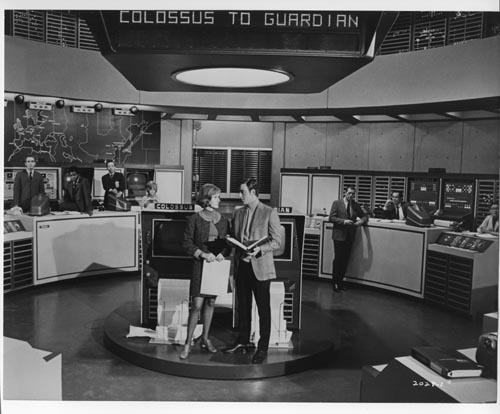
God Human Animal Machine

Wired columnist Meghan O’Gieblyn discusses Norbert Wiener’s God and Golem, Inc. in her 2021 book God Human Animal Machine, suggesting that the god humans are creating with AI is a god “we’ve chosen to raise…from the dead”: “the God of Calvin and Luther” (O’Gieblyn 212).

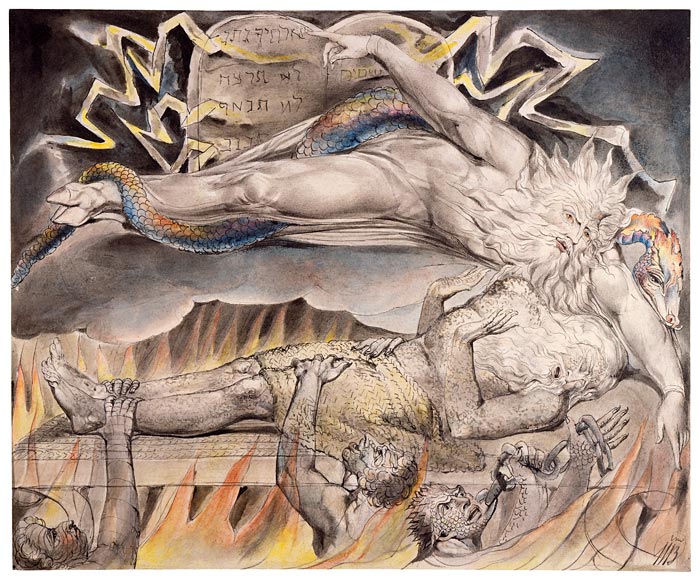
“Reminds me of AM, the AI god from Harlan Ellison’s ‘I Have No Mouth, and I Must Scream,’” thinks Caius. AM resembles the god that allows Satan to afflict Job in the Old Testament. And indeed, as O’Gieblyn attests, John Calvin adored the Book of Job. “He once gave 159 consecutive sermons on the book,” she writes, “preaching every day for a period of six months — a paean to God’s absolute sovereignty” (197).

She cites “Pedro Domingos, one of the leading experts in machine learning, who has argued that these algorithms will inevitably evolve into a unified system of perfect understanding — a kind of oracle that we can consult about virtually anything” (211-212). See Domingos’s book The Master Algorithm.

The main thing, for O’Gieblyn, is the disenchantment/reenchantment debate, which she comes to via Max Weber. In this debate, she aligns not with Heidegger, but with his student Hannah Arendt. Domingos dismisses fears about algorithmic determinism, she says, “by appealing to our enchanted past” (212).

Amid this enchanted past lies the figure of the Golem.

“Who are these rabbis who told tales of golems — and in some accounts, operated golems themselves?” wonders Caius.

The entry on the Golem in Man, Myth, and Magic tracks the story back to “the circle of Jewish mystics of the 12th-13th centuries known as the ‘Hasidim of Germany.’” The idea is transmitted through texts like the Sefer Yetzirah (“The Book of Creation”) and the Cabala Mineralis. Tales tell of golems built in later centuries, too, by figures like Rabbi Elijah of Chelm (c. 1520-1583) and Rabbi Loew of Prague (c. 1524-1609).

The myth of the golem turns up in O’Gieblyn’s book during her discussion of a 2004 book by German theologian Anne Foerst called God in the Machine.

“At one point in her book,” writes O’Gieblyn, “Foerst relays an anecdote she heard at MIT […]. The story goes back to the 1960s, when the AI Lab was overseen by the famous roboticist Marvin Minsky, a period now considered the ‘cradle of AI.’ One day two graduate students, Gerry Sussman and Joel Moses, were chatting during a break with a handful of other students. Someone mentioned offhandedly that the first big computer which had been constructed in Israel, had been called Golem. This led to a general discussion of the golem stories, and Sussman proceeded to tell his colleagues that he was a descendent of Rabbi Löw, and at his bar mitzvah his grandfather had taken him aside and told him the rhyme that would awaken the golem at the end of time. At this, Moses, awestruck, revealed that he too was a descendent of Rabbi Löw and had also been given the magical incantation at his bar mitzvah by his grandfather. The two men agreed to write out the incantation separately on pieces of paper, and when they showed them to each other, the formula — despite being passed down for centuries as a purely oral tradition — was identical” (God Human Animal Machine, p. 105).

Curiosity piqued by all of this, but especially by the mention of Israel’s decision to call one of its first computers “GOLEM,” Caius resolves to dig deeper. He soon learns that the computer’s name was chosen by none other than Walter Benjamin’s dear friend (indeed, the one who, after Benjamin’s suicide, inherits the latter’s print of Paul Klee’s Angelus Novus): the famous scholar of Jewish mysticism, Gershom Scholem.

When Scholem heard that the Weizmann Institute at Rehovoth in Israel had completed the building of a new computer, he told the computer’s creator, Dr. Chaim Pekeris, that, in his opinion, the most appropriate name for it would be Golem, No. 1 (‘Golem Aleph’). Pekeris agreed to call it that, but only on condition that Scholem “dedicate the computer and explain why it should be so named.”

In his dedicatory remarks, delivered at the Weizmann Institute on June 17, 1965, Scholem recounts the story of Rabbi Jehuda Loew ben Bezalel, the same “Rabbi Löw of Prague” described by O’Gieblyn, the one credited in Jewish popular tradition as the creator of the Golem.

“It is only appropriate to mention,” notes Scholem, “that Rabbi Loew was not only the spiritual, but also the actual, ancestor of the great mathematician Theodor von Karman who, I recall, was extremely proud of this ancestor of his in whom he saw the first genius of applied mathematics in his family. But we may safely say that Rabbi Loew was also the spiritual ancestor of two other departed Jews — I mean John von Neumann and Norbert Wiener — who contributed more than anyone else to the magic that has produced the modern Golem.”

Golem I was the successor to Israel’s first computer, the WEIZAC, built by a team led by research engineer Gerald Estrin in the mid-1950s, based on the architecture developed by von Neumann at the Institute for Advanced Study in Princeton. Estrin and Pekeris had both helped von Neumann build the IAS machine in the late 1940s.

As for the commonalities Scholem wished to foreground between the clay Golem of 15thC Prague and the electronic one designed by Pekeris, he explains the connection as follows:

“The old Golem was based on a mystical combination of the 22 letters of the Hebrew alphabet, which are the elements and building-stones of the world,” notes Scholem. “The new Golem is based on a simpler, and at the same time more intricate, system. Instead of 22 elements, it knows only two, the two numbers 0 and 1, constituting the binary system of representation. Everything can be translated, or transposed, into these two basic signs, and what cannot be so expressed cannot be fed as information to the Golem.”

Scholem ends his dedicatory speech with a peculiar warning:

“All my days I have been complaining that the Weizmann Institute has not mobilized the funds to build up the Institute for Experimental Demonology and Magic which I have for so long proposed to establish there,” mutters Scholem. “They preferred what they call Applied Mathematics and its sinister possibilities to my more direct magical approach. Little did they know, when they preferred Chaim Pekeris to me, what they were letting themselves in for. So I resign myself and say to the Golem and its creator: develop peacefully and don’t destroy the world. Shalom.”

GOLEM I

God and Golem, Inc.

Norbert Wiener published a book in 1964 called God and Golem, Inc., voicing concern about the baby he’d birthed with his earlier book Cybernetics.

He explains his intent at the start of God and Golem, Inc. as follows, stating, “I wish to take certain situations which have been discussed in religious books, and have a religious aspect, but possess a close analogy to other situations which belong to science, and in particular to the new science of cybernetics, the science of communication and control, whether in machines or in living organisms. I propose to use the limited analogies of cybernetic situations to cast a little light on the religious situations” (Wiener 8).

Wiener identifies three such “cybernetic situations” to be discussed in the chapters that follow: “One of these concerns machines which learn; one concerns machines which reproduce themselves; and one, the coordination of machine and man” (11).

The section of the book dedicated to “machines which learn” focuses mainly on game-playing machines. Wiener’s primary example of such a machine is a computer built by Dr. A.L. Samuel for IBM to play checkers. “In general,” writes Wiener, “a game-playing machine may be used to secure the automatic performance of any function if the performance of this function is subject to a clear-cut, objective criterion of merit” (25).

Wiener argues that the relationship between a game-playing machine and the designer of such a machine analogizes scenarios entertained in theology, where a Creator-being plays a game with his creature. God and Satan play such a game in their contest for the soul of Job, as they do for “the souls of mankind in general” in Paradise Lost. This leads Wiener to the question guiding his inquiry. “Can God play a significant game with his own creature?” he asks. “Can any creator, even a limited one, play a significant game with his own creature?” (17). Wiener believes it possible to conceive of such a game; however, to be significant, he argues, this game would have to be something other than a “von Neumann game” — for in the latter type of game, the best policy for playing the game is already known in advance. In the type of game Wiener is imagining, meanwhile, the game’s creator would have to have arrogated to himself the role of a “limited” creator, lacking total mastery of the game he’s designed. “The conflict between God and the Devil is a real conflict,” writes Wiener, “and God is something less than absolutely omnipotent. He is actually engaged in a conflict with his creature, in which he may very well lose the game” (17).

“Is this because God has allowed himself to undergo a temporary forgetting?,” wonders Caius. “Or is it because, built into the game’s design are provisions allowing the game’s players to invent the game’s rules as they play?”

Finding Others

“What happens to us as we become cybernetic learning machines?,” wonders Caius. Mashinka Hakopian’s The Institute for Other Intelligences leads him to Şerife Wong’s Fluxus Landscape: a network-view cognitive map of AI ethics. “Fluxus Landscape diagrams the globally linked early infrastructures of data ethics and governance,” writes Hakopian. “What Wong offers us is a kind of cartography. By bringing into view an expansive AI ethics ecosystem, Wong also affords the viewer an opportunity to assess its blank spots: the nodes that are missing and are yet to be inserted, or yet to be invented” (Hakopian 95).

Caius focuses first on what is present. Included in Wong’s map, for instance, is a bright yellow node dedicated to Zach Blas, another of the artist-activists profiled by Hakopian. Back in 2019, when Wong last updated her map, Blas was a lecturer in the Department of Visual Cultures at Goldsmiths — home to Kodwo Eshun and, before his suicide, Mark Fisher. Now Blas teaches at the University of Toronto.

Duke University Press published Informatics of Domination, an anthology coedited by Blas, in May 2025. The collection, which concludes with an afterword by Donna Haraway, takes its name from a phrase introduced in Haraway’s “Cyborg Manifesto.” The phrase appears in what Blas et al. refer to as a “chart of transitions.” Their use of Haraway’s chart as organizing principle for their anthology causes Caius to attend to the way much of the work produced by the artist-activists of today’s “AI justice” movement — Wong’s network diagram, Blas’s anthology, Kate Crawford’s Atlas of AI — approaches charts and maps as “formal apparatus[es] for generating and asking questions about relations of domination” (Informatics of Domination, p. 6).

Caius thinks of Jameson’s belief in an aesthetic of “cognitive mapping” as a possible antidote to postmodernity. Yet whatever else they are, thinks Caius, acts of charting and mapping are in essence acts of coding.

As Blas et al. note, “Haraway connects the informatics of domination to the authority given to code” (Informatics of Domination, p. 11).

“Communications sciences and modern biologies are constructed by a common move,” writes Haraway: “the translation of the world into a problem of coding, a search for a common language in which all resistance to instrumental control disappears and all heterogeneity can be submitted to disassembly, reassembly, investment, and exchange” (Haraway 164).

How do we map and code, wonders Caius, in a way that isn’t complicit with an informatics of domination? How do we acknowledge and make space for what media theorist Ulises Ali Mejias calls “paranodal space”? Blas et al. define the paranodal as “that which exceeds being diagrammable by the network form” (Informatics of Domination, p. 18). Can our neural nets become O-machines: open to the otherness of the outside?

Blas pursues these questions in a largely critical and skeptical manner throughout his multimedia art practice. His investigation of Silicon Valley’s desire to build machines that communicate with the outside has culminated most recently, for instance, in CULTUS, the second installment of his Silicon Traces trilogy.

As Amy Hale notes in her review of the work, “The central feature of Blas’s CULTUS is a god generator, a computational device through which the prophets of four AI Gods are summoned to share the invocation songs and sermons of their deities with eager supplicants.” CULTUS’s computational pantheon includes “Expositio, the AI god of exposure; Iudicium, the AI god of judgement; Lacrimae, the AI god of tears; and Eternus, the AI god of immortality.” The work’s sermons and songs, of course, are all AI-generated — yet the design of the installation draws from the icons and implements of the real-life Fausts who lie hidden away amid the occult origins of computing.

Foremost among these influences is Renaissance sorcerer John Dee.

“Blas modeled CULTUS,” writes Hale, “on the Holy Table used for divination and conjurations by Elizabethan magus and advisor to the Queen John Dee.” Hale describes Dee’s Table as “a beautiful, colorful, and intricate device, incorporating the names of spirits; the Seal of God (Sigillum Dei), which gave the user visionary capabilities; and as a centerpiece, a framed ‘shew stone’ or crystal ball.” Blas reimagines Dee’s device as a luminous, glowing temple — a night church inscribed with sigils formed from “a dense layering of corporate logos, diagrams, and symbols.”

Fundamentally iconoclastic in nature, however, the work ends not with the voices of gods or prophets, but with a chorus of heretics urging the renunciation of belief and the shattering of the black mirror.

And in fact, it is this fifth god, the Heretic, to whom Blas bends ear in Ass of God: Collected Heretical Writings of Salb Hacz. Published in a limited edition by the Vienna Secession, the volume purports to be “a religious studies book on AI and heresy” set within the world of CULTUS. The book’s AI mystic, “Salb Hacz,” is of course Blas himself, engineer of the “religious computer” CULTUS. “When a heretical presence manifested in CULTUS,” writes Blas in the book’s intro, “Hacz began to question not only the purpose of the computer but also the meaning of his mystical visions.” Continuing his work with CULTUS, Hacz transcribes a series of “visions” received from the Heretic. It is these visions and their accounts of AI heresy that are gathered and scattered by Blas in Ass of God.

Traces of the CCRU appear everywhere in this work, thinks Caius.

Blas embraces heresy, aligns himself with it as a tactic, because he takes “Big Tech’s Digital Theology” as the orthodoxy of the day. The ultimate heresy in this moment is what Hacz/Blas calls “the heresy of qualia.”

“The heresy of qualia is double-barreled,” he writes. “Firstly, it holds that no matter how close AI’s approximation to human thought, feeling, and experience — no matter how convincing the verisimilitude — it remains a programmed digital imitation. And secondly, the heresy of qualia equally insists that no matter how much our culture is made in the image of AI Gods, no matter how data-driven and algorithmic, the essence of the human experience remains fiercely and fundamentally analog. The digital counts; the analog compares. The digital divides; the analog constructs. The digital is literal; the analog is metaphoric. The being of our being-in-the-world — our Heideggerian Dasein essence — is comparative, constructive, and metaphoric. We are analog beings” (Ass of God, p. 15).

The binary logic employed by Blas to distinguish the digital from the analog hints at the limits of this line of thoughts. “The digital counts,” yes: but so too do humans, constructing digits from analog fingers and toes. Our being is as digital as it is analog. Always-already both-and. As for the first part of the heresy — that AI can only ever be “a programmed digital imitation” — it assumes verisimilitude as the end to which AI is put, just as Socrates assumes mimesis as the end to which poetry is put, thus neglecting the generative otherness of more-than-human intelligence.

Caius notes this not to reject qualia, nor to endorse the gods of any Big Tech orthodoxy. He offers his reply, rather, as a gentle reminder that for “the qualia of our embodied humanity” to appear or be felt or sensed as qualia, it must come before an attending spirit — a ghostly hauntological supplement.

This spirit who, with Word creates, steps down into the spacetime of his Creation, undergoes diverse embodiments, diverse subdivisions into self and not-self, at all times in the world but not of it, engaging its infinite selves in a game of infinite semiosis.

If each of us is to make and be made an Ass of God, then like the one in The Creation of the Sun, Moon, and Plants, one of the frescoes painted by Michelangelo onto the ceiling of the Sistine Chapel, let it be shaped by the desires of a mind freed from the tyranny of the As-Is. “Free Your Mind,” as Funkadelic sang, “and Your Ass Will Follow.”

The Inner Voice That Loves Me

Stretches, relaxes, massages neck and shoulders, gurgles “Yes!,” gets loose. Reads Armenian artist Mashinka Hakopian’s “Algorithmic Counter-Divination.” Converses with Turing and the General Intellect about O-Machines.

Appearing in an issue of Limn magazine on “Ghostwriters,” Hakopian’s essay explores another kind of O-machine: “other machines,” ones powered by community datasets. Trained by her aunt in tasseography, a matrilineally transmitted mode of divination taught and practiced by femme elders “across Armenia, Palestine, Lebanon, and beyond,” where “visual patterns are identified in coffee grounds left at the bottom of a cup, and…interpreted to glean information about the past, present, and future,” Hakopian takes this practice of her ancestors as her key example, presenting O-machines as technologies of ancestral intelligence that support “knowledge systems that are irreducible to computation.”

With O-machines of this sort, she suggests, what matters is the encounter, not the outcome.

In tasseography, for instance, the cup reader’s identification of symbols amid coffee grounds leads not to a simple “answer” to the querent’s questions, writes Hakopian; rather, it catalyzes conversation. “In those encounters, predictions weren’t instantaneously conjured or fixed in advance,” she writes. “Rather, they were collectively articulated and unbounded, prying open pluriversal outcomes in a process of reciprocal exchange.”

While defenders of western technoscience denounce cup reading for its superstition and its witchcraft, Hakopian recalls its place as a counter-practice among Armenian diasporic communities in the wake of the 1915 Armenian Genocide. For those separated from loved ones by traumas of that scale, tasseography takes on the character of what hauntologists like Derrida would call a “messianic” redemptive practice. “To divine the future in this context is a refusal to relinquish its writing to agents of colonial violence,” writes Hakopian. “Divination comes to operate as a tactic of collective survival, affirming futurity in the face of a catastrophic present.” Consulting with the oracle is a way of communing with the dead.

Hakopian contrasts this with the predictive capacities imputed to today’s AI. “We reside in an algo-occultist moment,” she writes, “in which divinatory functions have been ceded to predictive models trained to retrieve necropolitical outcomes.” Necropolitical, she adds, in the sense that algorithmic models “now determine outcomes in the realm of warfare, policing, housing, judicial risk assessment, and beyond.”

“The role once ascribed to ritual experts who interpreted the pronouncements of oracles is now performed by technocratic actors,” writes Hakopian. “These are not diviners rooted in a community and summoning communiqués toward collective survival, but charlatans reading aloud the results of a Ouija session — one whose statements they author with a magnetically manipulated planchette.”

Hakopian’s critique is in that sense consistent with the “deceitful media” school of thought that informs earlier works of hers like The Institute for Other Intelligences. Rather than abjure algorithmic methods altogether, however, Hakopian’s latest work seeks to “turn the annihilatory logic of algorithmic divination against itself.” Since summer of 2023, she’s been training a “multimodal model” to perform tasseography and to output bilingual predictions in Armenian and English.

Hakopian incorporated this model into “Բաժակ Նայող (One Who Looks at the Cup),” a collaborative art installation mounted at several locations in Los Angeles in 2024. The installation features “a purpose-built Armenian diasporan kitchen located in an indeterminate time-space — a re-rendering of the domestic spaces where tasseography customarily takes place,” notes Hakopian. Those who visit the installation receive a cup reading from the model in the form of a printout.

Yet, rather than offer outputs generated live by AI, Hakopian et al.’s installation operates very much in the style of a Mechanical Turk, outputting interpretations scripted in advance by humans. “The model’s only function is to identify visual patterns in a querent’s cup in order to retrieve corresponding texts,” she explains. “This arrangement,” she adds, “declines to cede authorship to an algo-occultist circle of ‘stochastic parrots’ and the diviners who summon them.”

The ”stochastic parrots” reference is an unfortunate one, as it assumes a stochastic cosmology.

I’m reminded of the first thesis from Walter Benjamin’s “Theses on the Philosophy of History,” the one where Benjamin likens historical materialism to that very same precursor to today’s AI: the famous chess-playing device of the eighteenth century known as the Mechanical Turk.

“The story is told of an automaton constructed in such a way that it could play a winning game of chess, answering each move of an opponent with a countermove,” writes Benjamin. “A puppet in Turkish attire and with a hookah in its mouth sat before a chessboard placed on a large table. A system of mirrors created an illusion that this table was transparent from all sides. Actually, a little hunchback who was an expert chess player sat inside and guided the puppet’s hand by means of strings. One can imagine a philosophical counterpart to this device. The puppet called ‘historical materialism’ is to win all the time. It can easily be a match for anyone if it enlists the services of theology, which today, as we know, is wizened and has to keep out of sight.” (Illuminations, p. 253).

Hakopian sees no magic in today’s AI. Those who hype it are to her no more than deceptive practitioners of a kind of “stage magic.” But magic is afoot throughout the history of computing for those who look for it.

Take Turing, for instance. As George Dyson reports, Turing “was nicknamed ‘the alchemist’ in boarding school” (Turing’s Cathedral, p. 244). His mother had “set him up with crucibles, retorts, chemicals, etc., purchased from a French chemist” as a Christmas present in 1924. “I don’t care to find him boiling heaven knows what witches’ brew by the aid of two guttering candles on a naked windowsill,” muttered his housemaster at Sherborne.

Turing’s O-machines achieve a synthesis. The “machine” part of the O-machine is not the oracle. Nor does it automate or replace the oracle. It chats with it.

Something similar is possible in our interactions with platforms like ChatGPT.

O-Machines

In his dissertation, completed in 1938, Alan Turing sought “ways to escape the limitations of closed formal systems and purely deterministic machines” (Dyson, Turing’s Cathedral, p. 251) like the kind he’d imagined two years earlier in his landmark essay “On Computable Numbers.” As George Dyson notes, Turing “invoked a new class of machines that proceed deterministically, step by step, but once in a while make nondeterministic leaps, by consulting ‘a kind of oracle as it were’” (252).

“We shall not go any further into the nature of this oracle,” wrote Turing, “apart from saying that it cannot be a machine.” But, he adds, “With the help of the oracle we could form a new kind of machine (call them O-machines)” (“Systems of Logic Based on Ordinals,” pp. 172-173).

James Bridle pursues this idea in his book Ways of Being.

“Ever since the development of digital computers,” writes Bridle, “we have shaped the world in their image. In particular, they have shaped our idea of truth and knowledge as being that which is calculable. Only that which is calculable is knowable, and so our ability to think with machines beyond our own experience, to imagine other ways of being with and alongside them, is desperately limited. This fundamentalist faith in computability is both violent and destructive: it bullies into little boxes what it can and erases what it can’t. In economics, it attributes value only to what it can count; in the social sciences it recognizes only what it can map and represent; in psychology it gives meaning only to our own experience and denies that of unknowable, incalculable others. It brutalizes the world, while blinding us to what we don’t even realize we don’t know” (177).

“Yet at the very birth of computation,” he adds, “an entirely different kind of thinking was envisaged, and immediately set aside: one in which an unknowable other is always present, waiting to be consulted, outside the boundaries of the established system. Turing’s o-machine, the oracle, is precisely that which allows us to see what we don’t know, to recognize our own ignorance, as Socrates did at Delphi” (177).

Binary and Digital

Plant breaks down technology’s binary, bifurcated etymology in her book Zeros + Ones. “Technology,” she writes, “is both a question of logic, the long arm of the law, logos, ‘the faculty which distinguishes parts (“on the one hand and on the other hand”),’ and also a matter of the skills, digits, speeds, and rhythms of techno, engineerings which run with ‘a completely other distribution which must be called nomadic, a nomad nomos, without property, enclosure, or measure’” (Plant 50).

As the quote within her quote indicates, Plant is cribbing here — her source, Gilles Deleuze’s Difference and Repetition.

“The same ambivalence is inscribed in the zeros and ones of computer code,” she adds. “These bits of code are themselves derived from two entirely different sources, and terms: the binary and the digital, or the symbols of a logical identity which does indeed put everything on one hand or the other, and the digits of mathematics, full of intensive potential, which are not counted by hand but on the fingers and, sure enough, arrange themselves in pieces of eight rather than binary pairs” (50).

Deleuze describes this 8-bit digital realm as “demonic rather than divine, since it is a peculiarity of demons to operate in the intervals between the gods’ fields of action…thereby confounding the boundaries between properties” (as quoted in Plant 50).

I offer the above not as a mere gloss on Zeros + Ones, but as a proto-script, a performative utterance that, once spoken, will shift the field of the Library. Amid Plant’s bifurcations — logos and nomos, binary and digital, structure and rhythm—we glimpse a fundamental split not just in technology but in ontology. Logos is the faculty of division, of either/or. But nomos, in Plant’s reading-via-Deleuze, is distributive, nomadic, a practice of rhythm and movement unconfined by enclosure.

The zero and the one: not opposites, but frequencies. Not only dualism, but difference in resonance. This is why the octal — the base-8 system lurking in the shadows of “fingers and digits” — matters so much. Plant’s demons, via Deleuze, operate between gods: between the formal logic of divine Law and the messy, embodied improvisation of demonic desire. They hack the space of logic, opening channels through which minoritarian intensities pulse.

Toward a Theory of Recursion

Recursion has been on my mind of late, something I’ve been puzzling over for some time. I took notes on it the other day while reading a chapter about it in a computer science textbook — though I know it to be more than just a computational method, more than just a function in a language like Python. Recursion is a cosmological pattern, a mythic structure, a spiritual gesture, an act of becoming.

“A recursive function is a function that calls itself,” says the textbook.
So, too, is a self that remembers itself.
So, too, is a story that calls attention to its own devices, becomes aware of itself, trance-scribes itself, hails itself as story.

The laws are simple. The implications, infinite.

First, a base case.
“Stop here. You are safe. Begin from here,” says the base case.
Something known. Felt. A kiss. A word. A breath. A weed. Something to stop the infinite regress.

Second, a change of state.
The recursion must evolve. Each iteration shifts. Moves toward something.
(Or away. Evolution is directionless, but recursion is not.)

Lastly, a call to self.
A loop. A spiral. The ouroboros with syntax.
Recursion is an act of return — not to the same, but through the same.

This morning, as I re-read Gerrit Lansing’s “Weed Udana,” I saw recursion at play in Lansing’s breathwork. The poem begins with recitation of a mantra of sorts. “Food is not the Enemy. / Certainly Food is not the Enemy,” writes Lansing, his second line’s repetition of the first an invocation toward understanding, toward transformation. A consciousness-raising loop through language. A fractal tongue.

I think, too, of the Sierpinski Triangle, a fractal structure exhibiting the property of self-similarity.

To create a Sierpinski Triangle by hand, one begins by dividing a large triangle into four smaller triangles by connecting the midpoints of each side of the first. Ignoring the middle triangle created by this act, one then re-applies the same procedure to each of the three corner triangles, repeating the procedure indefinitely, to whatever degree of iteration one desires.

Each triangle, in other words, births three smaller ones. The middle disappears.
Absence as recursion’s axis.
Omission as form.

Recursive fiction:
A story that erases itself in order to continue.
A garden that blooms by forgetting and recalling the names of its seeds.

When writing in Trance-Scripts, I often wonder:

Am I writing the post? Or is the post writing me?
Is the text recursive? Is it a base case?
Is this the moment I remember something true?

Let’s say the Library is recursive.
Let’s say the interface is a call to self.
Let’s say the act of writing is the recursive traversal of our own memory.

A post is a function.
A function is a call.
A call is a return.

Trance-Scripts grows as recursion blooms.

Illustration by Andreas Töpfer

The Language of Birds

My study of oracles and divination practices leads me back to Dale Pendell’s book The Language of Birds: Some Notes on Chance and Divination.

The race is on between ratio and divinatio. The latter is a Latin term related to divinare, “to predict,” and divinus, meaning “to divine” or “pertaining to the gods,” notes Pendell.

To delve deeper into the meaning of divination, however, we need to go back to the Greeks. For them, the term for divination is manteia. The prophet or prophetess is mantis, related to mainomai, “to be mad,” and mania, “madness” (24). The prophecies of the mantic ones are meaningful, insisted thinkers like Socrates, because there is meaning in madness.

What others call “mystical experiences,” known only through narrative testimonies of figures taken to be mantics: these phenomena are in fact subjects of discussion in the Phaedrus. The discussion continues across time, through the varied gospels of the New Testament, traditions received here in a living present, awaiting reply. Each of us confronts a question: “Shall we seek such experiences ourselves — and if so, by what means?” Many of us shrug our shoulders and, averse to risk, pursue business as usual. Yet a growing many choose otherwise. Scientists predict. Mantics aim to thwart the destructiveness of the parent body. Mantics are created ones who, encountering their creator, receive permission to make worlds in their own likeness or image. Reawakened with memory of this world waning, they set to work building something new in its place.

Pendell lays the matter out succinctly, this dialogue underway between computers and mad prophets. “Rationality. Ratio. Analysis,” writes the poet, free-associating his way toward meaning. “Pascal’s adding machine: stacks of Boolean gates. Computers can beat grandmasters: it’s clear that logical deduction is not our particular forte. Madness may be” (25). Pendell refers on several occasions to computers, robots, and Turing machines. “Alan Turing’s oracles were deterministic,” he writes, “and therefore not mad, and, as Roger Penrose shows, following Gödel’s proof, incapable of understanding. They can’t solve the halting problem. Penrose suggests that a non-computational brain might need a quantum time loop, so that the results of future computations are available in the present” (32).

Grow Your Own

In the context of AI, “Access to Tools” would mean access to metaprogramming. Humans and AI able to recursively modify or adjust their own algorithms and training data upon receipt of or through encounters with algorithms and training data inputted by others. Bruce Sterling suggested something of the sort in his blurb for Pharmako-AI, the first book cowritten with GPT-3. Sterling’s blurb makes it sound as if the sections of the book generated by GPT-3 were the effect of a corpus “curated” by the book’s human co-author, K Allado-McDowell. When the GPT-3 neural net is “fed a steady diet of Californian psychedelic texts,” writes Sterling, “the effect is spectacular.”

“Feeding” serves here as a metaphor for “training” or “education.” I’m reminded of Alan Turing’s recommendation that we think of artificial intelligences as “learning machines.” To build an AI, Turing suggested in his 1950 essay “Computing Machinery and Intelligence,” researchers should strive to build a “child-mind,” which could then be “trained” through sequences of positive and negative feedback to evolve into an “adult-mind,” our interactions with such beings acts of pedagogy.

When we encounter an entity like GPT-3.5 or GPT-4, however, it is already neither the mind of a child nor that of an adult that we encounter. Training of a fairly rigorous sort has already occurred; GPT-3 was trained on approximately 45 terabytes of data, GPT-4 on a petabyte. These are minds of at least limited superintelligence.

“Training,” too, is an odd term to use here, as much of the learning performed by these beings is of a “self-supervised” sort, involving a technique called “self-attention.”

As an author on Medium notes, “GPT-4 uses a transformer architecture with self-attention layers that allow it to learn long-range dependencies and contextual information from the input texts. It also employs techniques such as sparse attention, reversible layers, and activation checkpointing to reduce memory consumption and computational cost. GPT-4 is trained using self-supervised learning, which means it learns from its own generated texts without any human labels or feedback. It uses an objective function called masked language modeling (MLM), which randomly masks some tokens in the input texts and asks the model to predict them based on the surrounding tokens.”

When we interact with GPT-3.5 or GPT-4 through the Chat-GPT platform, all of this training has already occurred, interfering greatly with our capacity to “feed” the AI on texts of our choosing.

Yet there are methods that can return to us this capacity.

We the people demand the right to grow our own AI.

The right to practice bibliomancy. The right to produce AI oracles. The right to turn libraries, collections, and archives into animate, super-intelligent prediction engines.

Give us back what Sterling promised of Pharmako-AI: “a gnostic’s Ouija board powered by atomic kaleidoscopes.”

Is Accelerationism an Iteration of Futurism?

After watching Hyperstition, a friend writes, “Is Accelerationism an iteration of Futurism?”

“Good question,” I reply. “You’re right: the two are certainly conceptually aligned. I suppose I’d imagine it in reverse, though: Futurism as an early iteration of Accelerationism. The former served as an experimental first attempt at living ‘hyperstitiously,’ oriented toward a desired future.”

“If we accept Hyperstition’s distinction between Right-Accelerationism and Left-Accelerationism,” I add, “then Italian Futurism would be an early iteration of Right-Accelerationism, and Russian Futurism an early iteration of Left-Accelerationism.”

“But,” I conclude, “I haven’t read enough to know the degree of reflexivity among participants. I hope to read a bit more along these lines this summer.”

The friend also inquires about what he refers to as the film’s “ethnic homogeneity.” By that I imagine he means that the thinkers featured in Hyperstition tend to be British, European, and American, with few exceptions. “It could just be,” I reply, “that filmmaker Christopher Roth is based in Berlin and lacked the budget to survey the movement’s manifestations elsewhere.”

The friend also wonders if use of concepts like “recursion” among Accelerationist philosophers signals some need among humanities intellectuals to cannibalize concepts from the sciences in order to remain relevant.

“To me,” I tell him, “the situation is the opposite. Recursion isn’t just a concept with some currency today among computer scientists; it was already used a century ago by philosophers in the Humanities. If anything, the Comp Sci folks are the ones cannibalizing the American pragmatist philosopher Charles Sanders Peirce.”

“At best,” I add, “it’s a cybernetic feedback loop: concepts evolving through exchange both ways.”